
Bivalves · Mytilidae
Brachidontes adamsianus
Brachidontes adamsianus (Dunker, 1857)
- Peruvian Register of Marine Species
- Listed in PeRMS (IMARPE)

Species account
Summary
Brachidontes adamsianus is a small mussel of the family Mytilidae. Its accepted name is Brachidontes adamsianus (Dunker, 1857), and it was described in 1857 as Mytilus adamsianus [1]. The annotated checklist of Peruvian marine bivalves records it from the rocky intertidal, from the Gulf of California to Paita, in Piura [2]. In northern Peru its mitochondrial DNA was sequenced in 6 populations, from Zorritos to Paita, and showed low genetic diversity and no geographic structure [3].
Identification and similar species
The shells of specimens collected on Peru's north coast are narrow and elongated. The dorsal side has a high, angled, domed umbonal crest, and the ventral side is flat. The periostracum is purple on the dorsal side and white on the ventral side, with granulate ribs on the dorsal side. The shells measured in that study averaged 15 mm in length, 7 mm in diameter and 9 mm in height, and colour pattern and shape varied among individuals [3].
To confirm the species, the author compared a sequence of the mitochondrial COI gene against GenBank and got a 99 % match with Brachidontes adamsianus. By contrast, the BOLD database held no sequences of this species, and the 16S gene matched other species of the genus only at 83 % because reference sequences were missing. In the COI distance tree the species sat far from Semimytilus algosus and Perumytilus purpuratus, two mytilids common on rocky shores of the Peruvian Province [3].
Distribution and habitat
The type locality lies in Panamanian waters [1]. The annotated checklist of Peruvian bivalves gives its range as Santa Cruz Island (California, United States), the Gulf of California, the Galápagos Islands and, to the south, Lobos de Tierra Island and Paita (Piura). It gives the habitat as the rocky intertidal [2].
A master's thesis on Peru's north coast confirms that habitat and southern limit: the species lives on rocky intertidal shores from the Gulf of California to Paita, and includes the Galápagos [3]. In May 2016 the author found specimens from Zorritos to Paita, that is, in the Panamic Province and in the transition zone that separates it from the Peruvian Province [3].
Biology
More is known about its mitochondrial DNA than about the animal's life. In 55 sequences of the COI gene (660 base pairs) there were 22 variable sites and 14 haplotypes; in 38 sequences of the 16S gene (536 base pairs) there were 11 haplotypes (counting insertions and deletions as variable sites). Haplotype diversity was low in both genes (0.420 in COI and 0.533 in 16S). Máncora and Punta Sal yielded only 1 COI haplotype, and the most diverse populations were El Ñuro (0.722 in COI) and Paita (0.667) [3].
Nearly all the genetic variation (between 98.7 % and 99.5 % in COI) lay within each population, and neither the comparisons between zones nor the differences between pairs of populations were significant [3]. The trees showed 2 genetic groups with statistical support, but neither matched geography [3]. The demographic analysis indicated that the population size stayed constant through time, unlike the snail Echinolittorina paytensis, which did expand [3].
Ecology
Peru's north coast has a marine transition zone between 4° and 6° S, the only recognisable biogeographic boundary in the Peruvian marine ecosystem; it separates the Panamic Province from the Peruvian one [3]. The study of Brachidontes adamsianus found no lineages tied to that zone, and its author interprets this, for the two species studied, as likely due to high larval dispersal capacity, and suggests that El Niño events could make that barrier unstable [3]. A later study of the snail Echinolittorina paytensis, with 95 individuals between Ecuador and central Peru, likewise found no genetic structure across the zone [4].
Where to see it in Peru
The only recent survey in Peru that we cite dates from May 2016: from 19 to 21 of that month the species was searched for on the rocky intertidal at low tide [3]. It was found in 6 populations, which the thesis calls Zorritos, Punta Mero, Punta Sal, Máncora, El Ñuro and Paita; the sampling points were Acapulco, Punta Mero, El Bravo, La Punta, Punta Veleros (beside El Ñuro) and Yacila [3]. The published Peruvian range ends at Lobos de Tierra Island and at Paita [2].
References (4)
- WoRMS Editorial Board (2026). Brachidontes adamsianus (Dunker, 1857). World Register of Marine Species. https://www.marinespecies.org/aphia.php?p=taxdetails&id=505982 (accessed 2026-10-25)
- Paredes, C., Cardoso, F., Santamaría, J. et al. (2016). Lista anotada de los bivalvos marinos del Perú. Revista Peruana de Biología, 127-150. doi:10.15381/rpb.v23i2.12397 (accessed 2026-10-25)
- Barahona Padilla, S. (2017). Patrones filogeográficos de dos moluscos intermareales a lo largo de un gradiente biogeográfico en la costa norte del Perú. Tesis de maestría en Ciencias del Mar, Universidad Peruana Cayetano Heredia. https://repositorio.upch.edu.pe/bitstreams/9e386892-0beb-4d1d-a567-357aae0e5455/download (accessed 2026-10-25)
- Barahona, S.P., Vélez-Zuazo, X., Santa-Maria, M. et al. (2019). Phylogeography of the rocky intertidal periwinkle Echinolittorina paytensis through a biogeographic transition zone in the Southeastern Pacific. Marine Ecology, e12556. doi:10.1111/maec.12556 (accessed 2026-10-25)
More pictures
Where it has been recorded
- Filled: scientific records, or confirmed by a curator
- Hatched: isolated record
- Dotted outline: no scientific records and no curator's confirmation (an ORKA sighting is not drawn here)
- Tropical northern sea
Scientific records (3 records)
- Tropical–cold transition zone
Scientific records (1 record)
- Cold central sea
Scientific records (1 record)
From openly licensed OBIS and GBIF records (CC0 or CC BY). How each list is built.
Related species
From the same genus (Brachidontes) and from the same family (Mytilidae).

Brachidontes semilaevis
IUCN status: Not evaluated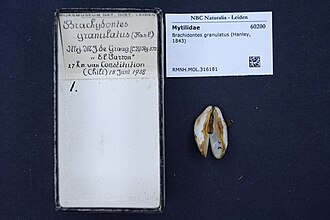
Brachidontes granulatus
IUCN status: Not evaluatedBrachidontes playasensis
IUCN status: Not evaluatedBrachidontes puntarenensis
IUCN status: Not evaluated
Aulacomya atra
IUCN status: Not evaluated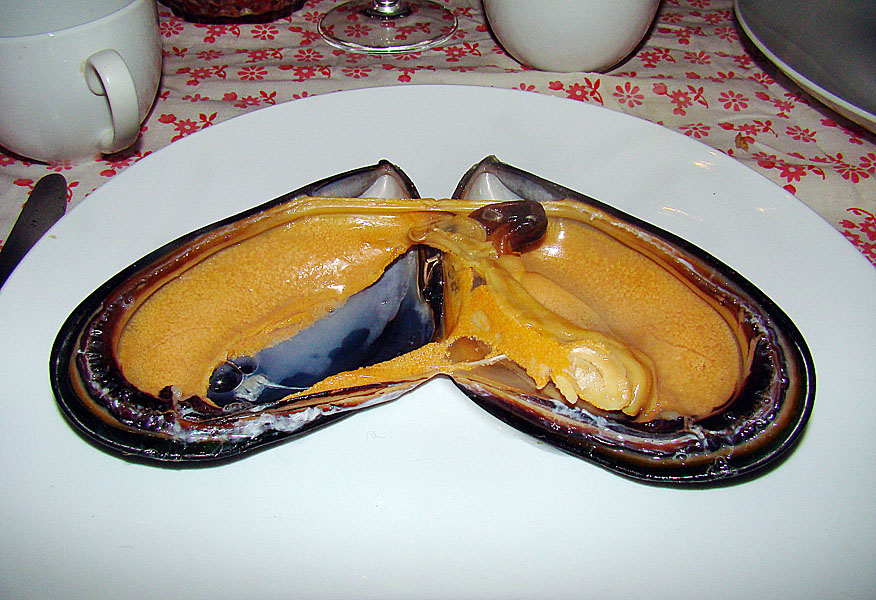
Chorus mussel
Choromytilus chorus
IUCN status: Not evaluated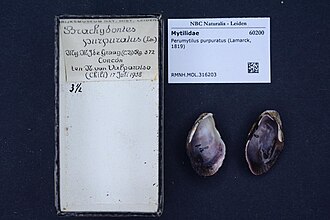
Perumytilus purpuratus
IUCN status: Not evaluatedSemimytilus patagonicus
IUCN status: Not evaluated
Names and sources
Classification
Learn more
Conservation status: no data (IUCN). Taxonomy: PeRMS / WoRMS (CC BY 4.0).