
Bony fishes · Labridae
Brown hogfish
Bodianus eclancheri (Valenciennes, 1846)
Spanish: Vieja negrilla
- Names in Peru
- Vieja negrilla · Loberos · Mulata · Vieja colorada
- Peruvian Register of Marine Species
- Listed in PeRMS (IMARPE)
Species account
Summary
Bodianus eclancheri is a fish of the wrasse family (Labridae), described by Valenciennes in 1846 under the name Cossyphus eclancheri [1]. In Peru it is called «vieja negrilla» [2]. Its global category on the IUCN Red List is Least Concern [3]. On the Peruvian coast, however, spearfishers interviewed in 2020 describe a decline so steep that by the 2010s they found it almost only at a small group of remote islands off Lima [4].
Etymology
According to Jordan and Evermann (1896), the genus name, Bodianus, comes from Bodiano or Pudiano, words derived from the Portuguese pudor, which means modesty [5]. The epithet eclancheri commemorates M. L'Eclancher, that is, Charles René Augustin Leclancher (1804–1857), a surgeon in the French navy [5].
Identification and similar species
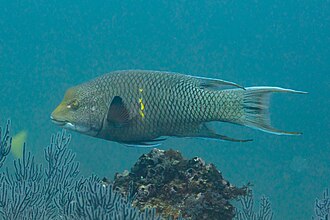
Its body is moderately deep and flattened from side to side, and the head is big and ends in a point; the long, compressed teeth recall incisors [5]. The single dorsal fin bears 12 spines, and both it and the anal fin end at the back in thread-like lobes; the lower part of the first gill arch holds 9 or 10 rakers [5]. Large individuals reach 61 cm total length, though the common size is around 40 cm [5].
Its colouring varies with size and sex and may be brown, black, red or orange; fish that are black from end to end account for under 5 % of individuals [5]. The old photographs gathered to test fishers' accounts include multicoloured individuals caught at Cabo Blanco in 1992 [4].
Distribution and habitat
It occurs in the southeast Pacific between Ecuador and central Chile; it has its origin in the Peru-Chile biogeographic province and also reaches the cooler-water areas of the Galápagos Islands [5]. It lives on reefs and has been recorded from 5 to 46 m deep [5].
An interview-based study groups it with the species endemic to the Humboldt Current and a few parts of Galápagos; it notes that Chilean records are scarce, confined to the far north and clustered in El Niño years, and that in Galápagos it turns up only in very localised spots [4]. In Peru, its widest extent according to fishers was in the 1980s: some 860 km of coast spread over 6 fishing grounds, from Sechura to Paracas [4].
Biology
It is a protogynous sequential hermaphrodite: individuals first mature as females and some later become males [6]. In the Galápagos archipelago, males hold no territories and spawn in groups; females mate every day and spend little time on social and mating activity; fertilisation is external and there is no care of the young [6]. Its eggs are released into the water column [5].
In the same study, males spent 70.2 % of their time feeding and females 77.3 %, unlike two other species of the genus in which territorial males eat far less than females [6]. The author's reading is that, because these males compete by producing as much sperm as possible, their reproductive success, like that of females, seems to depend mainly on the energy they can put into gametes and growth [6].
Ecology
Conservation
Its global category on the IUCN Red List is Least Concern, according to a 2007 assessment [3].
In Peru the picture is different. From interviews with 40 spearfishers carried out in 2020, the species' usual fishing area shrank from 860 km of coast in the 1980s to just 2 km in the 2010s, in practice a 100 % reduction [4]. Since it is rare in Chile and occupies few places in Galápagos, the authors warn that this loss may reflect a critical reduction of its whole distribution, and they count it among the species needing strict measures such as fishing closures [4]. A productivity and susceptibility analysis gave it a high vulnerability to overfishing (V = 2.05) [7].
In the Mar Tropical de Grau National Reserve, the management plan lists it among the rocky-reef species highly threatened as a result of poor spearfishing practices and other fishing gear [2]. The plan prohibits taking it in the Arrecifes de Punta Sal [2], Cabo Blanco – El Ñuro [2] and Isla Foca sectors [2].
Human relevance
Where to see it in Peru
According to spearfishers interviewed in 2020, in the 2010s it was still turning up regularly only at Hormigas de Afuera, some uninhabited islets and reefs lying 62 km off the coast of Lima [4]. The 2026 management plan of the Mar Tropical de Grau National Reserve mentions it among the threatened reef species of the Arrecifes de Punta Sal sector [2] and among those of the Isla Foca sector, where taking it is prohibited [2].
References (7)
- WoRMS Editorial Board (2026). Bodianus eclancheri (Valenciennes, 1846). World Register of Marine Species. https://www.marinespecies.org/aphia.php?p=taxdetails&id=273528 (accessed 2026-10-20)
- Servicio Nacional de Áreas Naturales Protegidas por el Estado (SERNANP) (2026). Plan Maestro de la Reserva Nacional Mar Tropical de Grau 2026-2031. SERNANP; aprobado por RPE N.° 000052-2026-SERNANP. https://cdn.www.gob.pe/uploads/document/file/9468842/7752998-5-pm_2026-2031_rnmtg-f-f-f-f.pdf (accessed 2026-10-20)
- Allen, G., Lea, B., Rivera, F. et al. (2007). Bodianus eclancheri: Allen, G., Lea, B., Rivera, F., Zapata, F., Merlen, G., Edgar, G. & Russell, B. The IUCN Red List of Threatened Species 2010: e.T183539A8130971. doi:10.2305/IUCN.UK.2010-3.RLTS.T183539A8130971.en (accessed 2026-10-20)
- Castagnino, F., Estévez, R.A., Caillaux, M. et al. (2023). Local ecological knowledge (LEK) suggests overfishing and sequential depletion of Peruvian coastal groundfish. Marine and Coastal Fisheries, e210272. doi:10.1002/mcf2.10272 (accessed 2026-10-20)
- Froese, R., Pauly, D. (2026). Bodianus eclancheri, Harlequin wrasse. FishBase. https://www.fishbase.se/summary/Bodianus-eclancheri.html (accessed 2026-10-20)
- Hoffman, S.G. (1983). Sex-Related Foraging Behavior in Sequentially Hermaphroditic Hogfishes (Bodianus Spp.). Ecology, 798-808. doi:10.2307/1937203 (accessed 2026-10-20)
- Castagnino, F., Caillaux, M., Ramos, E. (2024). Productivity susceptibility analysis in extremely data-poor scenarios: The case of Peruvian coastal groundfish. Fisheries Research, 107044. doi:10.1016/j.fishres.2024.107044 (accessed 2026-10-20)
More pictures
If you come across it
Protected or threatened species. Watch it without touching, feeding, chasing or taking it, and keep the recommended viewing distances.extraction prohibited in the sector — SERNANP (2026). Plan Maestro de la Reserva Nacional Mar Tropical de Grau 2026–2031. RPE N.° 000052-2026-SERNANP, p. 128 of the PDF
Where it has been recorded
- Filled: scientific records, or confirmed by a curator
- Hatched: isolated record
- Dotted outline: no scientific records and no curator's confirmation (an ORKA sighting is not drawn here)
- Tropical–cold transition zone
Scientific records (2 records)
- Cold central sea
Scientific records (6 records)
From openly licensed OBIS and GBIF records (CC0 or CC BY). How each list is built.
Related species
From the same genus (Bodianus) and from the same family (Labridae).
Mexican hogfish
Bodianus diplotaenia
IUCN status: LC · Least Concern- No openly licensed image yet
Bodianus darwini
IUCN status: Not evaluated 
Chameleon wrasse
Halichoeres dispilus
IUCN status: LC · Least ConcernBumphead parrotfish
Scarus perrico
IUCN status: LC · Least ConcernProtected in PeruBanded wrasse
Halichoeres notospilus
IUCN status: LC · Least Concern
Loosetooth parrotfish
Nicholsina denticulata
IUCN status: LC · Least ConcernCortez rainbow wrasse
Thalassoma lucasanum
IUCN status: LC · Least Concern- No openly licensed image yet
Blackspot wrasse
Decodon melasma
IUCN status: LC · Least Concern
Names and sources
In Spanish
- Vieja negrilla — Peru; SERNANP (2026). Plan Maestro de la Reserva Nacional Mar Tropical de Grau 2026–2031. RPE N.° 000052-2026-SERNANP, p. 54 of the PDF · main name
- Loberos — Peru; fishbase; Wikidata
- Mulata — Peru; fishbase; Wikidata
- Vieja arlequin — Wikidata
- Vieja colorada — Peru; fishbase; Wikidata
- Vieja zamba — Wikidata
In English
- Brown hogfish — Wikidata
- Galápagos hogfish — Wikidata
- Harlequin wrasse — Wikidata
Classification
Learn more
Conservation status: Least Concern (IUCN Red List, according to Wikidata). Taxonomy: PeRMS / WoRMS (CC BY 4.0).