
Jellyfish, hydroids and comb jellies · Abylidae
Bassia bassensis
Bassia bassensis (Quoy & Gaimard, 1833)
- Peruvian Register of Marine Species
- Listed in PeRMS (IMARPE)
Species account
Summary
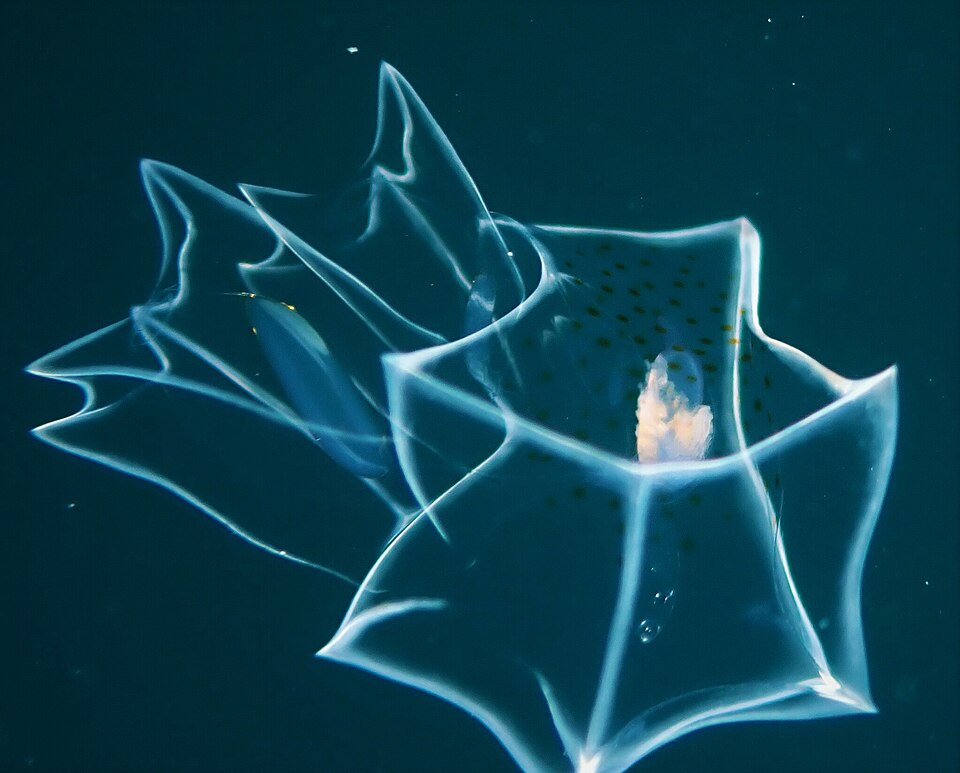
Bassia bassensis is a calycophoran siphonophore of the family Abylidae, a jelly-like colony a few millimetres tall that lives in the epipelagic layer of the sea [1],[2],[3]. In the Humboldt Current System, off the Mejillones Peninsula (Chile), it was by far the most abundant species of the gelatinous zooplankton sampled in January 1997 [3].
It feeds on small copepods and, given how abundant it was, it was estimated that it could remove a considerable share of them in that area [3].
Etymology
Bassia bassensis carries the authority of Quoy and Gaimard in parentheses, which by convention indicates that it is now classified in a genus other than the original one [1]. Mapstone lists it among the species of the Astrolabe voyage, with Bass Strait as the locality [2]. The epithet is consistent with that locality, but the sources consulted do not explain its derivation [2].
Identification and similar species
Tropical abylids are calycophoran siphonophores whose swimming bells, with a faceted surface, are arranged in a line rather than in staggered pairs [2]. In samples from the coast of Chile, the polygastric stages of Bassia bassensis were up to 6 mm tall and the eudoxids up to 8 mm [3].
The species has two phases: the polygastric colony, with on average 10.5 gastrozooids per specimen in the data used by Pagès and colleagues, and the eudoxids, free units with a single bract covering a gastrozooid with a tentacle, which detach from the end of the stem [2],[3]. Around Taiwan, eudoxids were slightly more numerous than polygastric stages [4].
Distribution and habitat
It is a relatively common epipelagic calycophoran, living mostly in the uppermost 50 m of temperate waters of the three main oceans and the Mediterranean [3]. Mapstone places it among the species of shallow epipelagic layers at tropical latitudes [2]. Off northern Chile, between 22° 30' and 24° S, it was always concentrated at 0 to 50 m and was associated with Subtropical Surface Water, at 16 to 24 °C [3].
In Chile it reached its highest densities where surface temperature exceeded 19 °C, and it was very scarce or absent at coastal stations below 18 °C [3]. Around Taiwan, its abundance was very low or zero at some coastal stations with a temperature below 23 °C [4]. Further south, in the Valparaíso samples of 1990 and 1991, it did not appear [3].
Biology
Small siphonophores of the epipelagic zone lie in wait for copepods and other zooplankton [2]. For Bassia bassensis, Pagès and colleagues used data from Purcell according to which it ate only copepods of 0.4 to 1.2 mm, and 60 polygastric specimens collected in situ had 630 gastrozooids in total, with prey in 8.2 % of them [3].
With those values, the authors estimated that, leaving out two coastal stations, the species could remove between 2.9 and 69.3 % of the small copepods, and on average 17.3 % of the copepod carbon [3]. This is an estimate from data in the literature, not a direct measurement, and it does not allow a daily consumption to be calculated because digestion time and the daily feeding cycle are still unknown [3].
Ecology
In January 1997, off the Mejillones Peninsula, it was by far the most abundant species at every station except two coastal ones (79.15 % of the total abundance), with up to 13622 polygastric stages and 22832 eudoxids per 1000 m3 at the three oceanic stations [3]. As far as the authors knew, the highest published densities were 0.38 polygastric stages and 0.48 eudoxids per m3 [3].
Its abundance depends on the water mass: in the California Current it is uncommon, in the Gulf of California it is more frequent, and in the northern Benguela Current it ranked second in abundance, but in very low numbers [3]. Around Taiwan it was one of the five most abundant calycophorans, which together made up over 61 % of the siphonophores [4].
References (4)
- WoRMS Editorial Board (2026). Bassia bassensis (Quoy & Gaimard, 1833). World Register of Marine Species. https://www.marinespecies.org/aphia.php?p=taxdetails&id=135404 (accessed 2026-10-25)
- Mapstone, G.M. (2014). Global Diversity and Review of Siphonophorae (Cnidaria: Hydrozoa). PLoS ONE 9(2). doi:10.1371/journal.pone.0087737 (accessed 2026-10-25)
- Pagès, F., González, H.E., Ramón, M. et al. (2001). Gelatinous zooplankton assemblages associated with water masses in the Humboldt Current System, and potential predatory impact by Bassia bassensis (Siphonophora: Calycophorae). Marine Ecology Progress Series 210, 13-24. doi:10.3354/meps210013 (accessed 2026-10-25)
- Lo, W.-T., Yu, S.-F., Hsieh, H.-Y. (2014). Hydrographic Processes Driven by Seasonal Monsoon System Affect Siphonophore Assemblages in Tropical-Subtropical Waters (Western North Pacific Ocean). PLoS ONE 9(6). doi:10.1371/journal.pone.0100085 (accessed 2026-10-25)
More pictures
Where it has been recorded
- Filled: scientific records, or confirmed by a curator
- Hatched: isolated record
- Dotted outline: no scientific records and no curator's confirmation (an ORKA sighting is not drawn here)
- Cold central sea
Scientific records (3 records)
- Cold southern sea
Scientific records (3 records)
From openly licensed OBIS and GBIF records (CC0 or CC BY). How each list is built.
Related species
From the same family.
Names and sources
Learn more
Conservation status: no data (IUCN). Taxonomy: PeRMS / WoRMS (CC BY 4.0).