
Marine mammals · Balaenopteridae
Antarctic minke whale
Balaenoptera bonaerensis Burmeister, 1867
Spanish: Ballena minke antártica
- Names in Peru
- Ballena minke antártica
- Peruvian Register of Marine Species
- Listed in PeRMS (IMARPE)
Species account
Summary
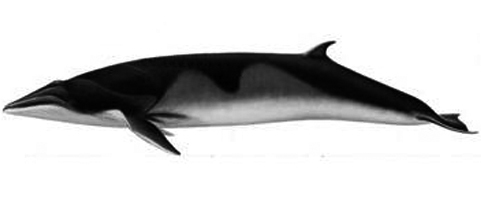
The Antarctic minke whale (Balaenoptera bonaerensis) is a small rorqual of the Southern Hemisphere, described by Burmeister in 1867 and accepted as a valid species in the world register of cetaceans [1]. It lives tied to the sea ice of the Southern Ocean and is the only baleen whale that consistently inhabits ice-covered waters [2].
In 1998 two species of minke whale were recognised, this one and the common minke, and its abundance was estimated at 515000 individuals from surveys run from 1992 to 2004 [3]. The International Union for Conservation of Nature rates it globally as near threatened [4]. Peru's marine wildlife watching manual lists it among the larger cetaceans (cetáceos mayores) under the name ballena minke antártica [5].
Identification and similar species
It is a rorqual of modest size: on the western side of the Antarctic Peninsula, 68 individuals measured by photogrammetry from drones had a mean length of 8.04 m [6]. That figure comes from one particular population and does not summarise the whole species [6].
At sea it is hard to separate from the dwarf form of the common minke whale, with which it shares part of the Southern Hemisphere, and knowledge of its distribution at low and mid latitudes is very limited owing to little research effort and low detectability at sea [3]. The most practical clue is geographic: the Antarctic minke is relatively more frequent south of 65° S [3].
Similar species
- Balaenoptera acutorostrata: At sea it can be mistaken for the dwarf form of this species; the Antarctic minke is relatively more frequent south of 65° S [3].
Distribution and habitat
It has a circumpolar distribution and probably breeds between 7° and 35° S [6]. It is thought to breed in subtropical waters of the South Atlantic, South Pacific and Indian Oceans during the austral winter and to migrate south in summer to feed on krill, although direct evidence for that link is scarce [3].
Within the ice, the highest densities are predicted at the ice edge and at medium concentrations, and medium densities were recorded up to 500 km into the ice [2]. By contrast, very few animals were counted in ice-free waters west of the Antarctic Peninsula, which supports its dependence on sea ice [2]. Populations of the Indo-Pacific sector seem to separate into at least 2 stocks [3].
Biology
On the western side of the Antarctic Peninsula, DNA profiling of 82 biopsies taken between 2013 and 2020 identified 29 distinct males and 40 distinct females [6]. Blubber progesterone levels indicated that 59 % of the sampled females were pregnant, and after adjusting for sexual maturity the median pregnancy rate came to 92.3 %, so most mature females are pregnant in a given year [6].
Its repertoire of sounds includes the already known downsweep and, from tags carrying video and a hydrophone, 3 further new calls; all 4 have peak frequencies of 90 to 175 Hz and last 0.2 to 0.8 s [7]. Each call type was associated with behavioural and environmental variables measured by the tags [7].
Ecology
It feeds on krill under the ice, a niche that it has been proposed not to share with other krill-feeding whales of the Southern Ocean [2]. The ice may also help it avoid type A killer whales, which do not enter it [2].
It is among the most abundant yet most poorly understood cetacean species, because of the difficulty of working in its sea-ice habitat [7]. The video and sound tags of that study were deployed in 2 bays beside the Gerlache Strait, in February and March of 2018 and 2019 [7]. Among 333 examined animals, 7 species of epibionts were found, and 125 of the whales carried at least one; the authors propose that detecting coronulid barnacles could evince seasonal migration, since their occurrence drops markedly where the minimum sea surface temperature is below 12 °C [3].
Conservation
The current global assessment on the IUCN Red List classes it as near threatened [4]. An analysis of circumpolar ship-based surveys suggests a possible 30 % drop in abundance, and the authors stress that conservation measures and further study of its status are needed [2].
Its dependence on ice makes it vulnerable to climate: a general decrease in sea-ice cover would narrow its available habitat, and the forecast ice changes could affect it heavily [2]. West of the Antarctic Peninsula, where ice is changing fast, the pregnancy rates measured there serve as a baseline against which to detect future change [6].
Human relevance
Part of what is known about the species comes from captured animals. The 333 animals used to study its epibionts came from whales taken on the most recent NEWREP-A Antarctic cruise [3]. In a 2022 study, the length at which females mature was taken from commercial catch data [6].
In Peru it appears among the larger cetaceans (cetáceos mayores) covered by the good-practice manual for marine wildlife watching, which also sets minimum approach distances for cetaceans: 100 m for those longer than 5 m and 300 m when they are feeding or socialising [5].
Where to see it in Peru
The literature consulted documents no specific sightings of the species in Peru: the official marine wildlife watching manual (2026 edition) only names it in its list of larger cetaceans (cetáceos mayores), without giving sites [5]. It is thought to breed in subtropical waters in winter, but direct evidence for those migrations is limited, so it should not be counted on in any outing [3].
References (7)
- WoRMS Editorial Board (2026). Balaenoptera bonaerensis Burmeister, 1867. World Register of Marine Species. https://www.marinespecies.org/aphia.php?p=taxdetails&id=231405 (accessed 2026-10-25)
- Herr, H., Kelly, N., Dorschel, B. et al. (2019). Aerial surveys for Antarctic minke whales (Balaenoptera bonaerensis) reveal sea ice dependent distribution patterns. Ecology and Evolution. doi:10.1002/ece3.5149 (accessed 2026-10-25)
- Ten, S., Konishi, K., Raga, J.A. et al. (2022). Epibiotic fauna of the Antarctic minke whale as a reliable indicator of seasonal movements. Scientific Reports. doi:10.1038/s41598-022-25929-1 (accessed 2026-10-25)
- Cooke, J.G., Zerbini, A.N., Taylor, B.L. (2018). Balaenoptera bonaerensis: Cooke, J.G., Zerbini, A.N. & Taylor, B.L. The IUCN Red List of Threatened Species 2018: e.T2480A50350661. doi:10.2305/IUCN.UK.2018-1.RLTS.T2480A50350661.en (accessed 2026-10-25)
- MINCETUR (2026). Manual de buenas prácticas de gestión de servicio turístico para la actividad de observación de fauna marina (3.ª ed.). Ministerio de Comercio Exterior y Turismo, Perú, 25. https://cdn.www.gob.pe/uploads/document/file/10041919/8184632-mbp_faunamarina_3ra.pdf (accessed 2026-10-25)
- Pallin, L., Bierlich, K.C., Durban, J. (2022). Demography of an ice-obligate mysticete in a region of rapid environmental change. Royal Society Open Science. doi:10.1098/rsos.220724 (accessed 2026-10-25)
- Casey, C.B., Weindorf, S., Levy, E. et al. (2022). Acoustic signalling and behaviour of Antarctic minke whales (Balaenoptera bonaerensis). Royal Society Open Science. doi:10.1098/rsos.211557 (accessed 2026-10-25)
More pictures
If you come across it
Protected or threatened species. Watch it without touching, feeding, chasing or taking it, and keep the recommended viewing distances.
Related species
From the same genus (Balaenoptera) and from the same family (Balaenopteridae).



Names and sources
In Spanish
- Ballena minke antártica — Peru; MINCETUR (2026). Manual de buenas prácticas para la actividad de observación de fauna marina, 3.ª ed., p. 25 of the PDF · main name
In English
- Antarctic minke whale — WoRMS; Wikidata
- Ordinary minke whale — WoRMS
Classification
Learn more
Conservation status: Near Threatened (IUCN Red List, according to Wikidata). Taxonomy: PeRMS / WoRMS (CC BY 4.0).