
Sea snails · Littorinidae
Austrolittorina araucana
Austrolittorina araucana (A. d'Orbigny, 1841)
- Peruvian Register of Marine Species
- Listed in PeRMS (IMARPE)
Species account
Summary
Austrolittorina araucana is a small marine snail of the family Littorinidae and an accepted name in the World Register of Marine Species [1]. Its range runs from Peru to southern Chile, and molecular data place it as the basal member of its genus [2]. On the upper band of the rocky shore of northern Chile, covered by the sea only at high tide and with 90–95 % bare rock, it forms abundant populations beside another littorinid [3].
Identification and similar species
The shell is small, with a rounded periphery and numerous fine spiral grooves that fade out; its colour runs from white to dark brown, with a paler basal band [2]. The species is very variable in shape and colour: shells may be white, blue-grey or a uniform brown, rarely with indistinct markings [2].
In the genus Austrolittorina the axial colour pattern (lines or series of spots aligned with the shell axis) that most species of the subfamily Littorininae have is missing, and the cephalic tentacles are black [2]. A secure separation from similar species needs anatomy: the penial filament is broad, with the opening of the sperm groove in a subterminal position, and the pallial oviduct has a simple loop of the egg groove in the albumen gland [2].
Some pale shells resemble small examples of two other species in the same genus, but the three do not share a range, and the oviduct and penis of Austrolittorina araucana are unique [2].
Similar species
- Austrolittorina unifasciata: Its pale shells can resemble small examples of Austrolittorina araucana, but the two species do not share a range; the pallial oviduct and penis of Austrolittorina araucana are unique [2].
- Austrolittorina fernandezensis: Some pale shells of Austrolittorina araucana look like it, but the two species do not share a range and the pallial oviduct and penis are different [2].
Distribution and habitat
The range runs from Peru to southern Chile [2]. d'Orbigny described the name from material from the Chilean coast between Valparaíso and Arica, and the type locality was later restricted to Valparaíso, where the lectotype was designated [2].
On the rocky shore of northern Chile the species is abundant in the uppermost intertidal band, covered by the sea only at high tide, where between 90 % and 95 % of the surface is bare rock [3]. It occurs there beside another littorinid, Echinolittorina peruviana [3].
Shell colour changes with latitude: populations in the south are entirely brown, and those in the north mix brown and white shells [2].
Biology
Molecular data show that Austrolittorina araucana is the basal member of the genus, that is, the one that split off first from the other four living species [2]. That split was estimated at between 40 and 73 million years ago, an age sufficient to ascribe it to the fragmentation of Gondwana [2].
On reproduction, the sources consulted describe the anatomy. In the pallial oviduct the egg groove makes a simple loop in the albumen gland, a large circular loop in the capsule gland and a smaller one in the jelly gland; the copulatory bursa opens in a posterior position [2].
For the north-south colour gradient (southern populations entirely brown, northern ones brown and white) it has been suggested that climatic selection might account for it, since pale shells help regulate temperature in intertidal gastropods [2].
Ecology
In the highest intertidal band of Antofagasta Bay, in northern Chile, covered by the sea only at high tide and with 90–95 % bare rock, this species and Echinolittorina peruviana form abundant populations. Further down a band of dense matrices of the mussel Perumytilus purpuratus dominates [3].
It has also been recorded on hot artificial substrata. On artificial rock breakwaters in the Coquimbo region, at 29° S, the rock was on average 3.7 °C warmer than in the neighbouring natural habitat at two of the three sites studied, and in the artificial habitat bare rock covered about 85 % [4]. There Austrolittorina araucana and Echinolittorina peruviana reached large densities and made up most of the density of mobile species [4].
In Peru, a survey of 41 sites between 3.5° S and 13.5° S found that snails of the genus Austrolittorina are among the mobile taxa whose subset reproduces the pattern of variation among rocky communities along the coast [5].
Where to see it in Peru
The studies consulted give no Peruvian localities with species-level data. The survey of rocky intertidal communities in Peru, carried out between February and May 2015 at 41 sites between 3.5° S and 13.5° S, included snails of the genus Austrolittorina among the mobile taxa analysed [5].
Outside Peru, the literature places it on the high level of the rocky shore of Antofagasta Bay and on breakwaters in the Coquimbo region, in Chile [3],[4].
References (5)
- MolluscaBase eds. (2026). Austrolittorina araucana (A. d'Orbigny, 1841). World Register of Marine Species. https://www.marinespecies.org/aphia.php?p=taxdetails&id=446840 (accessed 2026-10-25)
- Reid, D.G., Williams, S.T. (2004). The subfamily Littorininae (Gastropoda: Littorinidae) in the temperate Southern Hemisphere: the genera Nodilittorina, Austrolittorina and Afrolittorina. Records of the Australian Museum, 75-122. doi:10.3853/j.0067-1975.56.2004.1393 (accessed 2026-10-25)
- Castilla, J.C., Manríquez, P.H., Delgado, A.P. et al. (2014). Rocky Intertidal Zonation Pattern in Antofagasta, Chile: Invasive Species and Shellfish Gathering. PLoS ONE. doi:10.1371/journal.pone.0110301 (accessed 2026-10-25)
- Aguilera, M.A., Arias, R.M., Manzur, T. (2019). Mapping microhabitat thermal patterns in artificial breakwaters: Alteration of intertidal biodiversity by higher rock temperature. Ecology and Evolution, 12915-12927. doi:10.1002/ece3.5776 (accessed 2026-10-25)
- Ibanez-Erquiaga, B., Pacheco, A.S., Rivadeneira, M.M. et al. (2018). Biogeographical zonation of rocky intertidal communities along the coast of Peru (3.5–13.5° S Southeast Pacific). PLoS ONE. doi:10.1371/journal.pone.0208244 (accessed 2026-10-25)
More pictures
Where it has been recorded
- Filled: scientific records, or confirmed by a curator
- Hatched: isolated record
- Dotted outline: no scientific records and no curator's confirmation (an ORKA sighting is not drawn here)
- Tropical northern sea
Scientific records (2 records)
- Tropical–cold transition zone
Scientific records (3 records)
- Cold central sea
Scientific records (8 records)
- Cold southern sea
Scientific records (9 records)
From openly licensed OBIS and GBIF records (CC0 or CC BY). How each list is built.
Related species
From the same family.
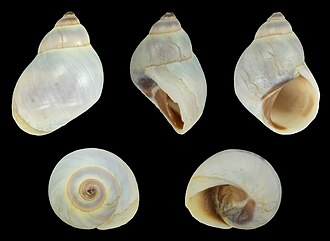
Echinolittorina modesta
IUCN status: Not evaluated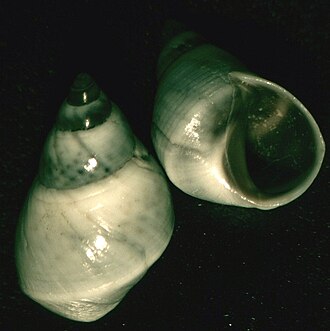
Echinolittorina paytensis
IUCN status: Not evaluated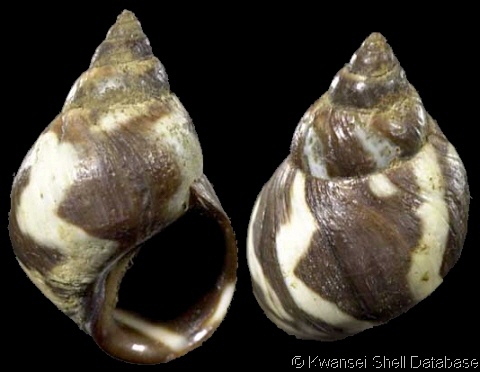
Echinolittorina peruviana
IUCN status: Not evaluated
Littoraria varia
IUCN status: Not evaluatedLittoraria variegata
IUCN status: Not evaluated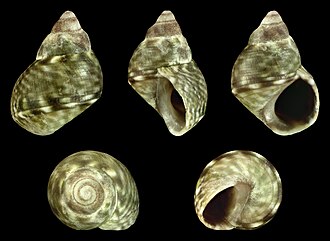
Echinolittorina aspera
IUCN status: Not evaluated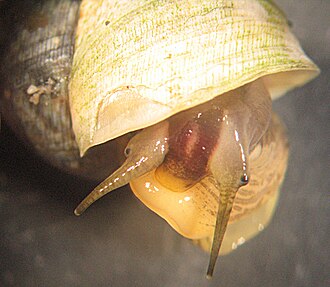
Littoraria zebra
IUCN status: Not evaluated
Names and sources
Classification
Learn more
Conservation status: no data (IUCN). Taxonomy: PeRMS / WoRMS (CC BY 4.0).