
Bivalves · Mytilidae
Aulacomya atra
Aulacomya atra (Molina, 1782)
Spanish: Choro
- Names in Peru
- Choro · Cholga
- Peruvian Register of Marine Species
- Listed in PeRMS (IMARPE)

Species account
Summary
Identification and similar species
It is a bivalve of the family Mytilidae that attaches to hard substrates by byssal threads [1]. Among specimens collected at four fishing grounds off Matarani in 2024, valve length ranged from 46 to 82 mm [1].
Size tracks maturity: virgin or resting individuals had a median of 50 to 55 mm, while those developing, mature or spawning had 65 to 70 mm, with no clear difference between the sexes [1].
Distribution and habitat
In the Pacific the species ranges from El Callao to the Strait of Magellan; in the Atlantic, from southern Argentina to southern Brazil, and it also occurs on the South African coast [2]. WoRMS lists Aulacomya ater as an unaccepted spelling of this same name, with an incorrect gender ending [3].
It lives mainly in shallow settings, from the intertidal to about 40 m depth, fixed to hard substrates [1]. In Bahía Independencia, inside the Paracas National Reserve, one population was studied on rocky bottom at about 15 m depth [2].
Biology
It is a dominant filter feeder that takes plankton and suspended particles [1].
At Matarani 523 gonads were examined during 2024: the main spawning ran from August to October, with the highest spawning fraction when the sea was coldest and upwelling strongest [1]. Females ripened earlier than males; in August up to 71.4 % of them were spawning, whereas males released most gametes in spring [1].
In Bahía Independencia, that study treated individuals of 30 mm or more as mature adults and those of 10.9 mm or more as recruits; spawning stock biomass peaked from June to August and from November to January [2].
At Matarani the length-weight relationship had an exponent of 2.47, not the 3 usually assumed; condition factor rose with reproductive activity and fell significantly after spawning [1].
Ecology
Dense beds of this species create a three-dimensional habitat that other organisms use for shelter and food, so it is regarded as an ecosystem engineer, as well as a dominant filter feeder in coastal benthic communities [1].
In Bahía Independencia, the strong El Niño of 1997 and 1998 sharply reduced biomass and larval settlement [2].
The same study found that larval settlement was explained by adult biomass, with a lag of 2 to 3 months, and that recruitment stayed high during El Niño despite the fall in biomass, which the authors explain, as a presumption, by reduced competition for food and reduced predation [2].
Conservation
To protect spawning, the Ministry of Production set a reproductive closure from 8 September to 30 November 2024 along the whole coast (R.M. 361-2024-PRODUCE) [1].
In 2026, R.M. N° 000002-2026-PRODUCE banned the extraction, transport, processing, marketing and storage of choro in the sea adjacent to Moquegua and Tacna until IMARPE recommends resuming the activity; the rule relies on an IMARPE report stating that biomass is below the level needed for population renewal and that specimens under the 65 mm minimum catch size are highly present [4].
In Bahía Independencia, biomass and recruitment declined persistently between 1996 and 2004; the authors most likely relate the fall to human exploitation, which would have lowered density by one order of magnitude [2].
Human relevance
In southern Peru it is one of the main benthic resources of commercial importance; domestic demand raised landings from 2010, mainly in Ica, Arequipa and Moquegua [1].
At Matarani the peak was 1246 t in 2006, it fell below 300 t in 2017, stayed under 100 t a year from 2019 and reached 29 t in 2024 [1].
References (4)
- Yauri, C., Campos-León, S., Buitrón, B. et al. (2026). Condición reproductiva del choro Aulacomya atra (Molina, 1782) en el litoral de Matarani, región Arequipa, 2024. Boletín del Instituto del Mar del Perú 41(1), e448. doi:10.53554/boletin.v41i1.448 (accessed 2026-10-25)
- Solís, M.A., Ballesteros, E., Riascos, J.M. (2019). The Early Life History Transitions of the Bivalve Aulacomya atra From the Humboldt Current System Off Peru Are Affected by Human Exploitation and Modulated by El Niño–La Niña Cycle. Frontiers in Marine Science, 496. doi:10.3389/fmars.2019.00496 (accessed 2026-10-25)
- WoRMS Editorial Board (2026). Aulacomya atra (Molina, 1782). World Register of Marine Species. https://www.marinespecies.org/aphia.php?p=taxdetails&id=505963 (accessed 2026-10-25)
- Ministerio de la Producción (2026). Resolución Ministerial N° 000002-2026-PRODUCE: Establecen disposiciones para el desarrollo de la actividad extractiva del recurso choro durante el año 2026 en el ámbito marítimo adyacente a los departamentos de Moquegua y Tacna. Diario Oficial El Peruano, 10 January 2026. https://busquedas.elperuano.pe/dispositivo/NL/2475778-1 (accessed 2026-10-25)
More pictures
Where it has been recorded
- Filled: scientific records, or confirmed by a curator
- Hatched: isolated record
- Dotted outline: no scientific records and no curator's confirmation (an ORKA sighting is not drawn here)
- Cold central sea
Scientific records (2 records)
- Cold southern sea
Scientific records (3 records)
From openly licensed OBIS and GBIF records (CC0 or CC BY). How each list is built.
Related species
From the same family.

Brachidontes adamsianus
IUCN status: Not evaluated
Brachidontes semilaevis
IUCN status: Not evaluated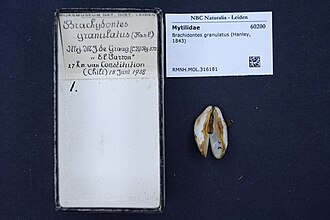
Brachidontes granulatus
IUCN status: Not evaluatedBrachidontes playasensis
IUCN status: Not evaluatedBrachidontes puntarenensis
IUCN status: Not evaluated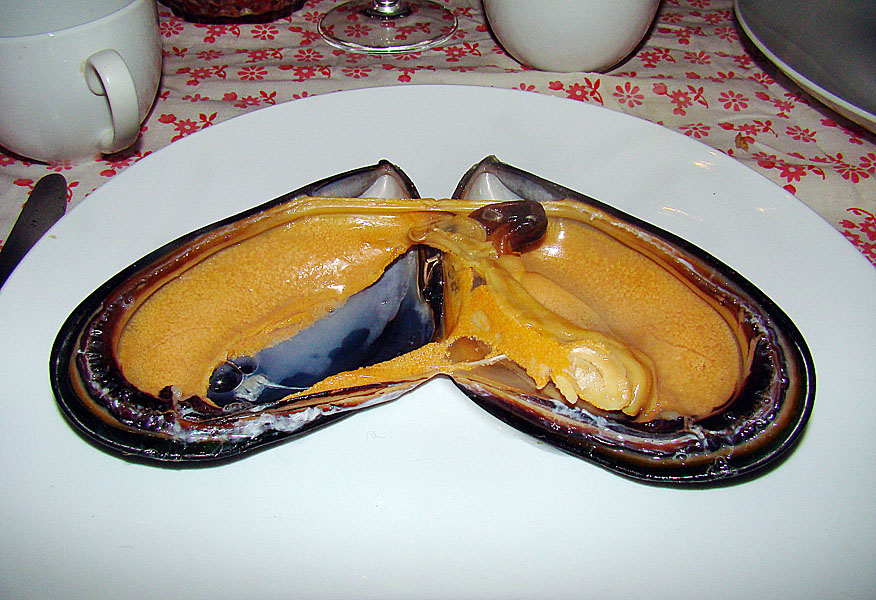
Chorus mussel
Choromytilus chorus
IUCN status: Not evaluated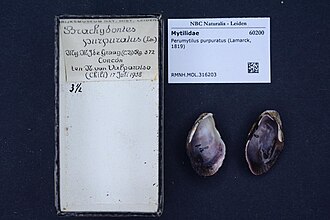
Perumytilus purpuratus
IUCN status: Not evaluatedSemimytilus patagonicus
IUCN status: Not evaluated
Names and sources
In Spanish
- Choro — Peru; SERNANP (2016). Plan Maestro de la Reserva Nacional Sistema de Islas, Islotes y Puntas Guaneras 2016-2020, p. 49 of the PDF · main name
- Cholga — Peru; sealifebase
Also cited as
- Aulacomya ater
Learn more
Conservation status: no data (IUCN). Taxonomy: PeRMS / WoRMS (CC BY 4.0).