
Bony fishes · Congridae
Slope conger
Ariosoma prorigerum (Gilbert, 1891)
Spanish: Congrio del talud
- Peruvian Register of Marine Species
- Listed in PeRMS (IMARPE)
Species account
Summary
Ariosoma prorigerum is a small deep-water conger of the family Congridae, known in English as the slope conger [1],[2]. Charles Gilbert described it in 1891 from material that the steamer Albatross collected in 1888 around Panama and the Galápagos Islands [3].
It lives close to the seabed at roughly 380 to 740 m depth and does not exceed 35 cm in length [2]. The IUCN assessed it in 2007 as Least Concern [4].
Etymology
Identification and similar species
It is a slender, elongate eel. In his original description Gilbert noted that the head is as long as the trunk; the body depth is one thirteenth of the total length [3]. The vent lies well forward, so the tail is much longer than the body, although less than twice as long [3].
The snout is long and sharp, with its soft tip projecting beyond the lower jaw by more than two thirds of the orbit length [3]. The jaws are broad and strong, and the gape reaches back to a vertical line through the rear edge of the pupil [3]. The teeth are fine and bristle-like, set in broad bands, and none is enlarged; behind the head of the vomer there is a transverse groove that receives the tip of the lower jaw [3]. The eye is small: half the snout length, going about 8 times into the head [3].
The colour is a uniform light brown. The fins are dusky and nearly black towards the tail tip, where they carry a very narrow white margin; the mouth, gill cavity and peritoneum are black [3]. The dorsal fin starts in front of the gill opening, and the pectoral fin is two sevenths of the head length [3].
Similar species
- Ariosoma balearicum: In Gilbert's key, that species has the vent near the middle of the body and a body and tail of similar length, whereas in Ariosoma prorigerum the vent is anterior and the tail is much longer than the body [3].
Distribution and habitat
According to FishBase, the species lives in the eastern Pacific, with records from Costa Rica, Panama and Ecuador, between 10° N and 1° S [2]. Gilbert's type is a single individual taken at Albatross station 2792 in 401 fathoms (about 733 m); a second small specimen came from station 2799 [3].
It is a bathydemersal species, meaning it lives in deep water close to the bottom, over a depth range of 380 to 740 m [2]. The accepted classification places it in Chordata, Teleostei, Anguilliformes, Congridae, Ariosoma [1]. FishBase cautions that further studies are still needed to confirm that it belongs in that genus [2].
Conservation
Health, toxicological and chemical relevance
Not medical advice. For a sting, a poisoning or an allergy, seek medical care.
FishBase rates it as harmless to people [2].
Human relevance
References (4)
- WoRMS Editorial Board (2026). Ariosoma prorigerum (Gilbert, 1891). World Register of Marine Species. https://www.marinespecies.org/aphia.php?p=taxdetails&id=712431 (accessed 2026-10-25)
- Froese, R., Pauly, D. (2026). Ariosoma prorigerum, Slope conger. FishBase. https://www.fishbase.se/summary/Ariosoma-prorigerum.html (accessed 2026-10-25)
- Gilbert, C.H. (1891). Scientific results of explorations by the U. S. Fish Commission steamer Albatross, No. XXI.—Descriptions of apodal fishes from the tropical Pacific. Proceedings of the United States National Museum, 347-352. doi:10.5479/si.00963801.14-856.347 (accessed 2026-10-25)
- McCosker, J., Béarez, P., Bernal, O. et al. (2007). Ariosoma prorigerum: McCosker, J., Béarez, P., Bernal, O. & Lea, B. The IUCN Red List of Threatened Species. doi:10.2305/iucn.uk.2010-3.rlts.t183237a8077916.en (accessed 2026-10-25)
More pictures
Where it has been recorded
- Filled: scientific records, or confirmed by a curator
- Hatched: isolated record
- Dotted outline: no scientific records and no curator's confirmation (an ORKA sighting is not drawn here)
- Tropical northern sea
Scientific records (1 record)
- Tropical–cold transition zone
Scientific records (1 record)
- Cold southern sea
Scientific records (1 record)
From openly licensed OBIS and GBIF records (CC0 or CC BY). How each list is built.
Related species
From the same family.
Shorthead conger
Bathycongrus macrurus
IUCN status: LC · Least ConcernNeedletail conger
Rhynchoconger nitens
IUCN status: LC · Least Concern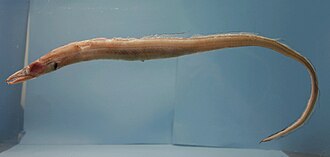
Twinpored eel
Xenomystax atrarius
IUCN status: LC · Least Concern- No openly licensed image yet
Largehead conger
Bathycongrus varidens
IUCN status: LC · Least Concern 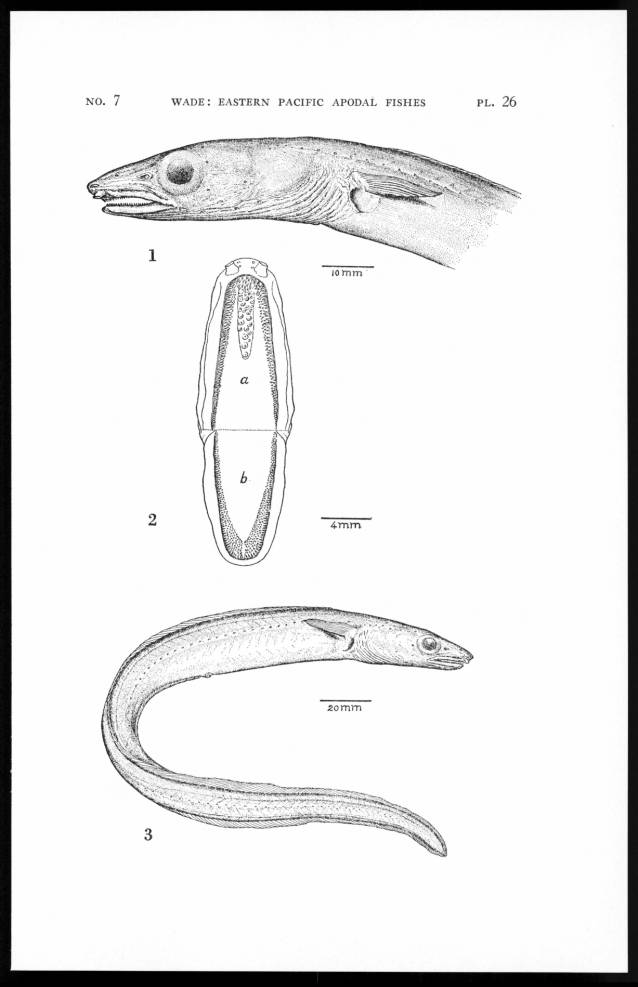
Hardtail conger
Gnathophis cinctus
IUCN status: LC · Least Concern- No openly licensed image yet
Ringeye conger
Paraconger californiensis
IUCN status: LC · Least Concern
Names and sources
In Spanish
- Congrio del talud — Wikidata · main name
In English
- Slope conger — Wikidata
- Black-fin conger — Wikidata
Classification
Learn more
Conservation status: Least Concern (IUCN Red List, according to Wikidata). Taxonomy: PeRMS / WoRMS (CC BY 4.0).