
Bivalves · Pectinidae
Catarina scallop
Argopecten ventricosus (G. B. Sowerby II, 1842)
- Peruvian Register of Marine Species
- Listed in PeRMS (IMARPE)

Species account
Summary
Argopecten ventricosus is a scallop (a bivalve of the family Pectinidae) of the eastern Pacific known in English as the Pacific calico scallop or Catarina scallop [1]. Its range runs from California to northern Peru, where it reaches 5.9° S, in Piura [2]. In Peru it shares only a short stretch of coast with Argopecten purpuratus, and unlike that species it is not exploited at large scale [2]. Most of what is known about its biology comes from Mexican populations [3],[4].
Identification and similar species
The genus Argopecten is recognised by well-marked disc flanks and auricle margins, a deep byssal notch, a ctenolium (a row of small teeth beside that notch) present throughout its development, and wide variation in shell colour [2]. The same source warns that identifying scallops from external shell traits alone can lead to errors, because valve shape can converge and the sea erodes the shells [2].
In the literature the species also appears as Argopecten circularis and Pecten ventricosus, which are disused synonyms. These names make it hard to match its distribution with the fossil record: for example, Argopecten circularis of Sowerby I is also a disused synonym of an Atlantic subspecies of Argopecten irradians [2]. The thesis illustrates the species with a 32 mm specimen from Ecuador, an image taken from WoRMS [2].
Similar species
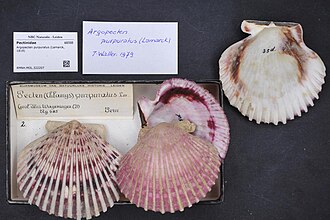
- Argopecten purpuratus: These are the only two species of the genus in the eastern Pacific and they overlap only between 5.1° S and 5.9° S, in Piura; Argopecten purpuratus continues south to Chile and lives at 5 to 40 m depth [2].
Distribution and habitat
Argopecten ventricosus is distributed from California to Bayóvar, in northern Peru (5.9° S), with occasional records up to Monterey Bay [2]. Another source gives a wider southern limit, to the southern coast of Peru, which does not match the thesis [5]. In Peru it coexists with Argopecten purpuratus between 5.1° S and 5.9° S, at the northern edge of the Humboldt current system [2].
It has been recorded between 1.5 and 136.5 m depth, on rocky, sandy, sandy-mud or mud bottoms, and associated with brown algae, coralline algae or gorgonians [2]. In the Gulf of California it reaches high densities in rhodolith beds, made of loose, branching coralline algae [4].
Biology
It is a short-lived species, of 2 to 3 years [3], and a suspension feeder that filters particles from the water [5]. In the Mexican field study, individuals spawned twice, whereas in the laboratory all of them died after the first spawning [3]. Another review reports two spawning peaks a year and a maturity that takes between 8 months and 1 year in the wild, with no clear link to temperature [2].
Larvae reach the juvenile stage at 25 to 27 days in captivity [2]. In the experiment by Guerra and colleagues, a temperature 5 °C above the field one sped up growth and gonad production but raised mortality [3]. Its vertical distribution seems limited by temperature: it withstands down to 16 °C in deep parts of Magdalena Bay [2].
Ecology
Larvae settle far more often on live rhodoliths than on sediment. In the field, settlement on Lithophyllum margaritae rhodoliths was 30 to 35 times higher than on non-carbonate sediment, and in the laboratory it was 3.3 times higher on whole live rhodoliths than on dead ones [4]. More complex rhodoliths also favoured a larger size after settlement [4].
The presence of predators changes how energy is shared out: with predators, individuals invested more in muscle than in gonad, delayed spawning and lived longer [3]. In Peru there are no studies of how sea conditions influence its distribution, behaviour or ecology [2].
Conservation
Health, toxicological and chemical relevance
Not medical advice. For a sting, a poisoning or an allergy, seek medical care.
In a laboratory experiment with juveniles fed the dinoflagellate Gymnodinium catenatum, a producer of paralytic shellfish toxins, about 60 % of the scallops were paralysed at 15 h [5]. The only toxins detected before hydrolysis in the dinoflagellates and in the scallops were C1 and C2, most abundant in the mantle and then in the digestive gland, and no biotransformation was seen in that short trial [5].
The authors recall that in Mexico (1970-2004) human poisonings from shellfish were mostly associated with bivalves that had ingested Pyrodinium bahamense and Gymnodinium catenatum [5].
Human relevance
On the Baja California peninsula there is a local commercial fishery for this scallop, of interest to aquaculture [5]. Up to 2013, its culture in Mexico supplied 1.5 % of Latin American scallop aquaculture output, while Argopecten purpuratus accounted for 68.2 % of Latin American production [2]. In Peru it is not marketed at large scale [2].
Genetic and physiological studies, focused on aquaculture, have been done mostly in Baja California (Mexico) and in Panama [2].
Where to see it in Peru
References (5)
- MolluscaBase eds. (2026). Argopecten ventricosus (G. B. Sowerby II, 1842). World Register of Marine Species. https://www.marinespecies.org/aphia.php?p=taxdetails&id=394270 (accessed 2026-10-25)
- Ruiz Ruiz, M.I. (2022). Explorando el origen de Argopecten purpuratus (Lamarck, 1819) y Argopecten ventricosus (G. B. Sowerby II, 1842) en el Pacífico Este. Tesis de licenciatura, Universidad Peruana Cayetano Heredia. https://repositorio.upch.edu.pe/handle/20.500.12866/12005 (accessed 2026-10-25)
- Guerra, C., Maeda-Martínez, A.N., Hernandez-Llamas, A. et al. (2011). The influence of temperature and presence of predators on growth, survival and energy allocation for reproduction in the Catarina scallop Argopecten ventricosus. Aquaculture Research 43(5), 756-766. doi:10.1111/j.1365-2109.2011.02885.x (accessed 2026-10-25)
- Steller, D.L., Cáceres-Martínez, C. (2009). Coralline algal rhodoliths enhance larval settlement and early growth of the Pacific calico scallop Argopecten ventricosus. Marine Ecology Progress Series 396, 49-60. doi:10.3354/meps08261 (accessed 2026-10-25)
- Escobedo-Lozano, A.Y., Estrada, N., Ascencio, F. et al. (2012). Accumulation, Biotransformation, Histopathology and Paralysis in the Pacific Calico Scallop Argopecten ventricosus by the Paralyzing Toxins of the Dinoflagellate Gymnodinium catenatum. Marine Drugs 10(5), 1044-1065. doi:10.3390/md10051044 (accessed 2026-10-25)
More pictures
Where it has been recorded
- Filled: scientific records, or confirmed by a curator
- Hatched: isolated record
- Dotted outline: no scientific records and no curator's confirmation (an ORKA sighting is not drawn here)
- Tropical northern sea
Scientific records (3 records)
- Tropical–cold transition zone
Scientific records (4 records)
- Cold central sea
Scientific records (1 record)
From openly licensed OBIS and GBIF records (CC0 or CC BY). How each list is built.
Related species
From the same genus (Argopecten) and from the same family (Pectinidae).
Purple scallop
Argopecten purpuratus
IUCN status: Not evaluatedLeptopecten tumbezensis
IUCN status: Not evaluated
Scallop
Nodipecten subnodosus
IUCN status: Not evaluatedDelectopecten zacae
IUCN status: Not evaluated- No openly licensed image yet
Euvola perulus
IUCN status: Not evaluated Hyalopecten neoceanicus
IUCN status: Not evaluatedLeopecten sericeus
IUCN status: Not evaluated- No openly licensed image yet
Paraleptopecten velero
IUCN status: Not evaluated
Names and sources
In English
- Catarina scallop — WoRMS
- Pacific Calico scallop — WoRMS
- Speckled scallop — WoRMS
Classification
Learn more
Conservation status: no data (IUCN). Taxonomy: PeRMS / WoRMS (CC BY 4.0).