
Seabirds · Procellariidae
Ardenna creatopus
Ardenna creatopus (Coues, 1864)
Spanish: Pardela de pata rosada
- Names in Peru
- Pardela de pata rosada
- Peruvian Register of Marine Species
- Listed in PeRMS (IMARPE)
Species account
Summary
Ardenna creatopus is a shearwater of the family Procellariidae, described by Coues in 1864 under the name Puffinus creatopus [1]. In Peru it is called «pardela de pata rosada», and the official 2014 list of threatened wildlife classifies it as Vulnerable [2]. It breeds on only 3 islands of central Chile, but part of the birds spend the whole non-breeding season at sea off Peru, and another part crosses Peruvian waters on the way to North America [3],[4].
Etymology
Distribution and habitat
It breeds only on 3 islands of central Chile. At least 70% of the population is estimated to nest on Isla Mocha, up to 20% on Isla Robinson Crusoe and up to 10% on Isla Santa Clara, these last two in the Juan Fernández archipelago; the world population is estimated at about 60000 birds [4].
It nests in burrows. On Mocha, the monitored colonies lay in mature forest with a fairly closed canopy, between 200 and 350 m above sea level; at Piedra Agujereada, on Robinson Crusoe, the colony covers about 12.3 ha of a deforested 30° to 40° slope, and at the camera points the vegetation was mostly grasses and herbs up to 30 cm tall [4].
Outside the breeding season, 42 birds tracked by satellite between 2006 and 2015 showed two strategies: 28% moved 1600 to 2500 km north and stayed off Peru for the whole season, while 72% covered 8000 to 11000 km to waters running from Baja California, in Mexico, to southern Canada [3].
Birds continuing to North America made landfall in Peruvian waters on both the outward and the return journey, and the authors call that zone a migratory bottleneck; one of the species' use cores is the continental shelf and slope between Trujillo and Lima [3]. In Canadian waters, its presence is linked mainly to latitude and to distance from the edge of the continental shelf [5].
Biology
Cameras in colonies on Mocha and Robinson Crusoe showed that the birds arrive at the colonies around late September or October: on Robinson Crusoe they appeared regularly from the last week of September and were detected almost every night from 8 October 2019; on Mocha the first detection of the season was on 16 October 2016, the same date as the first camera deployment, so arrival may have been earlier. The last detections were in early June on Mocha and on 23 May on Robinson Crusoe [4].
On both islands activity on the colony surface was strictly nocturnal, with one peak early in the night (21:00 to 23:00) and a larger one before dawn (03:00 to 06:00); on Robinson Crusoe the pre-dawn peak was between 05:00 and 06:00, and on Mocha between 03:00 and 04:00 [4].
Detections were high from November to February, during courtship, egg laying, incubation and early chick rearing; on Robinson Crusoe the monthly peak was in November. On Mocha they fell in late February and rose again in May, when chicks begin to fly [4]. On Mocha, burrow density in a separate study averaged 0.04 per m², with a maximum of 0.11, and at Piedra Agujereada the cameras covered areas of 0.10 to 0.15 burrows per m² [4].
Ecology
In the colonies, cameras recorded many introduced animals. In 5 colonies on Mocha, monitored between 2015 and 2020, rats were the most seen animal after the shearwaters and cats were present in all of them and in every month monitored; dogs and European hares appeared only in 2 colonies near trails [4].
At Piedra Agujereada, between February 2019 and February 2020, European rabbits were the most recorded animal, with a detection rate more than 7 times that of shearwaters, and cats were present all year; cattle entered the breeding area despite a 2011 fence, trampled burrows and changed the vegetation [4].
Rats may prey on eggs and chicks, although direct evidence is scarce and limited to descriptions, and coatis were seen pulling shearwaters from burrows and killing them at the Vaquería colony on Robinson Crusoe. Rabbits probably compete for burrows: occupancy rose after they were eradicated from Santa Clara, the only known colony free of introduced vertebrates [4].
Conservation
In Peru it is categorised as Vulnerable in the official list of threatened wildlife [2].
The authors of a study of the colonies list, among the species' threats, introduced mammals in the colonies and mortality from fisheries bycatch; they conclude that the regular presence of cats, rats, rabbits and cattle inside the colonies is a serious threat, and that neither Mocha nor Robinson Crusoe has a biosecurity system [4].
Satellite tracking found evidence of bycatch in 6 of the 12 exclusive economic zones the birds visited north of their breeding range, and the authors highlight the importance of international cooperation for their conservation [3].
Human relevance
On Mocha about 650 people live in scattered homesteads on the coastal plain, and the monitored colonies were 1 km or less from human settlement; one was crossed by a heavily used tourist trail and another lay beside a trail used mainly by local people [4]. About 1000 people live on Robinson Crusoe in San Juan Bautista, the only town on the island, and the Piedra Agujereada colony is 2.2 km in a straight line from the town [4]. On Mocha, the dogs seen in the colonies were often recognisable as residents' pets, and dogs are known to follow tourists along the trails into the colonies [4].
Where to see it in Peru
References (5)
- WoRMS Editorial Board (2026). Ardenna creatopus (Coues, 1864). World Register of Marine Species. https://www.marinespecies.org/aphia.php?p=taxdetails&id=1674258 (accessed 2026-10-21)
- Ministerio de Agricultura y Riego (2014). Decreto Supremo N.° 004-2014-MINAGRI: actualización de la lista de clasificación y categorización de las especies amenazadas de fauna silvestre legalmente protegidas. El Peruano (08-04-2014); ficha en SINIA, Ministerio del Ambiente. https://sinia.minam.gob.pe/normas/lista-especies-amenazadas-fauna-silvestre-legalmente-protegidas (accessed 2026-10-21)
- Felis, J.J., Adams, J., Hodum, P. et al. (2019). Eastern Pacific migration strategies of pink-footed shearwaters Ardenna creatopus: implications for fisheries interactions and international conservation. Endangered Species Research, 269-282. doi:10.3354/esr00969 (accessed 2026-10-21)
- Carle, R.D., Fleishman, A.B., Varela, T. et al. (2021). Introduced and native vertebrates in pink-footed shearwater (Ardenna creatopus) breeding colonies in Chile. PLOS One, e0254416. doi:10.1371/journal.pone.0254416 (accessed 2026-10-21)
- Pastran, S.A., O'Hara, P.D., Morgan, K.H. et al. (2026). Predicting suitable marine habitat for Pink-footed Shearwaters Ardenna creatopus in the waters along the Pacific coast of Canada. Marine Ornithology. doi:10.5038/2074-1235.54.1.1684 (accessed 2026-10-21)
More pictures
If you come across it
Protected or threatened species. Watch it without touching, feeding, chasing or taking it, and keep the recommended viewing distances.national category: Vulnerable (VU) — Supreme Decree No. 004-2014-MINAGRI, classification of threatened wild fauna species (El Peruano, 8 April 2014), p. 8 of the PDF
Where it has been recorded
- Filled: scientific records, or confirmed by a curator
- Hatched: isolated record
- Dotted outline: no scientific records and no curator's confirmation (an ORKA sighting is not drawn here)
- Cold southern sea
Isolated record (1 record)
From openly licensed OBIS and GBIF records (CC0 or CC BY). How each list is built.
Related species
From the same family.
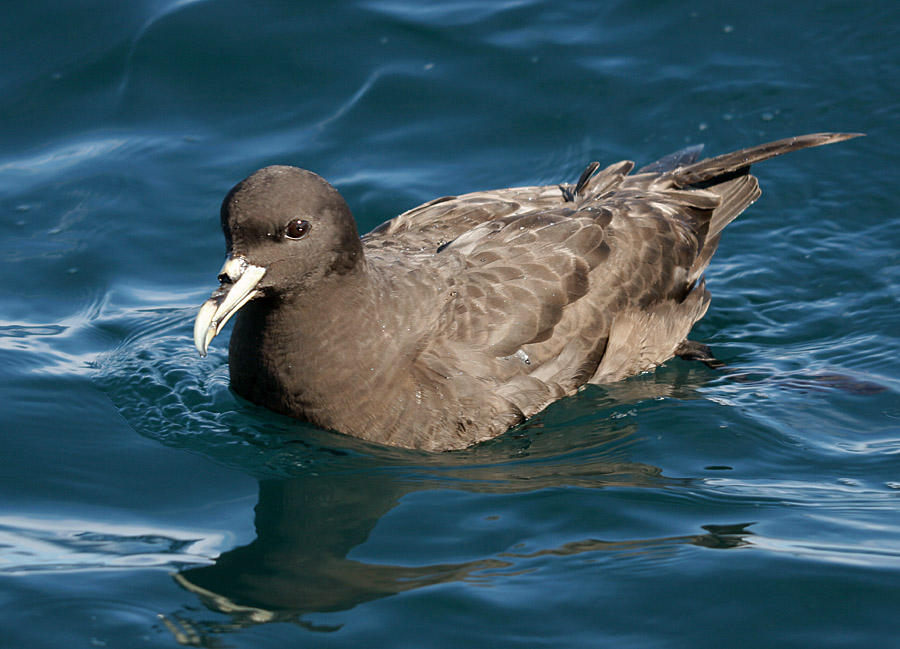
White-chinned petrel
Procellaria aequinoctialis
IUCN status: VU · VulnerableProtected in Peru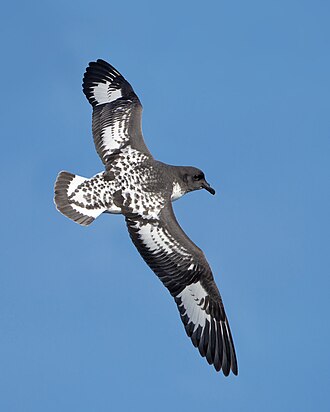
Pintado petrel
Daption capense
IUCN status: LC · Least Concern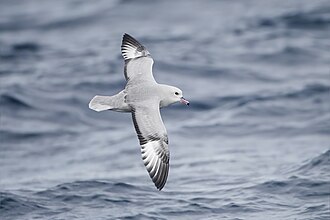
Southern fulmar
Fulmarus glacialoides
IUCN status: LC · Least Concern
Southern giant petrel
Macronectes giganteus
IUCN status: LC · Least ConcernProtected in Peru
Northern giant petrel
Macronectes halli
IUCN status: LC · Least ConcernProtected in Peru
Thin-billed prion
Pachyptila belcheri
IUCN status: LC · Least Concern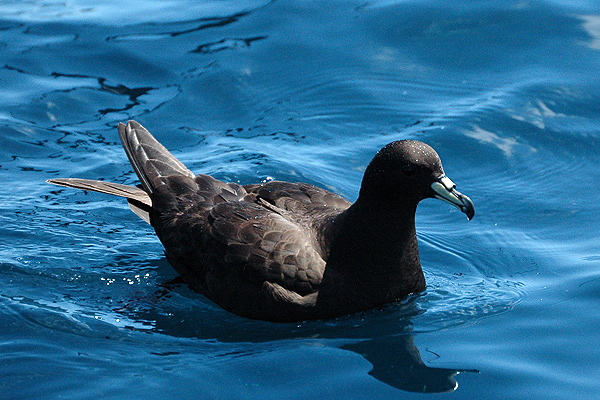
Black petrel
Procellaria parkinsoni
IUCN status: VU · VulnerableProtected in Peru
Cook's petrel
Pterodroma cookii
IUCN status: VU · Vulnerable
Names and sources
In Spanish
- Pardela de pata rosada — Peru; D.S. N.° 004-2014-MINAGRI, categorización de especies amenazadas de fauna silvestre (El Peruano, 08-04-2014), p. 8 of the PDF · main name
Also cited as
- Puffinus creatopus
Classification
Learn more
Conservation status: no data (IUCN). Taxonomy: PeRMS / WoRMS (CC BY 4.0).