
Bivalves · Arcidae
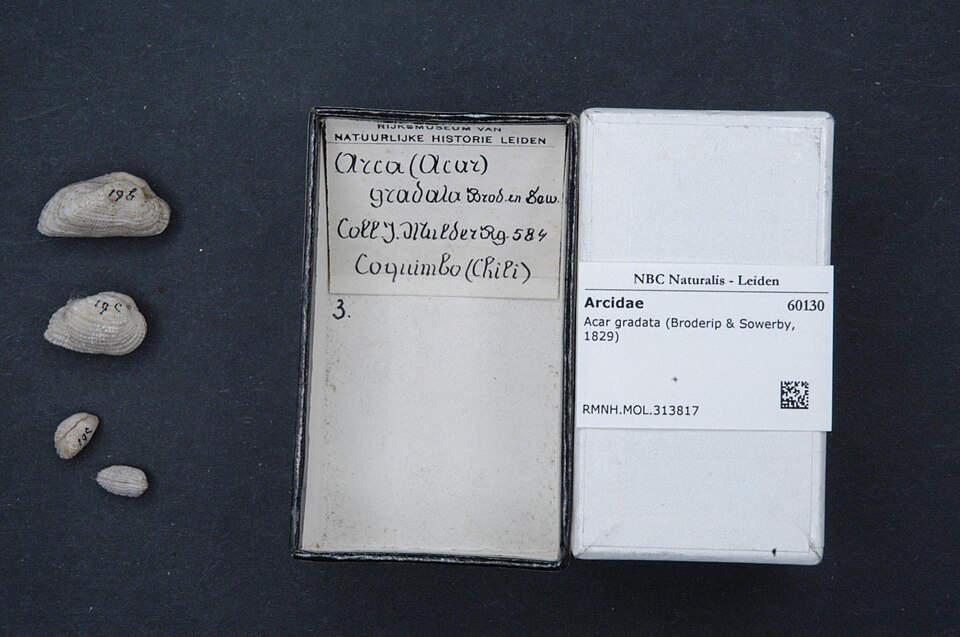
Acar gradata
Acar gradata (Broderip & G. B. Sowerby I, 1829)
- Peruvian Register of Marine Species
- Listed in PeRMS (IMARPE)
Species account
Summary
Acar gradata (Broderip & G. B. Sowerby I, 1829), the name now accepted in the family Arcidae [1], is a small ark clam described in 1829 from specimens collected at Mazatlán, Mexico, and recorded in the eastern Pacific from Baja California to northern Peru and the Galápagos Islands [2],[3].
It is a nestling species: it lives wedged under stones, in crevices and in old worm burrows, so its shell often grows distorted [3]. In Peru the annotated checklist of 2016 places it in Piura, at 5° south latitude, from the intertidal zone down to 37 m depth [4].
Identification and similar species
The shell is small to medium in size, about 33 mm long according to Olsson. Its outline is oblong, from nearly rhomboidal to very elongated, often distorted and with worn spots caused by rubbing against the wall of the cavity where it was wedged; it is white and is often covered with encrusting organisms [3].
When well preserved the sculpture is elaborate: strong concentric ridges and finer cord-like radial ribs whose crossings form rasp-like nodes. On the posterior slope of the umbo the concentric ridges are raised and form a fluted lamina [3].
Bartsch added that the muscle scars are large, smooth and strongly raised, and that the hinge teeth are small in the middle and grow toward both ends. For him these raised scars, together with the shape and sculpture, make Acar a compact group [2].
Similar species
- Acar reticulata: Acar reticulata, from the Caribbean, is a species Olsson considers closely related to Acar gradata; the source gives no criteria to separate them beyond one living in the Caribbean and the other in the eastern Pacific [3].
Distribution and habitat
Olsson gives the range of the species as Baja California to northern Peru and the Galápagos Islands. Bartsch had already noted it throughout the Mazatlán faunal area, with the type locality at Mazatlán, and on the outer coast of Baja California as far as Punta Abreojos [2],[3].
The 2016 Peruvian checklist records it in Piura (5° S) and gives its vertical distribution as intertidal down to 37 m. It also records the species in Mexico, Panama (Las Perlas archipelago), Costa Rica (Cocos Island) and Ecuador (Galápagos Islands) [4].
Ecology
It is a nestling species: it is commonly found under stones or wedged in abandoned worm burrows and in crevices, which explains the worn spots and the irregular shape of the valves [3].
Bartsch figured a specimen from Mazatlán, the type locality, that measured 23.8 mm long and 12.7 mm high. None of the sources consulted describes its feeding, reproduction or growth [2],[3].
Where to see it in Peru
Olsson (1961) cites for Peru the localities of Tumbes, Zorritos, Boca Pan, Caleto Sal, Máncora, Lobitos, Negritos and Paita; the 2016 checklist records it in Piura, in the intertidal zone and down to 37 m [3],[4].
The sources give localities, not dive sites, and do not say whether they are easy or hard to reach. The species lives hidden under stones and in crevices, and its shell is usually covered with encrustations [3].
References (4)
- MolluscaBase eds. (2026). Acar gradata (Broderip & G. B. Sowerby I, 1829). World Register of Marine Species. https://www.marinespecies.org/aphia.php?p=taxdetails&id=504280 (accessed 2026-10-25)
- Bartsch, P. (1931). The west American mollusks of the genus Acar. Proceedings of the United States National Museum, 1-4. doi:10.5479/si.00963801.80-2909.1 (accessed 2026-10-25)
- Olsson, A.A. (1961). Mollusks of the tropical eastern Pacific : particularly from the southern half of the Panamic-Pacific faunal province (Panama to Peru) ; Panamic-Pacific Pelecypoda. Paleontological Research Institution, Ithaca, 82-83. doi:10.5962/bhl.title.6853 (accessed 2026-10-25)
- Paredes, C., Cardoso, F., Santamaría, J. et al. (2016). Lista anotada de los bivalvos marinos del Perú. Revista Peruana de Biología, 127-150. doi:10.15381/rpb.v23i2.12397 (accessed 2026-10-25)
More pictures
Where it has been recorded
- Filled: scientific records, or confirmed by a curator
- Hatched: isolated record
- Dotted outline: no scientific records and no curator's confirmation (an ORKA sighting is not drawn here)
- Tropical northern sea
Scientific records (7 records)
- Tropical–cold transition zone
Scientific records (2 records)
From openly licensed OBIS and GBIF records (CC0 or CC BY). How each list is built.
Related species
From the same genus (Acar) and from the same family (Arcidae).
Acar rostae
IUCN status: Not evaluated- No openly licensed image yet
Acar pusilla
IUCN status: Not evaluated 
Anadara emarginata
IUCN status: Not evaluated
Anadara formosa
IUCN status: Not evaluatedAnadara similis
IUCN status: Not evaluatedFugleria illota
IUCN status: Not evaluated
Litharca lithodomus
IUCN status: Not evaluated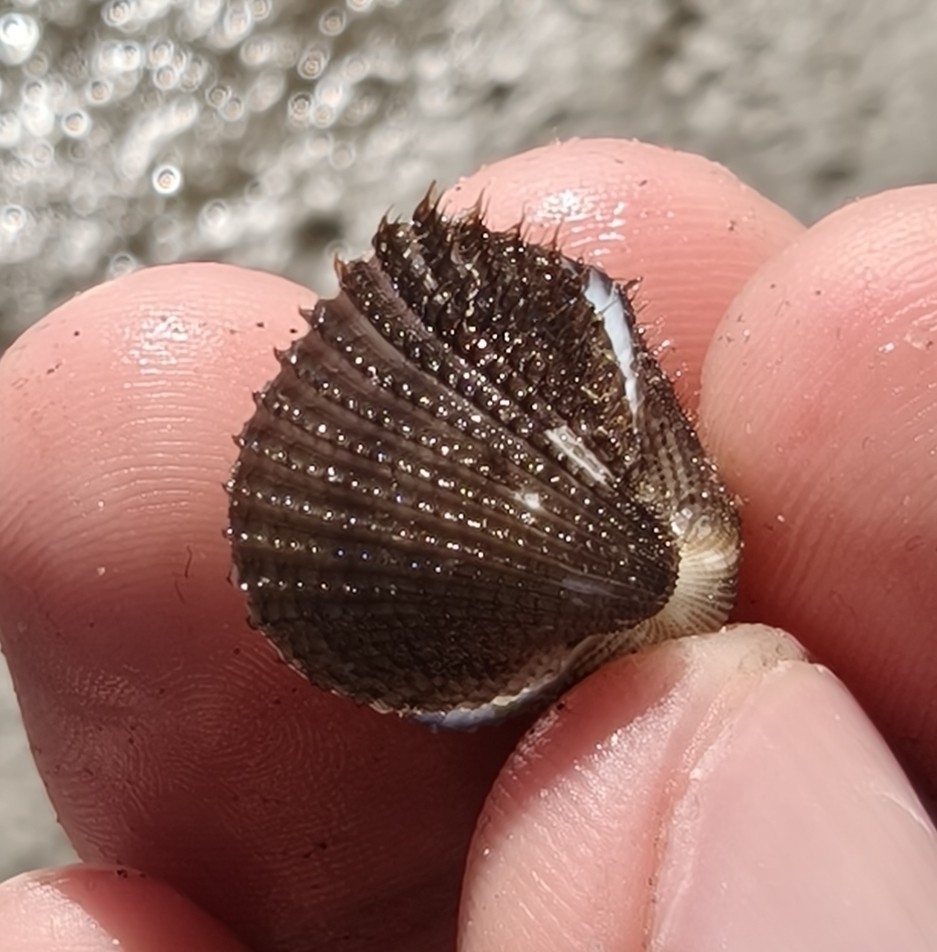
Anadara aequatorialis
IUCN status: Not evaluated
Names and sources
Classification
Learn more
Conservation status: no data (IUCN). Taxonomy: PeRMS / WoRMS (CC BY 4.0).