
Marine life guide of Peru · Xiphiidae
Swordfish
Xiphias gladius Linnaeus, 1758
- Names in Peru
- Pez espada
Species account
Summary
Xiphias gladius, the swordfish, is the only member of the family Xiphiidae and an open-ocean pelagic fish whose upper jaw is drawn out into a flat sword [1]. It lives in tropical, temperate and sometimes cold waters of all oceans [1]. At night it stays in the mixed layer and by day it typically forages in deep water [2]. In Peru it is caught with longline, gillnet and, on the north coast, harpoon; national landings in 2015 were 1434 t [3]. Its global IUCN Red List category is Near Threatened [4].
Identification and similar species
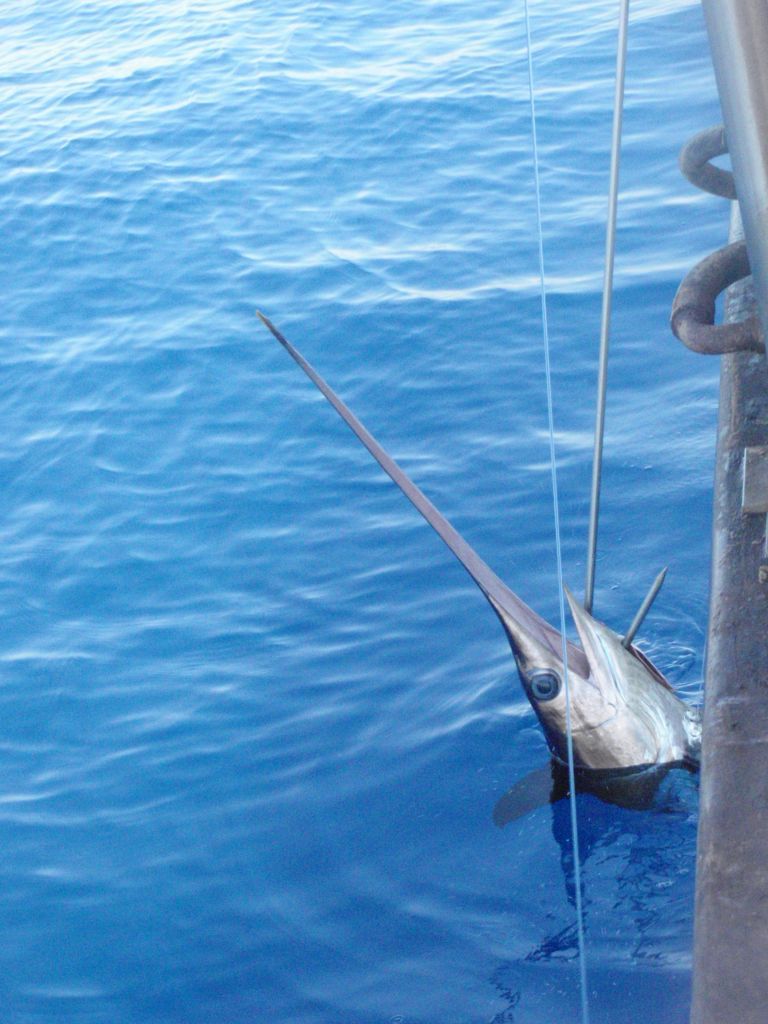
The body is elongate and cylindrical, with a large eye and an upper jaw drawn out into a bill that is flat and oval in cross-section, not round [1]. Adults have no pelvic fins and carry two widely separated dorsal fins, the first with 38 to 45 soft rays and the second with 4 or 5 [1]. They also have two separate anal fins, one large keel on each side of the tail base and a deep notch above and below it; the tail fin is large, forked and crescent-shaped [1].
Fish up to about 1.3 m total length keep fine file-like teeth, scales with small spines and a wavy lateral line, all of which disappear with growth; in young fish the dorsal and anal fins are continuous [1]. The back and flanks are dark brown, almost black, fading toward the belly [1]. It reaches about 4.5 m total length and is commonly up to 3 m [1].
Similar species
- Makaira nigricans: Fishes of the family Istiophoridae, to which Makaira nigricans belongs, have a spear-shaped upper jaw that is round in cross-section, pelvic fins, 2 keels on each side of the tail and only a shallow notch on the tail base, as well as 24 vertebrae against the swordfish's 26 [1].
Distribution and habitat
It is cosmopolitan in tropical, temperate and sometimes cold waters of all oceans [1]. It lives at the surface and in the mesopelagic zone, usually in water warmer than 13 °C; it tolerates the widest temperature range of any billfish, 5 to 27 °C, and in the northwestern Pacific its optimum runs from 18 to 22 °C [1]. In the northwestern Pacific its usual depth reaches about 550 m [1].
In the southeastern Pacific 21 fish carried satellite tags that detach and report their records, and 6 of the tags were analysed: the fish usually hunted at depth during daylight and spent the night in the surface mixed layer, with occasional departures from that pattern [2]. The deepest dive logged reached 1136 m, and five of the 6 tags recorded dives below 900 m [2]. In northern Peru, harpoon sailboats sight billfish, mostly swordfish, on the fishing ground 10 or 15 nautical miles offshore, usually off Máncora, Órganos, El Ñuro or Cabo Blanco [3].
Biology
The head holds a heater tissue attached to an eye muscle, rich in mitochondria and served by a vascular heat exchanger, which keeps the brain and eye warmer than the water [5]. This protects it from sudden cooling as it moves up and down between layers of very different temperature [5].
Off California, fish harpoon-tagged while basking at the surface spent 16.7 % of the day basking at the surface, 26.8 % in the mixed layer and 56.5 % in dives below the thermocline, while at night they swam at an average depth of 8.3 m [6].
In a harpoon fishery at El Ñuro in 2019, the swordfish measured were between 123 and 300 cm lower jaw-fork length, with a mean of 215.6 cm [3]. For females of the eastern Pacific a size at first maturity of 165 cm has been proposed, and 152 cm for males; by that criterion at least 94 % of the 278 fish measured were adults [3].
Ecology
It is an opportunistic predator that forages from the surface to the bottom; it feeds on pelagic squids where they are abundant, and slashes on the squids found in stomachs suggest that it uses the sword to kill prey [1].
Off Baja California, 175 stomachs held 1318 cephalopod beaks; ommastrephid squids, mainly the jumbo squid Dosidicus gigas, made up 60 % of the prey by number and 82 % of the estimated weight [7]. The diet was dominated by medium to large muscular squids, which the authors consider probably eaten in surface waters at night [7]. In the Florida Straits, in 131 stomachs, cephalopods were 72.4 % of the diet by weight, and the study suggests the swordfish is an opportunistic feeder that may alter its diet when prey abundance changes [8].
Conservation
The IUCN classifies the swordfish globally as Near Threatened [4].
In Peru billfishes are caught mainly with gillnets for large pelagic fish and, to a lesser extent, surface longline; the harpoon contributes only 0.09 % of total artisanal catch [3]. Swordfish landings were 1434 t in 2015 in Peru and 30970 t in 2016 in the whole eastern Pacific [3]. The authors note that missing records for small-scale fisheries may add to the data shortage for assessing billfish populations [3].
Health, toxicological and chemical relevance
Not medical advice. For a sting, a poisoning or an allergy, seek medical care.
Mercury moves up the food chain and builds up in predatory fish such as this one [9]. In muscle samples of swordfish imported into Italy between 2014 and 2017 from various FAO fishing areas, estimated mercury intake was 0.40 μg per kg of body weight per day for adults, below the provisional limit of 0.57, and 0.97 for children, above it [9].
Human relevance
In Peru the use of the harpoon for fishing dates back to 10000 BC; that fishing led the country to have, around the 1940s and 1950s, one of the largest swordfish fisheries in Latin America [3]. It is the billfish with the largest catch record in the country, and in 2019 it made up 95 % of the billfish landed with harpoon at El Ñuro [3].
The fishers of El Ñuro go out in artisanal sailboats, and the authors point to the high selectivity of the harpoon and to this fishery possibly disturbing the ecosystem less than those that run an engine for the whole trip [3].
Where to see it in Peru
In 2019, at El Ñuro (Piura), sailboats reached the fishing ground after 5 or 6 hours of sailing, 10 or 15 miles offshore, and spotted the billfish by dorsal and tail fins above the water [3]. Landings were higher in the cold season, from May to November, peaking in July and August [3]. It is an open-sea animal; the source describes sightings from fishing boats and mentions neither diving nor tourist trips to see it [3].
References (9)
- Nakamura, I. (2001). XIPHIIDAE Swordfishes. FAO Species Identification Guide for Fishery Purposes. The Living Marine Resources of the Western Central Pacific, vol. 6, 3757-3758. https://www.fao.org/4/y0870e/y0870e39.pdf (accessed 2026-10-25)
- Abascal, F.J., Mejuto, J., Quintans, M. et al. (2009). Horizontal and vertical movements of swordfish in the Southeast Pacific. ICES Journal of Marine Science 67(3), 466-474. doi:10.1093/icesjms/fsp252 (accessed 2026-10-25)
- Pazos-Niño de Guzmán, A., Alfaro-Córdova, E., Alfaro-Shigueto, J. et al. (2022). La pesquería con arpón de peces picudos (Xiphiidae e Istiophoridae) en El Ñuro, Perú: Bases de una pesquería olvidada. Revista de Biología Marina y Oceanografía 56(3), 200-214. doi:10.22370/rbmo.2021.56.3.3181 (accessed 2026-10-25)
- Collette, B.B., Di Natale, A., Fox, W. et al. (2021). Xiphias gladius: Collette, B.B., Di Natale, A., Fox, W., Graves, J., Juan Jorda, M., Pohlot, B., Restrepo, V. & Schratwieser, J. The IUCN Red List of Threatened Species 2022: e.T23148A46625751. doi:10.2305/IUCN.UK.2022-1.RLTS.T23148A46625751.en (accessed 2026-10-25)
- Carey, F.G. (1982). A Brain Heater in the Swordfish. Science 216, 1327-1329. doi:10.1126/science.7079766 (accessed 2026-10-25)
- Sepulveda, C.A., Aalbers, S.A., Heberer, C. et al. (2018). Movements and behaviors of swordfish Xiphias gladius in the United States Pacific Leatherback Conservation Area. Fisheries Oceanography 27, 381-394. doi:10.1111/fog.12261 (accessed 2026-10-25)
- Markaida, U., Hochberg, F.G. (2005). Cephalopods in the Diet of Swordfish (Xiphias gladius) Caught off the West Coast of Baja California, Mexico. Pacific Science 59, 25-41. doi:10.1353/psc.2005.0011 (accessed 2026-10-25)
- Heemsoth, A.M., Hirons, A.C., Collatos, C.M. et al. (2020). Swordfish Xiphias gladius diet in the Florida Straits. Bulletin of Marine Science 96, 695-706. doi:10.5343/bms.2019.0097 (accessed 2026-10-25)
- Esposito, M., De Roma, A., La Nucara, R. et al. (2018). Total mercury content in commercial swordfish (Xiphias gladius) from different FAO fishing areas. Chemosphere 197, 14-19. doi:10.1016/j.chemosphere.2018.01.015 (accessed 2026-10-25)