
Marine life guide of Peru · Delphinidae
Bottlenose dolphin
Tursiops truncatus (Montagu, 1821)
- Names in Peru
- Delfín nariz de botella · Bufeo
Species account
Summary
Tursiops truncatus is a dolphin of the family Delphinidae [1]. It lives in temperate and tropical waters around the globe, from harbours, bays and estuaries to the continental shelf and the open ocean [2]. Law No. 26585 of 1996 names it «bufeo» and declares it a legally protected species in Peru [3], while the management plan of the Reserva Nacional Mar Tropical de Grau calls it «delfín nariz de botella» [4].
Etymology
Montagu described it in 1821 as Delphinus truncatus, and it is now placed in the genus Tursiops [1]. Its synonyms include two names coined for eastern Pacific dolphins: Tursiops gilli, described by Dall in 1873 for southern California and Baja California, and Tursiops nuuanu, described by Andrews in 1911 for the eastern tropical Pacific [1],[5].
Identification and similar species
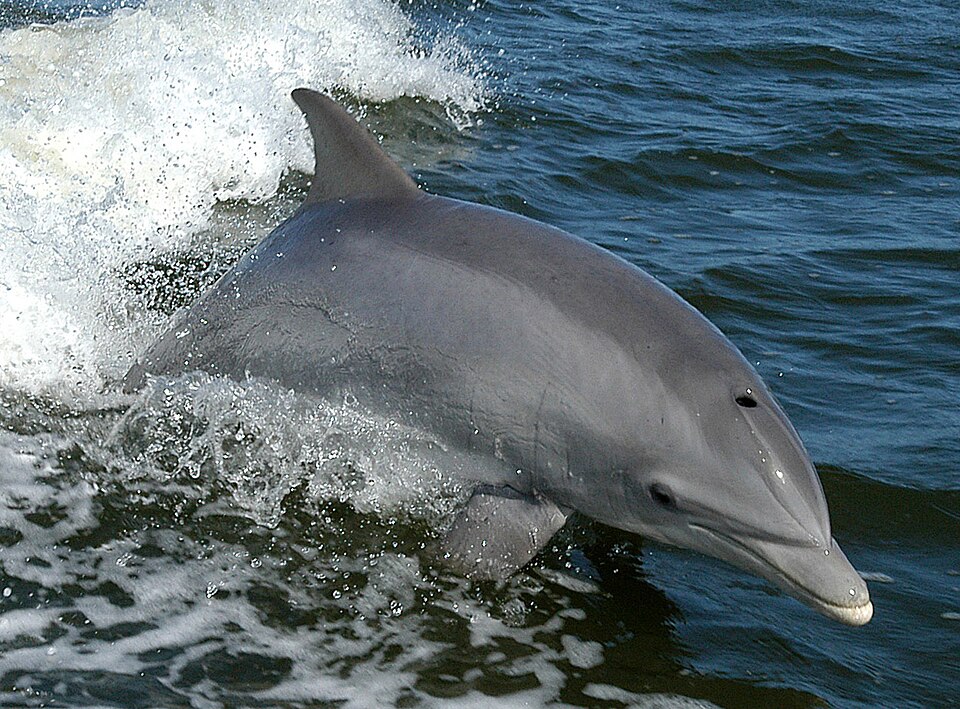
It is a sturdy dolphin with a short, thick snout. Its colour is grey, from light grey to almost black on the back near the dorsal fin, fading towards the belly, which ranges from pale grey to nearly white [2]. It measures 1.8 to 4 m and weighs 136 to 635 kg; animals living close to shore tend to be smaller and paler than offshore ones [2].
Two ecotypes occur off Peru, one coastal and one offshore, which in dead specimens are told apart by skull traits such as tooth diameter, the shape of the pterygoid and palatine bones and the spacing of the occipital condyles [5]. At sea the most consistent difference between them, and a reliable way to tell them apart by eye, is the curve of the dorsal fin, far more hooked in offshore animals and more triangular in coastal ones; in the Peruvian coastal sample the fin was proportionally the widest at mid-height of all the populations compared [6]. The 48 dolphins measured from photographs off Lima in 2021 all had fins typical of the coastal ecotype [7].
Similar species
- Delphinus delphis: The long-beaked common dolphin is smaller, 1.8 to 2.6 m, has a longer snout and an hourglass pattern with a yellowish panel ahead of the dorsal fin and a dark stripe from the jaw to the flipper [8]. The bottlenose dolphin, by contrast, is plain grey, paler below, with a short, thick snout [2].
Distribution and habitat
In the southeast Pacific it is known from the Galápagos Islands and the coast of Ecuador, along the entire Peruvian coastline, to northern and central Chile, and also around the Chilean oceanic islands of San Félix, San Ambrosio, Salas y Gómez and Juan Fernández [5]. The offshore ecotype ranges more or less continuously off South America to at least the Aisén Region in Chilean Patagonia, whereas the coastal form appears confined to the stretch from Colombia to south-central Peru, with only scattered occurrences further south [6].
On the central coast, between Pucusana and Arica beach, the groups seen in 2021 were on average 391 m from shore, ranging from 121 to 807 m, over depths of 2.8 to 12.3 m, and some individuals swam in water under 2 m deep [7]. Mean depth was greater in autumn, at 8.8 m, than in spring, at 4.3 m [7].
Biology
According to the United States fisheries agency, it begins breeding between 5 and 15 years of age depending on the population, and females usually mature before males [2]. Pregnancy lasts about 12 months, a female gives birth on average every 3 to 6 years, the calf suckles for around 20 months and stays with its mother for 3 to 6 years; it can live at least 40 years, some females reach 60 or more, and females have calved at up to 45 years old [2].
The first genetic study of the species in the southeast Pacific, based on mitochondrial DNA, placed the 3 Peruvian coastal dolphins examined in a lineage of their own, at a net distance of 2.9 % from Peruvian offshore animals; the authors propose treating the two ecotypes as distinct evolutionary units and managing them separately [5]. Two of those coastal animals shared a haplotype although they were landed at Chimbote and San Andrés, 556 km apart, and offshore dolphins from Peru and Chile did not differ, so they appear to form a single wide-ranging population [5].
Coastal dolphins usually move in small groups of a dozen or fewer and are resident or semi-resident, whereas offshore groups are larger, more variable in size and range over wider areas [6]. Off Lima, 52 individuals were photo-identified in 2021; 20 of them, 38.5 %, were seen in both autumn and spring, almost 6 months apart, and 2 already appeared in photographs from 2012 [7].
Ecology
It eats fish, squid and crustaceans such as crabs and shrimp; it hunts alone or cooperatively, herding schools and taking turns to charge through them, sometimes pins fish against sandbars, and swallows them whole, head first [2]. To find prey it listens passively or uses high-frequency echolocation [2]. In Peru the coastal and offshore ecotypes also differ in diet and in their parasite burden [5].
On the central coast, 11 groups of 2 to 25 dolphins, 12.7 on average, were recorded in 2021, made up mostly of adults; 4 adult and calf pairs were seen in autumn and 2 in spring [7]. They spent 41 % of the time milling, 34.7 % travelling, 16.4 % feeding and 7.8 % socialising; to catch jack mackerel, Trachurus murphyi, they swam belly-up beneath the school and then turned sharply towards the surface, and Inca terns, Belcher's gulls and Peruvian pelicans joined these hunts [7].
Conservation
The IUCN Red List classifies it as Least Concern (LC) [9]. It is listed in CITES Appendix II [2]. In Peru, Law No. 26585, published on 9 April 1996, declares it a legally protected species and bans catching, processing and selling dolphins and other small cetaceans; offenders commit the crime set out in article 308 of the Penal Code [3].
Even so, between March 2005 and July 2007 observers aboard 66 artisanal fishing trips out of Salaverry recorded 253 small cetaceans caught, of which 33, or 13 %, were bottlenose dolphins [10]. From that port's fishing effort, the authors estimated that its gillnet fleet took on average about 259 bottlenose dolphins a year between 2002 and 2007, with an interval of 136 to 383 [10].
In Ecuador and Peru it is also killed in collisions with boats, especially by propellers, and Peru's marine protected areas safeguard its coastal habitat only to a limited extent [6]. The conservation status of the central coast population remains unknown [7].
Health, toxicological and chemical relevance
Not medical advice. For a sting, a poisoning or an allergy, seek medical care.
It can suffer from a skin disease resembling lobomycosis: one or more greyish to whitish lumps and patches appear on the skin, sometimes ulcerating and enlarging over time; in South America it has been seen in Brazil, Venezuela, Colombia, Ecuador and Peru, where it was recorded in free-ranging dolphins off Callao in 2006 [11]. In lesions from dolphins in the United States and Cuba the fungus proved closer to Paracoccidioides brasiliensis, which causes paracoccidioidomycosis in people and land mammals in South America, than to the classic agent of lobomycosis [11]. Of the 21 affected dolphins gathered in that study, 2 turned up dead in southern Brazil, heavily covered in lesions, and another 2 vanished in Ecuador, presumably dead [11].
Photographs taken off Lima in 2021 showed wounds suggesting ulcerative dermatitis, irregular grey patches, an orange tinge on the back, skin nodules and one individual with a deformed body and a deep scar [7].
Human relevance
In the artisanal fishery of Salaverry the bottlenose dolphin was used as bait: of the 33 taken between 2005 and 2007, 3 were harpooned to serve as bait, and of those caught in gillnets 10 ended up as bait, 17 were thrown back dead and only 1 was released alive [10]. Off Lima in 2021 the dolphins did not change their behaviour around the survey boat and came to ride its bow wave, spy-hop and leap close by [7].
Where to see it in Peru
In 2021 it was seen often along the coast of Lima, between Pucusana and Arica beach, above all between Caballeros and Pulpos beaches, less than 1 km from shore [7]. In the north, the 2026 management plan of the Reserva Nacional Mar Tropical de Grau lists it among the 13 cetacean species sighted in the Cabo Blanco–El Ñuro sector [4].
References (11)
- WoRMS Editorial Board (2026). Tursiops truncatus (Montagu, 1821). World Register of Marine Species. https://www.marinespecies.org/aphia.php?p=taxdetails&id=137111 (accessed 2026-10-20)
- NOAA Fisheries (2026). Common Bottlenose Dolphin. NOAA Fisheries, species page. https://www.fisheries.noaa.gov/species/common-bottlenose-dolphin (accessed 2026-10-20)
- Congreso de la República del Perú (1996). Ley N.° 26585: declaran a delfines y otros mamíferos marinos como especies legalmente protegidas. El Peruano, Normas Legales (09-04-1996), N.° 5757; copia en FAOLEX. https://faolex.fao.org/docs/pdf/per193271.pdf (accessed 2026-10-20)
- Servicio Nacional de Áreas Naturales Protegidas por el Estado (2026). Plan Maestro de la Reserva Nacional Mar Tropical de Grau 2026–2031. Anexo de la Resolución de Presidencia Ejecutiva N.° 000052-2026-SERNANP/PE. https://cdn.www.gob.pe/uploads/document/file/9468842/7752998-5-pm_2026-2031_rnmtg-f-f-f-f.pdf (accessed 2026-10-20)
- Sanino, G.P., Van Waerebeek, K., Van Bressem, M.-F. et al. (n.d.). A preliminary note on population structure in eastern South Pacific common bottlenose dolphins, Tursiops truncatus. Journal of Cetacean Research and Management 7(1), 2005, 65-70. doi:10.47536/jcrm.v7i1.759 (accessed 2026-10-20)
- Félix, F., Van Waerebeek, K., Sanino, G.P. et al. (2018). Variation in Dorsal Fin Morphology in Common Bottlenose Dolphin Tursiops truncatus (Cetacea: Delphinidae) Populations from the Southeast Pacific Ocean. Pacific Science 72(3), 307-320. doi:10.2984/72.3.2 (accessed 2026-10-20)
- Cortez-Casamayor, S., Guidino, C., Silva, S. et al. (2024). Characterizing common bottlenose dolphin (Tursiops truncatus) ecology aspects in the central coast of Peru: Distribution, group dynamics, skin lesions and behavior patterns. Revista de Biología Marina y Oceanografía 59(2), 137-148. doi:10.22370/rbmo.2024.59.2.4811 (accessed 2026-10-20)
- NOAA Fisheries (2026). Long-Beaked Common Dolphin. NOAA Fisheries, species page. https://www.fisheries.noaa.gov/species/long-beaked-common-dolphin (accessed 2026-10-20)
- Wells, R.S., Natoli, A., Braulik, G. (2018). Tursiops truncatus: Wells, R.S., Natoli, A. & Braulik, G. The IUCN Red List of Threatened Species 2019: e.T22563A156932432. doi:10.2305/IUCN.UK.2019-1.RLTS.T22563A156932432.en (accessed 2026-10-20)
- Mangel, J.C., Alfaro-Shigueto, J., Van Waerebeek, K. et al. (2010). Small cetacean captures in Peruvian artisanal fisheries: High despite protective legislation. Biological Conservation 143(1), 136-143. doi:10.1016/j.biocon.2009.09.017 (accessed 2026-10-20)
- Van Bressem, M.-F., Simões-Lopes, P.C., Félix, F. et al. (2015). Epidemiology of lobomycosis-like disease in bottlenose dolphins Tursiops spp. from South America and southern Africa. Diseases of Aquatic Organisms 117(1), 59-75. doi:10.3354/dao02932 (accessed 2026-10-20)
More pictures
Photo: Mark Anderson · CC BY-SA 4.0 · GBIF (iNaturalist research-grade observations) Photo: Dan Horowitz · CC0 · GBIF (iNaturalist research-grade observations)