
Marine life guide of Peru · Triakidae
Spotted Houndshark
Triakis maculata Kner & Steindachner, 1867
- Names in Peru
- Tollo manchado
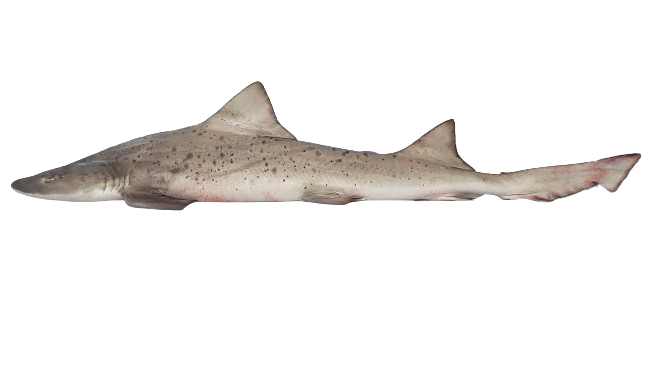
Species account
Summary
Triakis maculata is a shark of the family Triakidae, described by Kner and Steindachner in 1867 [1]. In Peru it is called «tollo manchado» [2]. It lives in coastal waters over the continental shelf of the South American Pacific, between Peru and northern Chile, and is also known from the Galápagos Islands [3]. In Lambayeque, the small-scale fleet catches it with coastal bottom gillnets [4]. The IUCN Red List classifies it as Critically Endangered in its 2019 assessment [5].
Identification and similar species
It is a heavy-bodied houndshark with a short, broadly rounded snout; its anterior nasal flaps are set well apart and stop short of the mouth [3]. The upper labial furrows are long, reaching as far as the level of the lower jaw's symphysis [3]. Its teeth are not blade-shaped: those in the middle two-thirds of the dental band carry a strong upright cusp, while the side cusplets are low or missing [3]. The rear edge of the first dorsal fin slopes backward and down, adult pectoral fins are broad and sickle-shaped, and the total vertebral count runs from 164 to 170 [3].
The body is generally dotted with many small black spots, although some individuals are plain, and an unspotted female can bear spotted pups [3]. In houndsharks landed in Peru in 2018 and 2019, juveniles were greyish with black spots all over the body and a white belly; adults were a slightly paler grey, sometimes without spots, and had darkened fin tips [2]. On the trunk, the first dorsal fin begins level with the end of the pectoral fin's lower edge, the pectoral fin arises beneath the fourth gill opening, and the second dorsal starts slightly ahead of the anal fin [2].
In the past, the genus Mustelus proved hard to separate from Triakis. In the Mustelus smooth-hounds, the upper labial furrows end well short of the upper symphysis and the teeth form a pavement whose cusps are usually much reduced or absent [3].
Similar species
- Mustelus mento: Its back carries numerous white spots and no black ones, and its teeth are molar-like, with a rounded crown and no cusp [3]; on landed trunks it can also be recognised by a white patch on the underside of the pectoral fin [2].
- Mustelus whitneyi: It is plain grey or grey-brown, with neither white nor black spots, and the rear edges of its dorsal fins are frayed, with a dark margin of bare fin rays [3]. In juveniles, fin measurements were not enough to separate it from Triakis maculata, so the black spots on the trunk are the thing to check [2].
Distribution and habitat
It ranges through the eastern Pacific from Peru to northern Chile, and also around the Galápagos Islands, where the record is a specimen that was caught, tagged and released off Fernandina Island in 1980 [3]. Records from Mexico are regarded as probably mistaken [3]. It is a shark of temperate coastal waters over the South American continental shelf, and little is known about it [3].
It appears in the updated list of cartilaginous fishes of the Peruvian sea published in 2015 [6]. In Lambayeque, between 6° and 7° 30′ S, it is caught with bottom gillnets that the small-scale fleet sets in coastal waters, weighted to fish the lower part of the water column, and in winter it is also taken incidentally in the bottom nets aimed at Mustelus smooth-hounds [4].
Biology
It is a little-known species: it is thought to be a probable aplacental live-bearer, and one female was found carrying 14 pups in a single litter [3]. Full-term embryos measure 30 to 40 cm, and one pup already free-living measured 43 cm [3].
The largest recorded size is 180 cm total length, and it may reach 240 cm [3].
Ecology
Its diet was first described from the stomach contents of commercial sharks and rays in northern Peru [7]. There it formed a feeding group with Mustelus whitneyi, Myliobatis chilensis, Pseudobatos planiceps, Carcharhinus brachyurus and Galeorhinus galeus, whose food consists mostly of bony fishes and invertebrates caught near the coast, both on the seabed and in the water column [7].
In 14 specimens bought at the Chorrillos fishing terminal in Lima, 7 parasite species were found: a monogenean of the genus Erpocotyle, a nematode of the genus Proleptus, tapeworms of the genera Callitetrarhynchus and Paraorygmatobothrium, and copepods of the genera Caligus, Achtheinus and Lernaeopoda; the commonest was the tapeworm Paraorygmatobothrium, present in 64.3 % of the sharks [8]. Off Chile, two parasitic copepods, Lernaeopoda tenuis and Pseudolernaeopoda caudocapta, were described as new to science from specimens of this species [9].
Conservation
Its global category is Critically Endangered [5]. In Peru, Ministerial Resolution No. 209-2001-PE, which sets minimum catch sizes for sharks, gives it a minimum size of 60 cm [10].
Between 1996 and 2010 it was one of 12 shark species that together made up only 2 % of the landings recorded in the country [10]. Some commercial species are also lumped under a single common name that can cover several species of Mustelus and Triakis, threatened ones among them, so the number of commercial shark species may be underestimated [10].
Moreover, sharks tend to reach port headless and cut at different points along the trunk, which makes identifying them harder [2]. Using specimens landed in 2018 and 2019, researchers built a key that recognises the spotted houndshark by the black spots on its trunk, but juvenile fin measurements did not tell it apart from Mustelus whitneyi [2].
Health, toxicological and chemical relevance
Not medical advice. For a sting, a poisoning or an allergy, seek medical care.
Because it is sold as food, one study checked whether this species carries parasites that pose a public-health risk: in the 14 sharks examined, none of the 7 parasites found was zoonotic [8].
Human relevance
It is fished off Peru, and probably also off Chile, for human consumption [3]. In Lambayeque, between 2005 and 2019, some of the smaller boats of the gillnet fleet used coastal bottom nets about 30 fathoms long, 2 fathoms high and of 4.5-inch mesh, targeting Mustelus smooth-hounds and the spotted houndshark [4].
It is among the 11 shark species most landed in Peru, and in Peruvian markets it is sold together with other sharks under one generic name [2]. The specimens in the Lima parasite study were bought at the Chorrillos fishing terminal [8].
Where to see it in Peru
Peruvian literature knows this species mainly through fishing. In Lambayeque, between 2005 and 2019, it was caught incidentally in winter in coastal bottom nets [4]. Between January 2018 and December 2019, 15 specimens were obtained in a survey of small-scale landings at 6 sites between Máncora and Pisco [2], and a study published in 2021 examined 14 specimens bought at the Chorrillos fishing terminal in Lima [8].
References (10)
- WoRMS Editorial Board (2026). Triakis maculata Kner & Steindachner, 1867. World Register of Marine Species. https://www.marinespecies.org/aphia.php?p=taxdetails&id=279058 (accessed 2026-10-20)
- Vitor-Caceres, M., Kanagusuku, K., Aponte, H. (2022). Análisis morfológico de troncos y aletas de cinco especies comerciales de tiburones desembarcados en el litoral peruano. Revista de Biología Marina y Oceanografía, 145-159. doi:10.22370/rbmo.2022.57.especial.3340 (accessed 2026-10-20)
- Compagno, L.J.V. (1984). FAO species catalogue. Vol. 4. Sharks of the world. An annotated and illustrated catalogue of shark species known to date. Part 2: Carcharhiniformes. FAO Fisheries Synopsis No. 125, Vol. 4, Part 2. FAO, Rome. https://www.fao.org/4/ad123e/ad123e00.htm (accessed 2026-10-20)
- Torres, D., Sarmiento, D. (2021). Interacción de cetáceos con la pesquería de enmalle artesanal en Lambayeque (06°S – 07°30’S). Boletín Instituto del Mar del Perú, 205-223. doi:10.53554/boletin.v36i1.327 (accessed 2026-10-20)
- Dulvy, N.K., Acuña, E., Bustamante, C. et al. (2019). Triakis maculata: Dulvy, N.K., Acuña, E., Bustamante, C., Herman, K. & Velez-Zuazo, X. The IUCN Red List of Threatened Species 2020: e.T63130A124461743. doi:10.2305/IUCN.UK.2020-3.RLTS.T63130A124461743.en (accessed 2026-10-20)
- Cornejo, R., Vélez-Zuazo, X., González-Pestana, A. et al. (2015). An updated checklist of Chondrichthyes from the southeast Pacific off Peru. Check List, 1809. doi:10.15560/11.6.1809 (accessed 2026-10-20)
- Gonzalez-Pestana, A., Mangel, J.C., Alfaro-Córdova, E. et al. (2021). Diet, trophic interactions and possible ecological role of commercial sharks and batoids in northern Peruvian waters. Journal of Fish Biology, 768-783. doi:10.1111/jfb.14624 (accessed 2026-10-20)
- Arrese-Dávila, V., Casas-Velásquez, G. (2021). Reporte parasitológico de Triakis maculata (Kner & Steindachner, 1867) «tollo manchado» (Chondrichthyes: Selachimorpha) en el terminal pesquero Chorrillos, Lima- Perú. Revista de Investigaciones Veterinarias del Perú, e19213. doi:10.15381/rivep.v32i4.19213 (accessed 2026-10-20)
- Castro Romero, R., Baeza Kuroki, H. (1986). Lernaeopoda tenuis n. sp. and Pseudolernaeopoda caudocapta n. g., n. sp. (Copepoda, Lernaeopodidae) parasitic on Triakis maculata (Kner & Steindachner) from the Chilean coast, South Pacific. Systematic Parasitology, 227-233. doi:10.1007/BF00009891 (accessed 2026-10-20)
- Gonzalez-Pestana, A., Kouri J., C., Velez-Zuazo, X. (2016). Shark fisheries in the Southeast Pacific: A 61-year analysis from Peru. F1000Research, 164. doi:10.12688/f1000research.4412.2 (accessed 2026-10-20)
More pictures
Photo: J. PFLIGER · CC BY 4.0 · GBIF (vía GBIF)Museum specimen (colours may differ from the living animal) Author not given · CC BY-SA 4.0 · GBIF (vía GBIF)Museum specimen (colours may differ from the living animal)