
Marine life guide of Peru · Scombridae
Yellowfin tuna
Thunnus albacares (Bonnaterre, 1788)
- Names in Peru
- Atún de aleta amarilla
Species account
Summary
The yellowfin tuna, Thunnus albacares, is a circumtropical tuna: it lives in all the warm seas of the world except the Mediterranean [1]. In the eastern Pacific it has been recorded from Point Conception, in California, to San Antonio, in Chile, and it is an open-ocean fish that seldom comes near the coast [1]. It feeds on fishes, crustaceans and cephalopods, and females spawn in batches through almost the whole year [1]. It is one of the most heavily fished tunas of the eastern Pacific, and genetic analyses of samples from Mexico and Ecuador (the latter from a fishing ground reaching northern Peru) found no sign of more than one population [2].
Identification and similar species
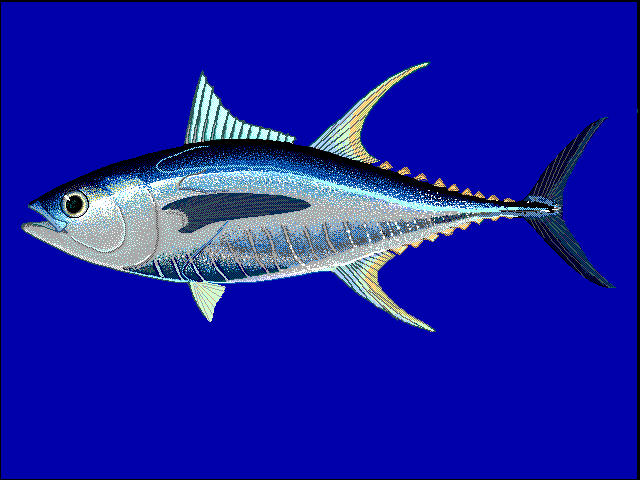
It is a tuna with a spindle-shaped, elongated body, a small head and a long tail section, completely covered in small scales: about 270 along the lateral line [1]. It has 39 vertebrae, 13 to 14 spines in the first dorsal fin, 8 to 11 dorsal finlets and 8 to 10 anal finlets [1]. The pectoral fins are long and reach or pass the origin of the second dorsal fin, except in very large fish; in these, the second dorsal and anal fins often become greatly elongated [1].
The liver has no striations on its surface and its right lobe is longer than the others; the swim bladder is narrow and long [1]. A large keel of skin on each side of the caudal peduncle is also present, a feature of the genus Thunnus [1]. The authors of the FAO synopsis recognise a single species of yellowfin tuna across the whole ocean, although in the Pacific there are populations that differ in body and fin shape without being separate species [1]. Its distribution overlaps largely with that of skipjack and bigeye, but yellowfin usually form schools of their own species [1].
Distribution and habitat
It is circumtropical and in the Pacific forms commercial concentrations in a broad band between the 20 °C surface isotherms, although it turns up sporadically in somewhat cooler water [1]. On the American side of the eastern Pacific it has been recorded from Point Conception, in California, to San Antonio, in Chile [1]. Temperature sets the limits of its range: its seasonal appearances off Baja California and off the northern coast of South America follow the advance of the isotherms [1].
It is oceanic at every stage of life, confined largely to the upper mixed layer, and rarely occupies coastal waters [1]. Within the range of tolerable temperatures its abundance follows food above all, and surface-schooling tunas are most abundant where phytoplankton and zooplankton productivity is high, in upwelling areas and where waters mix at current boundaries [1]. Electronic tag records from the tropical Pacific show that energy intake in the eastern Pacific was about 2.2 times that in the western Pacific, and that feeding was more likely where the thermocline was shallower [3].
Biology
According to the early reviews, size at first maturity varies greatly across the Pacific: near the Revillagigedo Islands few fish mature below 80 cm and the average size is 100 cm, while off Central America a substantial share of females mature at 50 to 60 cm [1]. Most individuals spawn for the first time in their second year of life [1]. Mature females hold several groups of developing eggs and spawn in batches of 1 to 8 million eggs each, at least 2 times a year [1].
Spawning takes place all year in the tropical Pacific, with peaks at different times in different areas; the eggs are pelagic, about 1 mm across with an oil globule of 0.26 mm, and hatch in about 2 days into larvae of 2 to 3 mm [1]. A near-global analysis of larval distribution found that yellowfin larvae were concentrated in water warmer than 25 °C [4]. In the eastern Pacific growth is fast: fish enter the surface fishery near the end of their first year, and early estimates give about 149 lb at 4 years of age and a natural mortality of about 55 % a year in commercial-sized fish [1].
Ecology
It is an opportunistic, barely selective predator. In 3763 stomachs from the eastern Pacific, from fish 253 to 1963 mm long, 24 % were empty, and by volume the food was 47 % fish, 45 % crustaceans and 8 % cephalopods, with prey from 43 families of fish [1]. It feeds by day and mostly in the surface layers [1]. In the northern Gulf of Mexico, a study of 577 individuals using stomach contents, DNA barcoding and stable isotopes found that the diet changes with the seasons, with squid and flying fish in spring and juvenile fishes in summer [5].
Yellowfin tunas associate at sea with floating objects such as logs, with schools of dolphins, with whales and with sharks [1]. Their predators include large tunas, billfishes, sharks and perhaps killer whales, and the juveniles are eaten by nearly all the large carnivorous fish that share their range [1]. Tagging data show that along the South American coast the fish tend to move south in the warm months and north in the cool ones, between the Gulf of Guayaquil and southern Peru [1].
Conservation
A genetic analysis of 164 yellowfin tuna landed at ports in Mexico and Ecuador (one with fishing grounds reaching northern Peru) found very low differentiation among sites, which the authors read as a single population in the eastern Pacific, in line with the 2019 assessment by the Inter-American Tropical Tuna Commission, which treats it as one stock [2]. The same authors note that the species is listed by the IUCN as least concern, with a declining population trend, and that overfishing is one of the greatest threats [2].
In Peruvian waters, a climate-change vulnerability analysis of 35 fishery resources of the Tropical Eastern Pacific Ecosystem off Peru ranked yellowfin tuna as low vulnerability, the only pelagic species in that group [6]. An analysis of longline catch data under the high-emissions RCP8.5 scenario projects that it would become more abundant in the tropical eastern Pacific and that its distribution would shift northwards by mid-century [6].
Health, toxicological and chemical relevance
Not medical advice. For a sting, a poisoning or an allergy, seek medical care.
In 40 yellowfin tuna from a market in Hungary, originating in Sri Lanka, cadmium and mercury were below European Union limits, but lead exceeded the limit of 0.30 mg/kg in 40 % of the samples [7]. Mercury stayed below 1.0 mg/kg in every case, although the estimated daily intake exceeded the reference value in 2 samples [7].
Histamine in fish is produced mainly by bacteria that convert free histidine. Strains of Morganella carrying histidine decarboxylase genes were isolated from yellowfin tuna, and one of them produced much more histamine than the other at 4 °C [8]. The United States Food and Drug Administration sets a maximum of 50 ppm of histamine in fish products [8].
Human relevance
It is one of the most important tunas in world fisheries, and four regional fisheries management organisations manage its populations, among them the Inter-American Tropical Tuna Commission in the eastern Pacific [2]. In the eastern Pacific it is caught with purse seines and bait boats, and the FAO synopsis describes as predominant in the Peruvian fishery of the time a type of small purse-seine boat, 45 to 60 feet long, without refrigeration, built for one-day trips [1].
In northern Peru, artisanal fishing communities are receiving training on selective fishing gear for yellowfin tuna, and experiential pole-and-line fishing of yellowfin tuna is mentioned as an alternative activity for fishers [6].
Where to see it in Peru
It is an open-ocean fish, and the literature treats it mainly as a fishery resource. Fisheries of the 1950s showed that yellowfin tuna move south off Peru in the warm months and north in the cool ones, and that spawning off Peru was scarce [1]. Between 2015 and 2017, yellowfin tuna were sampled at the port of Santa Rosa, in Ecuador, associated with a fishing ground covering the mainland coast of Ecuador and northern Peru; these are fishery catches, not sightings [2].
References (8)
- Schaefer, M.B., Broadhead, G.C., Orange, C.J. (1963). Synopsis on the biology of yellowfin tuna Thunnus (Neothunnus) albacares (Bonnaterre) 1788 (Pacific Ocean). FAO Fisheries Biology Synopsis No. 59. https://www.fao.org/4/ap886e/ap886e.pdf (accessed 2026-10-25)
- Muñoz-Abril, L., Torres, M.L., Valle, C.A. (2022). Lack of genetic differentiation in yellowfin tuna has conservation implications in the Eastern Pacific Ocean. PLOS ONE, e0272713. doi:10.1371/journal.pone.0272713 (accessed 2026-10-25)
- Hasegawa, T., Phillips, J.S., Fuller, D.W. (2026). Linking physiology to seascape: spatial patterns of energy intake in a highly mobile pelagic predator inferred from electronic tags. Conservation Physiology, coag059. doi:10.1093/conphys/coag059 (accessed 2026-10-25)
- Buenafe, K.C.V., Neubert, S., Scales, K.L. (2025). Near-global spawning strategies of large pelagic fish. Nature Communications, 8146. doi:10.1038/s41467-025-63106-w (accessed 2026-10-25)
- Lovell, M.S., Polito, M.J., Schuster, J.A. (2024). Seasonal variability in the feeding ecology of an oceanic predator. Scientific Reports, 17353. doi:10.1038/s41598-024-63557-z (accessed 2026-10-25)
- Ramos, J.E., Tam, J., Aramayo, V. (2026). Vulnerability of fishery resources to climate change in the Tropical Eastern Pacific Ecosystem off Peru. Scientific Reports, 23567. doi:10.1038/s41598-026-44359-x (accessed 2026-10-25)
- Lehel, J., Papp, Z., Bartha, A. (2023). Metal Load of Potentially Toxic Elements in Tuna (Thunnus albacares)—Food Safety Aspects. Foods, 3038. doi:10.3390/foods12163038 (accessed 2026-10-25)
- Wang, Y., Wang, D., Chen, S. (2025). Genomic Analysis of Two Histamine-Producing Strains Isolated from Yellowfin Tuna. Foods, 1532. doi:10.3390/foods14091532 (accessed 2026-10-25)