
Marine life guide of Peru · Diomedeidae
Salvin's albatross
Thalassarche salvini (Rothschild, 1893)
- Names in Peru
- Albatros de Salvin
Species account
Summary
Thalassarche salvini is an albatross of the family Diomedeidae, described by Rothschild in 1893 [1]. It was formerly classified as Diomedea cauta salvini [2]. In Peru it is called «albatros de Salvin» [3]. It nests in New Zealand, and outside the breeding season many of its birds spend the southern winter off the coasts of Chile and Peru [4]. The IUCN Red List classifies it as Vulnerable in its 2018 assessment [5], and Peru's official list of threatened wildlife, approved in 2014, also places it in the Vulnerable category [6].
Identification and similar species
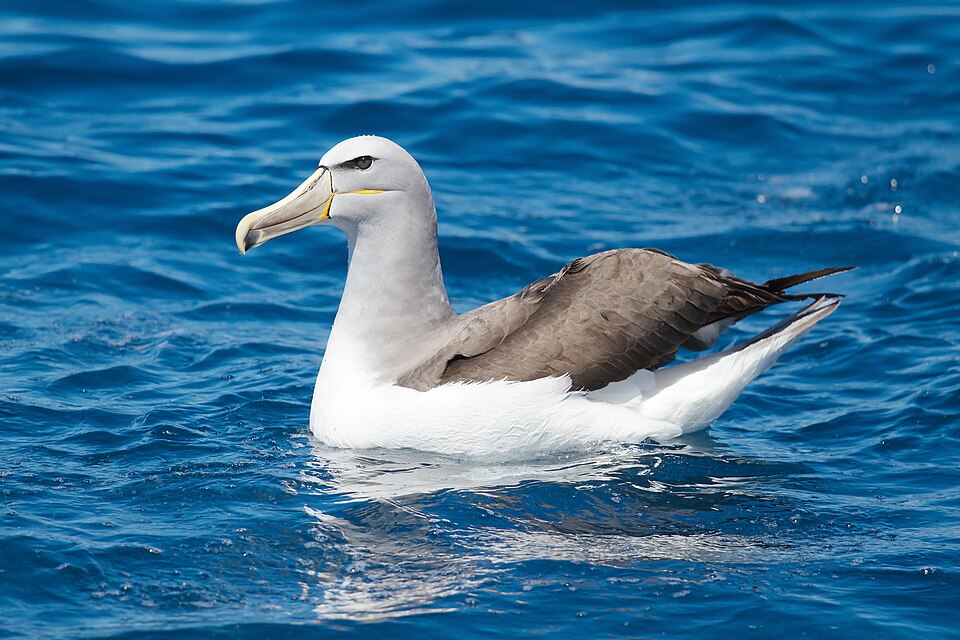
It is a medium-sized albatross that belongs to one group with Thalassarche cauta and Thalassarche eremita [7]. An adult seen in 2006 off Argentine Patagonia had a grey head, mantle and back, a pale grey crown and chin, a white rump and underside, and black upperwings; its bill was pale grey with a yellow ridge, a blackish tip to the lower mandible and a fairly bright yellow tip to the upper one, markings that showed it was an adult [8].
A bird seen in 2001 on Gonzalo Island, in the Diego Ramírez archipelago, had a grey head and neck with a paler forehead, a thin dark line above the eye, pale yellow on the top edge and lower part of the bill and blackish-yellow sides to the bill, a feature of an older juvenile or a subadult; an orange line could be made out at the base of the mandible [2]. In another subadult, observed in 2019 on the Patagonian shelf, that narrow line of orange skin at the base of the bill became very obvious when it opened its bill to feed [7].
Distribution and habitat
It breeds almost exclusively in New Zealand. For 2013 the breeding population was put at 39995 pairs, 99 % of them in the Bounty Islands and the rest, about 1000 pairs, in the Snares and possibly the Chatham Islands; in 1986, 4 pairs were also recorded in the Crozet archipelago in the Indian Ocean [7]. In the Western Chain of the Snares it nests on only 2 islets, Toru and Rima, where between 1100 and 1200 pairs were counted each year from 2008 to 2010 [9]. The Bounty Islands, 760 km east of the New Zealand mainland, are 22 outcrops of bare granite totalling 135 ha [10].
While breeding, adults are found mainly over the eastern shelf of New Zealand, between 38° S and 50° S [7]. Outside that season many cross the Pacific: on 15 cruises made between 1980 and 1995 off Chile and Peru, 475 individuals were logged, spread along the length of the current system and favouring waters over the continental slope; in the southern autumn their range leaned to the north, and in spring to the south [4]. According to that study's models, the Humboldt Current system held up to about 133100 birds of the species [4].
It has also been seen far from these areas, for instance at the Diego Ramírez Islands near Cape Horn in 2001 [2], 29 km off Puerto Deseado on the Argentine Patagonian shelf in 2006 [8], and again in waters of that shelf, beside freezer trawlers, in 2019 [7].
Biology
In the Western Chain most adults breed every year: of 71 banded birds whose breeding status was recorded in every year from 2008 to 2010, 51 (71.8 %) bred in all 3 years [9]. There, laying starts on average around 27 August and is over by the first week of October, according to an earlier estimate the authors cite [9].
On Proclamation Island, in the Bounties, hatching in 1997 ran from 5 to 21 November, with an estimated median date of 15 November; of 70 nests checked daily over that period, 24 (34.3 %) failed [10]. Assuming an incubation of 73 days, as in Thalassarche cauta, the authors work out that most eggs are laid between 24 August and 14 September [10].
It is a long-lived bird. In the Western Chain the yearly survival of breeding adults was estimated at 0.967, giving an average breeding life of 29.8 years and placing it among the highest values measured in albatrosses that breed every year [9]. A bird ringed as a chick in the Bounties in 1985 turned up nesting in the Western Chain, 930 km away, the first documented case of a ringed bird of this species reproducing outside the island where it hatched [9].
Ecology
In the Peru Current it is part of the group of birds that arrive in winter from Antarctic and sub-Antarctic latitudes and that feed mostly on carrion or on prey caught at the surface [11].
Off Peru, during two surveys in 2019, its presence overlapped in space with that of cephalopods, and was linked to warmer, saltier water, lower latitudes and lesser depth, unlike Thalassarche bulleri and Thalassarche eremita, which were tied more to waters farther from the shelf edge [12].
It also takes advantage of fishery discards. Beside the small-scale boats that fish for jumbo squid (Dosidicus gigas) in southern Peru, this species was seen eating offal discarded by the fishers in 27 % of cases, a higher share than for all the birds observed together, close to 17 % [13].
Conservation
Its global category is Vulnerable [5]. In Peru it is classified as Vulnerable, and the regulation that lists it prohibits the hunting, capture, possession, trade, transport and export for commercial purposes of the species included [6].
On Proclamation Island, the whole-island total was 3065 pairs in 1997 and 2634 in 2004, 14 % fewer, and in the sectors that can be compared across the entire period the fall reached 30 % between 1997 and 2011; in one sector of Depot Island the drop was 10 % between 2004 and 2011 [10]. As a result of this decrease, New Zealand raised its national threat ranking from vulnerable to critical [10].
There are no introduced plants or animals on the Bounties; as possible causes of the decline the authors point to disturbance of the colonies by the fur seal Arctocephalus forsteri, bycatch and competition with commercial fishing, and climate changes that alter its prey, without being able to separate the weight of each [10]. In New Zealand, captures and deaths of the species have been documented on pelagic and bottom longlines and in trawl nets [7].
The authors of the 1980 to 1995 study warned of a risk to it from the longline fishery then newly opened over the Chilean continental slope, because it feeds in those same waters and is drawn to fishing boats [4]. In southern Peru, on 16 small-scale squid-fishing trips with observers on board between 2015 and 2017, not one bird of this species was caught [13]. The Management Plan of the Dorsal de Nasca National Reserve regards the fishing done in the reserve as a potential threat to it [3].
Where to see it in Peru
On two at-sea surveys made in the autumn and spring of 2019, between 6° S and 18° S and from the coastline out to 100 nautical miles, 249 individuals were counted; they were found mostly along the edge of the continental shelf in the north and centre, between 7° S and 12° S, were most numerous from April to June, when 85.7 % were adults, and less abundant from October to December, when 62.5 % were subadults [12].
Between October 2015 and April 2017, aboard squid boats in southern Peru, 86 % of the individuals were seen over the continental slope, and they were nearly absent in summer [13]. According to the 2024 Management Plan, there is evidence of its presence in the Dorsal de Nasca area mainly from April to June and from July to September, from sightings on IMARPE cruises and from birds tracked by GPS [3].
References (13)
- WoRMS Editorial Board (2026). Thalassarche salvini (Rothschild, 1893). World Register of Marine Species. https://www.marinespecies.org/aphia.php?p=taxdetails&id=567903 (accessed 2026-10-20)
- Arata, J. (2003). New record of Salvin’s albatross (Thalassarche salvini) at the Diego Ramirez Islands, Chile. Notornis, 169-171. doi:10.63172/616564phyycc (accessed 2026-10-20)
- Servicio Nacional de Áreas Naturales Protegidas por el Estado (SERNANP) (2024). Plan Maestro de la Reserva Nacional Dorsal de Nasca 2024-2029. SERNANP; aprobado por RP N.° 000040-2024-SERNANP. https://cdn.www.gob.pe/uploads/document/file/5997712/5313081-anexo.pdf (accessed 2026-10-20)
- Spear, L.B., Ainley, D.G., Webb, S.W. (2003). Distribution, abundance and behaviour of Buller’s, Chatham Island and Salvin's Albatrosses off Chile and Peru. Ibis, 253-269. doi:10.1046/j.1474-919X.2003.00151.x (accessed 2026-10-20)
- BirdLife International (2018). Thalassarche salvini: BirdLife International. The IUCN Red List of Threatened Species 2018: e.T22698388A132644161. doi:10.2305/IUCN.UK.2018-2.RLTS.T22698388A132644161.en (accessed 2026-10-20)
- Ministerio de Agricultura y Riego (2014). Decreto Supremo N.° 004-2014-MINAGRI: actualización de la lista de clasificación y categorización de las especies amenazadas de fauna silvestre legalmente protegidas. El Peruano (08-04-2014); ficha en SINIA, Ministerio del Ambiente. https://sinia.minam.gob.pe/normas/lista-especies-amenazadas-fauna-silvestre-legalmente-protegidas (accessed 2026-10-20)
- Dellacasa, R.F., Chavez, L.N., Tamini, L.L. (2022). Salvin's Albatross Thalassarche salvini Interacting with Freezer Trawlers in Waters of the Patagonian Shelf. Marine Ornithology, 99-102. doi:10.5038/2074-1235.50.1.1465 (accessed 2026-10-20)
- Seco Pon, J.P., Weinecke, B., Robertson, G. (2007). First record of Salvin’s albatross (Thalassarche salvini) on the Patagonian Shelf. Notornis, 49-51. doi:10.63172/672134jtrlad (accessed 2026-10-20)
- Sagar, P.M., Charteris, M.R., Carroll, J.W.A. et al. (2011). Population size, breeding frequency and survival of Salvin’s albatrosses (Thalassarche salvini) at the Western Chain, The Snares, New Zealand. Notornis, 57-63. doi:10.63172//817994itflbl (accessed 2026-10-20)
- Sagar, P.M., Amey, J., Scofield, R.P. et al. (2015). Population trends, timing of breeding and survival of Salvin’s albatrosses (Thalassarche salvini) at Proclamation Island, Bounty Islands, New Zealand. Notornis, 21-29. doi:10.63172/558915nwiqgi (accessed 2026-10-20)
- Spear, L.B., Ainley, D.G. (2008). The Seabird Community of the Peru Current, 1980-1995, with Comparisons to Other Eastern Boundary Currents. Marine Ornithology, 125-144. doi:10.5038/2074-1235.36.2.781 (accessed 2026-10-20)
- Quiñones, J., Alegre, A., Romero, C. et al. (2021). Fine-Scale Distribution, Abundance, and Foraging Behavior of Salvin's, Buller's, and Chatham Albatrosses in the Northern Humboldt Upwelling System. Pacific Science, 85-105. doi:10.2984/75.1.4 (accessed 2026-10-20)
- Moreno, C., Quiñones, J. (2022). Albatross and Petrel Interactions with an Artisanal Squid Fishery in Southern Peru during El Niño, 2015-2017. Marine Ornithology, 49-56. doi:10.5038/2074-1235.50.1.1459 (accessed 2026-10-20)