
Marine life guide of Peru · Arhynchobatidae
Shorttail Fanskate
Sympterygia brevicaudata (Cope, 1877)
- Names in Peru
- Raya · Chilca skate · Chunchito · Chuncho · Pastelillo · Raya espinosa · Raya serrucho · Spine skate
Species account
Summary
Sympterygia brevicaudata is a skate of the family Arhynchobatidae, in the order Rajiformes [1]. It is known from the coasts of the Southeast Pacific, from Ecuador to central Chile, and appears on the updated list of chondrichthyans of the Peruvian sea [2],[3]. Its females fasten their egg capsules to algae and other objects with long tendrils [2]. A study based on specimens bought at Peruvian ports calls it «raya espinosa» [4]. Its global category on the IUCN Red List is Near Threatened [5].
Identification and similar species
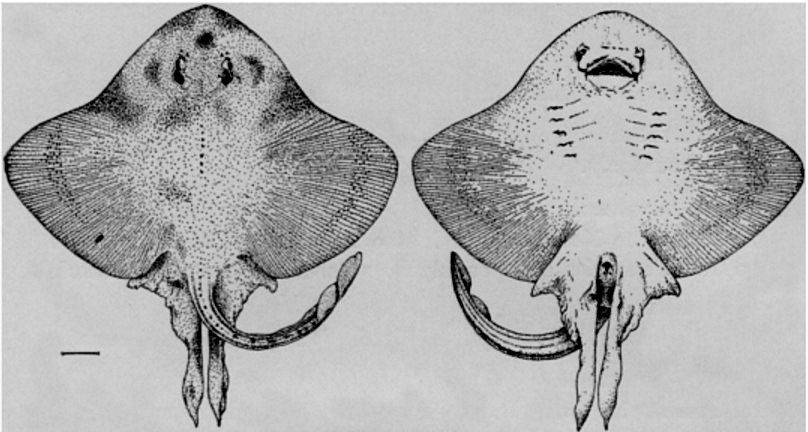
It is a small skate: descriptions used in Chile say it does not exceed 38 cm in total length, that its pelvic fins are markedly concave, that the tail is shorter than the rest of the body and that it has a spine between the two dorsal fins [6].
Its skin is not covered all over: the back has partial cover, with a patch of denticles behind the pectoral fins, and the underside has a row of denticles from the tip of the snout to the anterolateral edge [4]. It has several types of denticles and, in addition, malar, orbital, alar and caudal thorns, so its skin is not uniform [4].
In Peru an adult female of 475 mm total length was measured, bought at the Pacasmayo fishing terminal, that is, longer than the maximum of 38 cm cited in the Chilean descriptions [4],[6].
Similar species
- Rostroraja velezi: Rostroraja velezi is a skate of another family, Rajidae, with more alar thorns than Sympterygia brevicaudata, grouped in a triangular patch, and with the denticles of the back apparently all alike, whereas the skin of Sympterygia brevicaudata combines several types of denticles [4].
Distribution and habitat
It lives in coastal waters from Ecuador to central Chile [2]. It is on the list of chondrichthyans of the Peruvian sea [3]. In Chile its capsules have been collected from Arica to Taltal [6], and in Coquimbo Bay, at about 29° 57' S, they washed up after a storm [2].
What is known of its habitat comes mostly from the capsules. In northern Chile capsules were found between 3 and 10 m deep, and brown algae of the genus Lessonia are one of the supports where the tendrils get tangled; capsules were also seen stuck to ropes, remains of fishing nets and pier bases [6].
Biology
It reproduces by mating with internal fertilisation and is oviparous: the female lays barrel-shaped, brown egg capsules with two horns in front and two behind; the rear ones lengthen into tendrils that tie the capsule to its support [6]. In the capsules examined, each held a single embryo [6].
In a study in northern Chile, 72 capsules were kept in aquaria with water at 14–18 °C; 32 hatched (44.4 %) after about 7 months and the young averaged 5.2 cm at birth [6]. The authors distinguished 7 stages of late development; in stage IV the primordia of the spines of the back and tail are seen, and in stage VI the spines appear; the external yolk sac is absorbed late compared with other skates [6].
In Peruvian specimens, the caudal thorns of neonates differed significantly in length, width and height from those of juveniles and adults, while the denticles of juveniles and adults did not differ, which suggests that the skin becomes armed early [4].
Ecology
What it eats at sea has not been described; in captivity it accepted crustaceans and small fishes, and the authors suppose it would be mainly a crustacean-eating carnivore, like other species of its genus [6].
The capsules, by contrast, are well studied. Of 241 capsules stranded in Coquimbo Bay, 70.5 % had already hatched, 32.8 % had predation marks and 78 % had organisms attached, and among those not yet hatched the probability of marks was 0.54, against 0.24 in the hatched ones [2]. On a beach in Arica, this and another skate species appeared in mass strandings of capsules over a year, and the cause is not well understood [6].
Conservation
Its global category on the IUCN Red List is Near Threatened [5].
Little is known of its biology despite its wide distribution in the South Pacific [6]. In Peru, landings of chondrichthyans are usually recorded under a commercial name rather than by species, and the National Plan of Action for Sharks, Rays and Related Species, of 2014, improved that record but did not solve it [4].
Human relevance
The Peruvian specimens studied were bought between 2014 and 2019 from the small-scale fishery, at ports and fishing terminals along the coast [4]. In the north of the country there is high demand for fresh and dried skate meat for dishes such as sudado de raya, tortilla de raya and chinguirito, although that study says this of skates in general, not of this species [4].
Where to see it in Peru
The Peruvian literature consulted does not point to any place where it can be observed at sea. Specimens of this species are known through landings: between 2014 and 2019 skates were bought at ports and fishing terminals on the Peruvian coast, and the adult female photographed was acquired at the Pacasmayo terminal [4]. The species is on the list of chondrichthyans of the Peruvian sea [3].
References (6)
- Froese, R., Pauly, D. (2026). Sympterygia brevicaudata (Cope, 1877). World Register of Marine Species. https://www.marinespecies.org/aphia.php?p=taxdetails&id=315723 (accessed 2026-10-21)
- Seguel, M.E., Ramírez-Rivera, S., Concha, F. et al. (2022). Predation and epibiosis on egg capsules of the Shorttail fanskate, Sympterygia brevicaudata. Revista de Biología Marina y Oceanografía, 20-28. doi:10.22370/rbmo.2022.57.Especial.3314 (accessed 2026-10-21)
- Cornejo, R., Vélez-Zuazo, X., González-Pestana, A. et al. (2015). An updated checklist of Chondrichthyes from the southeast Pacific off Peru. Check List, 1809. doi:10.15560/11.6.1809 (accessed 2026-10-21)
- Sánchez-Rea, A., Kanagusuku, K. (2022). Caracterización morfológica preliminar de las estructuras dérmicas de tres especies de batoideos (Chondrichthyes: Batoidea) en el litoral peruano. Revista de Biología Marina y Oceanografía, 80-94. doi:10.22370/rbmo.2022.57.Especial.3334 (accessed 2026-10-21)
- Dulvy, N.K., Acuña, E., Bustamante, C. et al. (2019). Sympterygia brevicaudata: Dulvy, N.K., Acuña, E., Bustamante, C., Cevallos, A., Concha, F., Herman, K. & Velez-Zuazo, X. The IUCN Red List of Threatened Species 2020: e.T44596A124434224. doi:10.2305/IUCN.UK.2020-3.RLTS.T44596A124434224.en (accessed 2026-10-21)
- Méndez-Abarca, F., Pepe-Victoriano, R., Mundaca, E.A. (2024). Morfología de los estados embrionarios tardíos y cápsula ovígera de Sympterygia brevicaudata (Rajiformes: Arhynchobatidae) en el norte de Chile. Revista de Biología Marina y Oceanografía, 234-242. doi:10.22370/rbmo.2024.59.3.4929 (accessed 2026-10-21)