
Marine life guide of Peru · Laridae
South American tern
Sterna hirundinacea Lesson, 1831
- Names in Peru
- Gaviotín sudamericano
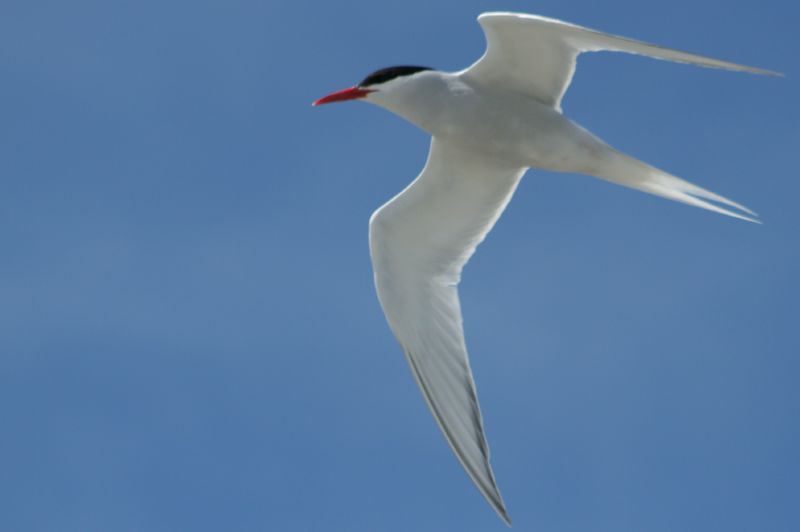
Species account
Summary
Sterna hirundinacea is a tern of the family Laridae described by Lesson in 1831 [1]. In Peru it is called «gaviotín sudamericano» [2]. It is a seabird of the coasts of South America: on the Atlantic side it lives from Brazil to Cape Horn, the Falkland Islands included, and on the Pacific side it reaches Ecuador [3]. The IUCN Red List classifies it as Least Concern [4], while Peru's official list of threatened wildlife approved in 2014 lists it as Critically Endangered [5].
Etymology
Lesson described the species in 1831, in his Traité d'Ornithologie, from specimens held at the National Museum of Natural History in Paris, and gave the coasts of Brazil as the type locality [6]. His short diagnosis, a grey and white bird with a black cap, yellow tarsus and coral-red bill, is enough to recognise a breeding adult [6].
Because Lesson designated no holotype, the specimens he used are syntypes: one was collected by Augustin de Saint-Hilaire in 1820 at Laguna, in the Brazilian state of Santa Catarina, and another probably comes from the coast of Rio de Janeiro [6]. To settle the doubt, the Laguna specimen was designated as lectotype in 2013; should Pacific birds one day prove genetically isolated, the name Sterna hirundinacea would be kept for the populations of Brazil and Patagonia [6].
Identification and similar species
In the breeding season the adult has pale grey upperparts that contrast with a black cap, and a vermilion bill; outside the breeding season the forehead and crown turn white and the bill becomes blackish or dull red [6]. In the birds Coker collected in Peru the bill was a deep blood red and the tarsus a brighter red, and in one of them the outer third of the upper mandible was almost black [7].
Chicks hatch in cryptically coloured down and soon grow their feathers; in southern Chile they reach fledgling plumage in January [3]. In Brazil both eggs and chicks are dark and blend in with the surroundings of the nest [8].
Similar species
- Sternula lorata: Its plumage pattern is very similar, but it is a much smaller bird; Coker saw it mostly in Paracas Bay [7].
Distribution and habitat
It breeds on coastal islands of southern Peru and south-eastern Brazil, and south to Tierra del Fuego, in Argentina and Chile, as well as the Falkland Islands; in the austral winter birds from the far south move north to Uruguay and Brazil, and on the Pacific side the species winters north to Ecuador [6]. The northernmost known colony on the South American Pacific coast is on Isla Vieja, in southern Peru, at about 14° S [9].
In Peru its main colonies are on the islands of the Paracas National Reserve, although no population estimates exist [3]. Early in the last century it was very common, above all on the southern coast, and the main breeding sites Coker observed were San Gallán Island and the Santa Rosa Islands, in Independencia Bay [7].
It nests mainly on sandy beaches and rocky shores, on islets or in crevices of cliffs [9]. Although it is a coastal bird, in Argentina it has been seen on inland lakes, and in 2020 a colony of 126 nests was found on an islet in Lake Epecuén, a hypersaline lake in Buenos Aires Province [10].
Biology
On the Pacific side there seem to be two breeding calendars: from May to July, with late cases into August, in Ecuador, Peru and northern Chile, and from November to January in southern Chile [3]. The Atlantic is similar, with austral-winter breeding in Brazil and austral-summer breeding in Patagonia, and a genetic study found little differentiation between the two populations despite that separation in time [11].
In Peru, Coker found active colonies in midwinter, on San Gallán Island on 25 June and on the Santa Rosa Islands on 18 July 1907 [7]. On south Santa Rosa, a low, flat-topped island, nests lay so close together on the ground and the eggs were so well hidden among the pebbles that it was almost impossible to walk without breaking them; the chicks, however, ran off quickly and became almost invisible beside the gravel [7].
On the Caicura Islands, in southern Chile, breeding was followed for 3 seasons, from 2013-14 to 2015-16: laying started in November, chicks appeared in December and fledglings in January [3]. Of the nests, 64.2% held a single egg, and hatching improved every year, from 41.2% in the first season to 62.5% in the second and 82.8% in the third [3].
There the birds laid in cracks and hollows of the rock without building a proper nest, except on the few patches of vegetation [3]. In La Herradura Bay, Coquimbo, northern Chile, the species has bred since 2011 on anchored boats, in nests of dried seaweed, twigs, dry grass and fragments of mussel shell, but almost without success: in 2015 and 2017 every nest was empty before the season ended, and a Chimango Caracara (Phalcoboenus chimango) was seen preying on a chick [9].
Ecology
It feeds mainly on small pelagic fish caught by plunge diving, and also on small decapod crustaceans, insects and fish scraps thrown overboard by fishing boats [3]. The two stomachs Coker examined in Peru held mostly small fish, in particular Peruvian anchoveta (Engraulis ringens) [7].
On the Atlantic coast of Uruguay, 844 pellets gathered outside the breeding season, in 2005 and 2006, were analysed: fish weighed most in the diet (88%), followed by insects (9%) and crustaceans (3%), and the most important prey was the Argentine anchovy (Engraulis anchoita), with 77.7% of the index of relative importance [12]. At Lake Epecuén, which has no fish, adults were seen catching grasshoppers over grassland and passing them to their fledglings, sometimes in mid-air [10].
In northern Chile and southern Peru, coastal upwelling that persists all year lets it find food near the colonies in any season, which could explain why it breeds there in autumn and winter [9]. At Mar del Plata, Argentina, a young Kelp Gull (Larus dominicanus) stole from it in mid-air a 10 cm fish it had taken from the discards of a fishing boat [13].
The Kelp Gull was also the main predator of eggs and chicks on the Caicura Islands [3]. On Ilha dos Cardos, in southern Brazil, where that gull does not breed, most chick deaths came from natural causes (2003, 63.17%; 2005, 81.41%; 2006, 79.96%) and the rest from predation [8].
Conservation
Its global category on the IUCN Red List is Least Concern [4]. In Peru it is classified as Critically Endangered, and the regulation that lists it prohibits hunting, capture, possession, trade, transport and export for commercial purposes of the listed species [5].
Even so, its population is thought to be declining, mainly because of human disturbance at nesting sites, such as egg collecting and unregulated tourism, predation by invasive alien species such as the American mink (Neovison vison), and growing numbers of natural competitors and predators such as the Kelp Gull [3]. In Chile it has been proposed as vulnerable from 42° S northwards [3].
In Peru early in the last century, Coker blamed the disappearance or decline of birds on many guano islands mostly on the way people treated them; on the Santa Rosa Islands, where this tern was abundant, he judged it likely that sea lions did the birds little harm until the working of the islands began [7].
Health, toxicological and chemical relevance
Not medical advice. For a sting, a poisoning or an allergy, seek medical care.
In Brazil, among surveillance records of highly pathogenic avian influenza H5N1, the South American tern was one of the most sampled birds, with 30 records, of which 26.7% tested positive [14]. Its presence in a municipality was associated with outbreaks, with an odds ratio of 20.86, and its areas of highest concentration, in the south of the country, were among those that overlapped most with outbreaks [14].
The authors of that study suggest that coastal birds like this one, whose continuous range runs from the Peruvian coast to Tierra del Fuego on the Pacific and from Patagonia to Brazil on the Atlantic, may have helped the H5N1 virus spread from south to north along the Atlantic coast [14].
Human relevance
Coker studied Peru's guano birds for their economic value and noted that this tern, which barely touches the water surface when catching its fish and may benefit greatly from sea lions, produced little guano on the Santa Rosa Islands, where it was abundant [7].
At Mar del Plata, Argentina, it attends the discards of the coastal fishing fleet, although it was only an occasional member of the flocks following the boats, with an annual frequency of occurrence of 1.38% [13]. In Chile it has even bred on boats anchored in a bay, a use of human structures that is new for the species [9].
Where to see it in Peru
In bird censuses on the beaches of San Andrés, Pisco, on the northern edge of the buffer zone of the Paracas National Reserve, a total of 1093 South American terns were counted in the January 2023 census and 263 in the December 2024 one [15]. Further north, the species is among the 158 birds recorded between 2015 and 2020 in Los Manglares de Tumbes National Sanctuary [2].
Its known breeding sites in Peru are islands: those of the Paracas National Reserve [3] and, according to observations from 1907, San Gallán Island and the Santa Rosa Islands, in Independencia Bay [7].
References (15)
- WoRMS Editorial Board (2026). Sterna hirundinacea Lesson, 1831. World Register of Marine Species. https://www.marinespecies.org/aphia.php?p=taxdetails&id=225979 (accessed 2026-10-20)
- Servicio Nacional de Áreas Naturales Protegidas por el Estado (2023). Plan Maestro del Santuario Nacional Los Manglares de Tumbes 2023-2027. SERNANP, RP N.° 064-2023-SERNANP. https://cdn.www.gob.pe/uploads/document/file/4137567/RESOLUCION%20PRESIDENCIAL%20N%20064-2023-SERNANP.pdf.pdf (accessed 2026-10-20)
- Jaime Cursach Valenzuela, Vilugrón, J., Rau, J.R. (2021). Nidificación del gaviotín sudamericano (Sterna hirundinacea) en islas Caicura (41° S), Seno de Reloncaví, sur de Chile. Anales del Instituto de la Patagonia, 49:6. doi:10.22352/AIP202149006 (accessed 2026-10-20)
- BirdLife International (2018). Sterna hirundinacea: BirdLife International. The IUCN Red List of Threatened Species 2018: e.T22694618A132562410. doi:10.2305/IUCN.UK.2018-2.RLTS.T22694618A132562410.en (accessed 2026-10-20)
- Ministerio de Agricultura y Riego (2014). Decreto Supremo N.° 004-2014-MINAGRI: actualización de la lista de clasificación y categorización de las especies amenazadas de fauna silvestre legalmente protegidas. El Peruano (08-04-2014); ficha en SINIA, Ministerio del Ambiente. https://sinia.minam.gob.pe/normas/lista-especies-amenazadas-fauna-silvestre-legalmente-protegidas (accessed 2026-10-20)
- Carlos, C.J., Voisin, J.-F. (2013). The type locality of the South American Tern, Sterna hirundinacea (Aves: Charadriiformes: Sternidae), with designation of a lectotype. Zoologia (Curitiba), 356-358. doi:10.1590/S1984-46702013000300017 (accessed 2026-10-20)
- Coker, R.E. (1919). Habits and economic relations of the guano birds of Peru. Proceedings of the United States National Museum, 449-511. doi:10.5479/si.00963801.56-2298.449 (accessed 2026-10-20)
- Fracasso, H.A.A., Branco, J.O., Efe, M.A. et al. (2014). Reproductive Dynamics of Sterna hirundinacea Lesson, 1831 in Ilha dos Cardos, Santa Catarina, Brazil. Scientifica, 1-16. doi:10.1155/2014/907549 (accessed 2026-10-20)
- Portflitt-Toro, M., Miranda-Urbina, D., Fernández, C. et al. (2018). Breeding of the South American Tern (Sterna hirundinacea) on anchored boats in Coquimbo, northern Chile. Ornitología Neotropical, 187-191. doi:10.58843/ornneo.v29i1.312 (accessed 2026-10-20)
- Castro, V., Abut, J.J., Preisz, S. et al. (2021). Reproducción del Gaviotín Sudamericano Sterna hirundinacea (Charadriiformes: Laridae) en el Lago Epecuén, Buenos Aires, Argentina. Acta Zoológica Lilloana, 173-181. doi:10.30550/j.azl/2021.65.2/2021-06-10 (accessed 2026-10-20)
- Faria, P.J., Campos, F.P., Branco, J.O. et al. (2010). Population structure in the South American tern Sterna hirundinacea in the South Atlantic: two populations with distinct breeding phenologies. Journal of Avian Biology, 378-387. doi:10.1111/j.1600-048X.2009.04902.x (accessed 2026-10-20)
- Alfaro, M., Mauco, L., Norbis, W. et al. (2011). Temporal variation on the diet of the South American Tern (Sterna hirundinacea, Charadriiformes: Laridae) on its wintering grounds. Revista Chilena de Historia Natural, 451-460. doi:10.4067/S0716-078X2011000300011 (accessed 2026-10-20)
- Seco Pon, J.P., Morettini, A. (2009). Kleptoparasitism by Kelp Gull Larus dominicanus on Common Tern Sterna hirundo and South American Tern S. hirundinacea attending coastal fisheries in Mar del Plata, Argentina. Marine Ornithology, 291-292. doi:10.5038/2074-1235.37.3.862 (accessed 2026-10-20)
- Hernández-Ortiz, B.A., dos Santos, T.A., Appolinário, C.M. et al. (2026). Spatial association of seabirds and aquatic birds with highly pathogenic avian influenza (H5N1) outbreaks in Brazil: A nationwide ecological and statistical modelling approach. PLOS One, e0350505. doi:10.1371/journal.pone.0350505 (accessed 2026-10-20)
- Pulido-Capurro, V. (2025). Las aves de la orilla marina de San Andrés, Pisco, Ica. The Biologist (Lima), 55-70. doi:10.62430/rtb20252311926 (accessed 2026-10-20)