
Marine life guide of Peru · Squatinidae
Pacific angel shark
Squatina californica Ayres, 1859
- Names in Peru
- Angelote
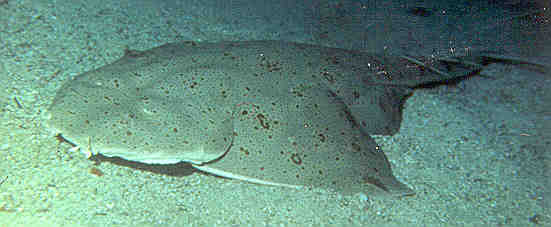
Species account
Summary
Squatina californica is a flattened shark of the family Squatinidae, in the order Squatiniformes [1]. Angel sharks are benthic sharks that look somewhat like rays [2]. Its global category on the IUCN Red List is Vulnerable [3]. In Peru it appears on the list of chondrichthyans of the Peruvian sea [4], but a DNA study of specimens from the north of the country showed that distinct lineages have been grouped under that name, one of them perhaps still undescribed [2].
Etymology
Ayres described it in 1859 from a single specimen of about 96 cm, sex not determined, collected in San Francisco Bay, United States, in September 1857 [2]. To tell it apart he compared that specimen with Squatina dumeril and noted differences in the shape of the orbits, teeth, pectoral fins, pelvic fins and dorsal fin, and in the number of teeth [2].
Identification and similar species
It is an angel shark: benthic, and ray-like in appearance [2]. In northern Peru, a pup attributed to this species had a reddish-brown back with scattered light spots, pectoral and pelvic fins with a white edge, thorns, and pale dorsal fins [2]. That pup was identified following an illustrated guide [2]. The authors note that, besides the two original descriptions, no study compares the two Eastern Pacific species directly [2].
Identification by eye is unreliable in northern Peru. Three angel sharks collected at Máncora were identified in the field as Squatina californica, but DNA analysis separated them as Squatina sp., a lineage that could be a new species [2]. In the Gulf of California, specimens measured in the artisanal fishery reached 100 cm total length, whereas up to 152.4 cm has been cited for California [5].
Similar species
- Squatina armata: Squatina armata has a reddish-brown to almost black back, a white belly with dark brown edges on the pectoral and pelvic fins, narrow simple barbels, fringed anterior nasal flaps and thorns on the snout, between the eyes and spiracles [2]; the two names have been used for fish from the same stretch of coast and landing lists do not separate them [2].
Distribution and habitat
Its distribution is discontinuous, with one stretch running from southern Alaska down to the Gulf of California and another from Ecuador down to Chile [5]. The distribution table of a recent genetic study places it from Puget Sound to Baja California Sur and notes that its presence from Ecuador southward needs confirmation [2]. For Peru it has been cited in studies that also recorded it in Ecuador [2], and the checklist of Peruvian chondrichthyans includes it [4].
In California it has been found in shallow water, 3 to 46 m, and in the Gulf of California at 183 m; it tends to lie buried in mud and sand, and has also been seen beside rocks and in kelp forests [5]. In Peru, a pup of 23.7 cm total length was caught 805 m from the coast off Punta Pico, in Tumbes [2]. The DNA sequence of that pup formed a group of its own, separated from that of specimens from the United States and Mexico by a minimum genetic distance of only 0.49 % [2].
Biology
In a sample of 306 specimens landed between 1998 and 2005 in Sonora and Sinaloa, Mexico, half the females were mature at 74.41 cm total length and half the males at 77.82 cm [5]. Females in that sample measured 23 to 100 cm, and males 25 to 99 cm [5].
That size at maturity is about 74 % of the maximum length observed in females, and the author notes that intense exploitation may prevent individuals from reaching the sizes they once did [5]. Its low productivity is consistent with elasmobranch traits such as late maturity, low fecundity and long life [5], and it is described as having low resilience to fishing mortality [5].
Ecology
Conservation
Its global category on the IUCN Red List is Vulnerable [3].
In Peru, between 1996 and 2010 angel sharks made up 4 % of the sharks landed, 95 % of it in the north and 86 % with gillnets [6]. Its landings fell by 18.88 % a year between 2000 and 2010 [6]. Those records, which IMARPE entered as Squatina californica [2], appear from 2010 to 2019 as Squatina sp. in the figures of the Ministry of Production, which indicate a drop in Tumbes, Piura, Lambayeque and La Libertad [2].
Because landings group different species and there may be a lineage still undescribed, the figures may underestimate the decline of all the species on the Peruvian coast [2].
Human relevance
Before 1996 Peruvian landings were recorded under the common name «angelote» [2]. The angel shark is one of the six most landed sharks in the country, with 4 % of what was landed between 1996 and 2010 [6].
Of what was landed between 1996 and 2010, 86 % was caught with gillnets [6]. Landings are reported from small-scale fisheries, the fishery continues and detailed landing records of angel sharks in Peru are still lacking [2].
Where to see it in Peru
The Peruvian specimens in this study come from fisheries, not from direct observation: they were taken in 2017 and 2018 at markets and landing sites in the north of the country [2]. One pup was caught off Punta Pico, in Tumbes, and three specimens from Máncora, in Piura, turned out to be Squatina sp. [2]. Landing figures for 2010 to 2019 indicate a drop in the catch in the north (Tumbes, Piura, Lambayeque and La Libertad) [2].
References (6)
- Froese, R., Pauly, D. (2026). Squatina californica Ayres, 1859. World Register of Marine Species. https://www.marinespecies.org/aphia.php?p=taxdetails&id=271667 (accessed 2026-10-21)
- Cañedo-Apolaya, R.M., Ortiz-Alvarez, C., Alfaro-Cordova, E. et al. (2021). Species Delimitation of Southeast Pacific Angel Sharks (Squatina spp.) Reveals Hidden Diversity through DNA Barcoding. Diversity, 177. doi:10.3390/d13050177 (accessed 2026-10-21)
- Rigby, C.L., Ebert, D.A., Charles, R. (2024). Squatina californica: Rigby, C.L., Ebert, D.A. & Charles, R. The IUCN Red List of Threatened Species 2025-2: e.T39328A124401300. doi:10.2305/IUCN.UK.2025-2.RLTS.T39328A124401300.en (accessed 2026-10-21)
- Cornejo, R., Vélez-Zuazo, X., González-Pestana, A. et al. (2015). An updated checklist of Chondrichthyes from the southeast Pacific off Peru. Check List, 1809. doi:10.15560/11.6.1809 (accessed 2026-10-21)
- Márquez-Farías, J.F. (2020). Length at maturity of the Pacific angel shark (Squatina californica) in the artisanal elasmobranch fishery in the Gulf of California in Mexico. Fishery Bulletin, 359-364. doi:10.7755/fb.118.4.5 (accessed 2026-10-21)
- Gonzalez-Pestana, A., Kouri J., C., Velez-Zuazo, X. (2016). Shark fisheries in the Southeast Pacific: A 61-year analysis from Peru. F1000Research, 164. doi:10.12688/f1000research.4412.2 (accessed 2026-10-21)