
Marine life guide of Peru · Squatinidae
Chilean Angel Shark
Squatina armata (Philippi, 1887)
Species account
Summary
Squatina armata is an angel shark of the family Squatinidae, order Squatiniformes [1]. Its body is flattened from top to bottom, and it has been reported along the Pacific coast of South America, from Ecuador to Chile [2]. Its global category is Critically Endangered [3]. In northern Peru it has high commercial value, and targeted gillnet fishing, for its meat and its eggs, is one of its main threats [4].
Etymology
Philippi described it in 1887 under the name Rhina armata, and its type locality is Iquique, in northern Chile [2]. The holotype was lost when fire broke out in the building of the Faculty of Sciences of the Universidad Austral de Chile, where it was being kept for study [2]. For that reason, in 2024 a mature male of 1004 mm total length, caught at about 20 m depth near Iquique in June 2019 and held at the Museo Nacional de Historia Natural de Chile, was designated as the neotype [2].
Identification and similar species
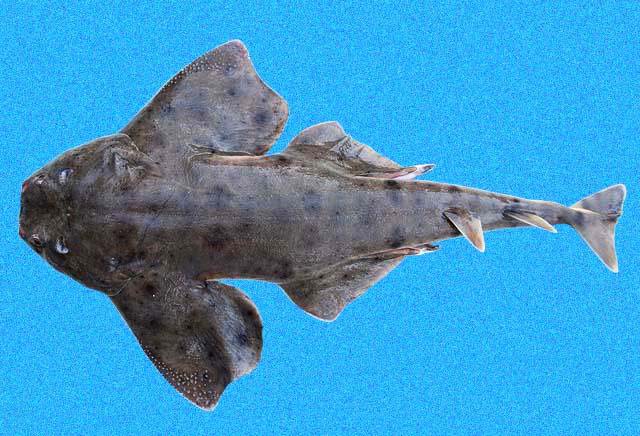
Its body is depressed from the head to the start of the tail fin; the pectoral fins are large and not joined to the head, and the mouth is wide and arched [2]. In the fresh neotype the back was dark greyish brown, dotted with small white spots and with pairs of large dark eyespots near the pelvic fins, at the tips of the pectorals and on the tail; the belly was whitish [2].
The head carries 4 pairs of patches of enlarged denticles: above the space between the nostrils, in front of the eyes, between each eye and its spiracle, and between the spiracles [2]. In the neotype, 36 thorns of similar size formed a single row along the back, with 1 in front of the pelvic girdle, 30 on the tail and 5 between the dorsal fins, and each pectoral fin bore at its apex a patch of hook-shaped thorns [2]. These pectoral patches are a secondary sexual character also found in mature males of other angel sharks [2]. Some earlier works draw it with a double row of dorsal thorns, whereas the 2 males studied had a single one; according to the authors, the difference could be due to phenotypic plasticity or to differences between sexes or ages [2].
The 2 mature males from Iquique measured 1004 and 1040 mm total length and weighed 10.01 and 11.63 kg [2]. In northern Peru, the 2 pregnant females examined measured 88.4 to 101.5 cm, and the 3 adult males 98.2 to 100.6 cm [4].
Similar species
- Squatina californica: Squatina armata has a head that is flat between the eyes with a concave front edge, softly wavy front edges to the pectoral fins, thorns on the head, back and tail, and a brown back with white dots and dark blotches; Squatina californica has a head that is concave between the eyes with a straight front edge, lacks those rows of thorns and is ash grey with whitish dots [2].
Distribution and habitat
It has been reported along the Pacific coast of South America from Ecuador to Chile, and it appears in the updated checklist of the cartilaginous fishes of the Peruvian sea [2],[5]. Its range limits with Squatina californica are unclear, and in northern South America, where both species may live side by side, the two are often confused [2]. A DNA barcoding study of angel sharks from northern Peru told three lineages apart there: Squatina armata, one assigned to Squatina californica, and a third that may be a species not yet described [6].
Angel sharks live on the continental shelf and favour soft bottoms, where they bury themselves to ambush prey [2]. The specimens studied in Chile were caught at about 20 m and 40 m depth [2]. Those from northern Peru came from a fishing area between Lambayeque and Piura, at depths of 4 to 84 m [4].
Biology
Like the rest of its family it is viviparous without a placenta: the embryos feed on yolk [4]. The first description of its embryos comes from Peruvian waters [7]: a pregnant female, caught incidentally in a bottom gillnet in southern Peru, carried 6 embryos with both an external and an internal yolk sac [4].
Between July 2022 and August 2023, 74 specimens, 43 females and 31 males, landed at San José, Lambayeque, were examined; 3 of the 5 reproductive stages were found in each sex [4]. No newborns and no females carrying young turned up, which the authors see as a possibly good sign that the fishery is not catching those stages [4].
The left ovary is clearly larger than the right, and the left testis also exceeds the right one [4]. An analysis of 76 specimens from the small-scale fishery confirmed this asymmetry in the ovary, uterus, testis and epididymis, and showed that all of these organs grow larger as the animal gets longer [8].
Ecology
The diet was analysed in 78 specimens caught between Punta Habid and Pacasmayo and landed at San José in 2022 and 2023: they ate mostly bony fishes and cephalopods, and crustaceans to a lesser extent [9]. The most important prey were the squid Doryteuthis gahi, the fishes Callaus deliciosa and Paralonchurus peruanus, and the anchovy Anchoa nasus [9].
Its estimated trophic level, 4.20, is that of a tertiary predator feeding on fish and squid [9]. The diets of males and females did not differ, and although the population behaved as an opportunist, some individuals favoured particular prey, such as Doryteuthis gahi [9].
In Ecuador, 320 angel sharks of 66 to 98.5 cm total length landed at Manta between November 2003 and October 2004 ate bony fishes, elasmobranchs, molluscs and crustaceans [10]. There the main prey were the shrimp Solenocera agassizii, lizardfishes of the genus Synodus and the shrimp Sicyonia picta, with no change in diet through the year [10].
Conservation
Its global category is Critically Endangered [3]. Angel sharks grow slowly, mature late and have low fecundity, and because they live in shallow coastal waters they are highly exposed to fishing and to habitat degradation; they are one of the most threatened orders of coastal cartilaginous fishes in the world [2],[2].
In Peru its main threats are targeted gillnet fishing, for its meat and its eggs, and incidental capture in trawls and gillnets [4]. Until 1996 landing statistics lumped all angel sharks together without separating species, and since then they have been recorded under the name Squatina californica; those landings fell by 18.9 % per year between 2000 and 2010 [11]. Species-level identification in these figures is still imprecise [4].
Human relevance
It is a species of high commercial value in northern Peru, and its eggs are used as well as its meat [4]. Between 1996 and 2010, angel sharks, recorded as Squatina californica, made up 4 % of the country's shark landings, and among the 7 main ports analysed 95 % of their landings were at the northern ones; between 1996 and 2000, 86 % were caught with gillnets [11].
Where to see it in Peru
Recent Peruvian studies rely on specimens from the small-scale fishery landed in 2022 and 2023 at the cove of San José, Lambayeque, caught between Lambayeque and Piura, including the islands of Lobos de Tierra and Lobos de Afuera [4], or between Punta Habid and Pacasmayo [9]. Between 1996 and 2010, 95 % of angel shark landings at the country's 7 main ports took place at the northern ones [11].
References (11)
- WoRMS Editorial Board (2026). Squatina armata (Philippi, 1887). World Register of Marine Species. https://www.marinespecies.org/aphia.php?p=taxdetails&id=271665 (accessed 2026-10-20)
- Kraft, S., Fernández-Cisternas, Í., Araya, M. et al. (2024). Redescription of the Chilean angel shark Squatina armata (Philippi, 1887) (Squatiniformes, Squatinidae). European Journal of Taxonomy 932, 112-137. doi:10.5852/ejt.2024.932.2515 (accessed 2026-10-20)
- Dulvy, N.K., Acuña, E., Bustamante, C. et al. (2020). Squatina armata: Dulvy, N.K., Acuña, E., Bustamante, C., Cevallos, A., Herman, K., Navia, A.F., Pardo, S.A. & Velez-Zuazo, X. The IUCN Red List of Threatened Species 2020: e.T44571A116831653. doi:10.2305/IUCN.UK.2020-3.RLTS.T44571A116831653.en (accessed 2026-10-20)
- Peña-Cutimbo, N., Cañedo-Apolaya, R.M., Cordero-Maldonado, C. et al. (2024). Biología reproductiva en soporte de la conservación: Primera descripción de algunos estadios reproductivos del angelote chileno Squatina armata (Phillipi, 1987). South Sustainability 5(2), e103. doi:10.21142/SS-0502-2024-e103 (accessed 2026-10-20)
- Cornejo, R., Vélez-Zuazo, X., González-Pestana, A. et al. (2015). An updated checklist of Chondrichthyes from the southeast Pacific off Peru. Check List 11(6), 1809. doi:10.15560/11.6.1809 (accessed 2026-10-20)
- Cañedo-Apolaya, R.M., Ortiz-Alvarez, C., Alfaro-Cordova, E. et al. (2021). Species Delimitation of Southeast Pacific Angel Sharks (Squatina spp.) Reveals Hidden Diversity through DNA Barcoding. Diversity 13(5), 177. doi:10.3390/d13050177 (accessed 2026-10-20)
- Campos-León, S., Kanagusuku, K., Zavalaga, F. et al. (2025). First description of the Chilean angel shark embryos, Squatina armata (Philippi, 1887) (Squatiniformes: Squatinidae) in Peruvian waters. Environmental Biology of Fishes 108, 429-436. doi:10.1007/s10641-025-01678-8 (accessed 2026-10-20)
- Peña-Cutimbo, N., Segura-Cobeña, E., Cañedo-Apolaya, R.M. et al. (2026). Morphometric Characterization of the Reproductive System of the Chilean Angelshark Squatina armata (Philippi, 1887). Journal of Morphology 287(5), e70134. doi:10.1002/jmor.70134 (accessed 2026-10-20)
- Garnique-Capuñay, D., Jimenez, A., Pingo, S. et al. (2025). New insights into the diet and feeding ecology of the South Pacific angelshark, Squatina armata (Philippi, 1887) from Peru. Journal of Fish Biology 108, 1138-1149. doi:10.1111/jfb.70291 (accessed 2026-10-20)
- Velázquez-Chiquito, V.M., Méndez-Macías, J.S., Estupiñán-Montaño, C. et al. (2021). Dietary ecology and trophic level of adults of the Chilean angel shark Squatina armata Philippi 1887 in the Central-Eastern Pacific Ocean. Regional Studies in Marine Science 43, 101675. doi:10.1016/j.rsma.2021.101675 (accessed 2026-10-20)
- Gonzalez-Pestana, A., Kouri J., C., Velez-Zuazo, X. (2016). Shark fisheries in the Southeast Pacific: A 61-year analysis from Peru. F1000Research 3, 164. doi:10.12688/f1000research.4412.2 (accessed 2026-10-20)