
Marine life guide of Peru · Sphyrnidae
Scoophead
Sphyrna media Springer, 1940
- Names in Peru
- Tiburón cabeza de pala
Species account
Summary
Sphyrna media is a small hammerhead shark of the family Sphyrnidae, in the order Carcharhiniformes [1]. It lives on the continental shelves of the Americas, in the western Atlantic and the eastern Pacific, and reaches a maximum of about 150 cm [2]. In Peru it appears in the updated checklist of the country's chondrichthyans, with a locality at Puerto Pizarro, Tumbes [3]. Its global category on the IUCN Red List is Critically Endangered [4].
Etymology
Springer described the species in 1940 in the Stanford Ichthyological Bulletin; the holotype is an adult male of 900 mm in the Stanford University collection, numbered SU-11583, and its type locality is Mazatlán, Sinaloa, in Mexico [2]. Sphyrna nana, a name proposed by Sadowsky in 1965, is a synonym [2]. The FAO catalogue of sharks gives it the English name scoophead and the Spanish name cornuda cuchara [2].
Identification and similar species
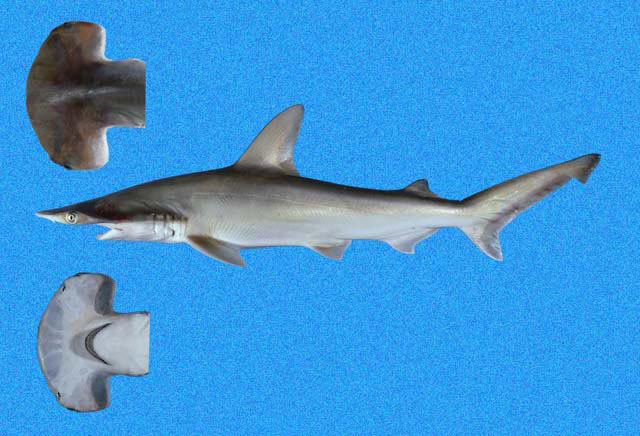
It is a small hammerhead with a mallet-shaped head of moderate width and a broadly arched front edge, only weakly notched at the centre and the sides [2]. The width of the head equals between 22 % and 33 % of the total length, the snout in front of the mouth is 1/3 to 2/5 of that width, the mouth is fairly large and broadly arched, and the grooves in front of the nostrils are absent or hardly developed [2]. The free rear tip of the first dorsal fin lies over the origin of the pelvic fins, and the anal fin has an almost straight rear edge [2].
The body is grey-brown above and pale below, and the fins carry no markings [2]. The FAO catalogue counts 101 to 196 vertebrae in total, and gives a maximum size of about 150 cm [2].
Similar species
- Sphyrna corona: Sphyrna corona has a rather long snout, about 2/5 of the head width, a small, strongly arched mouth, 135 to 140 vertebrae and is under 1 m [2].
- Sphyrna tiburo: Sphyrna tiburo has a shovel-shaped head with no notches on the front edge, flattened rear teeth like molars and often small dark spots on the flanks [2].
- Sphyrna lewini: Sphyrna lewini is a large hammerhead, over 3 m, with a very wide head and a prominent notch at the centre, grooves in front of the nostrils and dusky pectoral tips [2].
Distribution and habitat
According to the FAO catalogue, its range covers the coast between Panama and southern Brazil in the western Atlantic, and that between the Gulf of California and Ecuador in the eastern Pacific, with northern Peru as the probable limit [2]. The updated checklist of Peruvian chondrichthyans includes the species with a locality at Puerto Pizarro, Tumbes, taken from earlier Peruvian literature [3]. Its authors count it among the species whose record implies a likely range expansion, because the international literature they consulted had not previously reported them from Peruvian waters [3].
The FAO catalogue describes it as a little-known hammerhead of tropical coastal waters, typical of the continental shelves of the Americas [2].
Biology
Conservation
Human relevance
Where to see it in Peru
In Peruvian literature the species is known from a record at Puerto Pizarro, Tumbes, included in the checklist of Peruvian chondrichthyans published in 2015 [3]. That list gives no further data on where or when it has been found, and the FAO catalogue places it only as probable in northern Peru [2].
References (4)
- Froese, R., Pauly, D. (2026). Sphyrna media Springer, 1940. World Register of Marine Species. https://www.marinespecies.org/aphia.php?p=taxdetails&id=271379 (accessed 2026-10-21)
- Compagno, L.J.V. (1984). FAO species catalogue Vol. 4. Sharks of the world. An annotated and illustrated catalogue of shark species known to date. Part 2. Carcharhiniformes. FAO Fisheries Synopsis No. 125, Vol. 4, Part 2. FAO, Rome, 543-551. https://www.fao.org/4/ad123e/ad123e00.htm (accessed 2026-10-21)
- Cornejo, R., Vélez-Zuazo, X., González-Pestana, A. et al. (2015). An updated checklist of Chondrichthyes from the southeast Pacific off Peru. Check List, 1809. doi:10.15560/11.6.1809 (accessed 2026-10-21)
- Pollom, R., Avalos, C., Bizzarro, J. et al. (2019). Sphyrna media: Pollom, R., Avalos, C., Bizzarro, J., Burgos-Vázquez, M.I., Cevallos, A., Charvet, P., Espinoza, M., Faria, V., Herman, K., Mejía-Falla, P.A., Navia, A.F., Pérez-Jiménez, J.C., Rincon, G. & Sosa-Nishizaki, O. The IUCN Red List of Threatened Species 2020: e.T60201A3091753. doi:10.2305/IUCN.UK.2020-3.RLTS.T60201A3091753.en (accessed 2026-10-21)