
Marine life guide of Peru · Sciaenidae
Sciaena deliciosa
Sciaena deliciosa (Tschudi, 1846)
- Names in Peru
- Cholo · Lorna · Losna
Species account
Summary
Sciaena deliciosa is a fish of the family Sciaenidae from the coast of Peru; Tschudi originally described it as Corvina deliciosa [1]. WoRMS now accepts the name Sciaena deliciosa [2]. Hildebrand recorded the names lorna and cholo for it [1]. It is one of the main coastal fish species landed in the La Libertad region, in north-central Peru [3]. The IUCN rates it Least Concern [4].
Identification and similar species
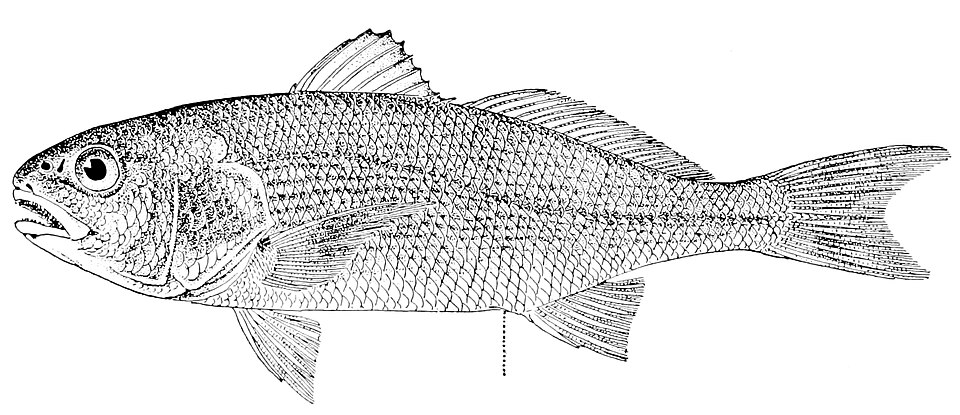
The body is quite elongate and compressed, with a moderately elevated back, and the snout is rather long and nearly conical, projecting beyond the mouth; the mouth is moderately large, slightly oblique and inferior, with the lower jaw shorter and the lips, maxillary and chin papillose [1]. The first dorsal fin has 10 spines (rarely 9) and the second 1 spine and 21 to 24 soft rays; the anal fin has 2 spines and 9 or 10 rays, the pectoral fin 18 rays (rarely 19), and the lateral line carries 57 to 62 scales [1].
The back is grayish with bluish metallic reflections and the belly silvery; the rows of scales along the side show fairly definite dark streaks, the fins are somewhat dusky (the pelvic ones lighter), and the axil of the pectoral fin is black [1]. The 9 specimens Hildebrand examined were 210 to 330 mm in total length [1]. FishBase gives a maximum length of 46 cm [5].
Similar species
- Sciaena callaensis: It is very similar, but in Sciaena callaensis the teeth of the upper jaw form a narrower band with a close-set outer series of enlarged teeth, and those of the lower jaw form two main series rather than a band [1].
Distribution and habitat
A feeding study in La Libertad describes its range as from Puerto Pizarro, in Peru, to Corral, in Chile (39°52' S), and places it in the benthopelagic zone of the continental shelf, over shallow sand and sand-and-rock bottoms, common in the area of the Peruvian Coastal Current [3]. Hildebrand noted that large quantities were landed between Puerto Pizarro and Chala, with Callao and Paita as the chief ports [1].
An old record from Panama Bay, based on a few specimens, had not been confirmed by recent collectors, according to Hildebrand in 1946 [1].
Biology
FishBase lists a length at first maturity of 23.9 cm [5]. The feeding study notes that no dedicated maturity-size studies exist for the species, so it separated juveniles (15 to 23 cm) from adults (24 cm or more) using the minimum catch size [3].
In monthly samplings from 2016 to 2019 in La Libertad, 2359 fish of 18 to 50 cm total length were examined, and only 766 stomachs held identifiable food [3]. The diet included 31 prey items; by the index of relative importance the Pacific sand crab Emerita analoga (42.2 %) and the Peruvian anchoveta Engraulis ringens (36.0 %) dominated, followed by a benthic worm and a brittle star [3].
Ecology
The authors describe it as a carnivorous, specialist predator of the benthopelagic zone, whose trophic level works out at 4.2, and with a narrow trophic niche (Levin's index of 0.066) [3]. Diet did not differ significantly between males and females, but it did between juveniles and adults and between seasons [3].
Among juveniles the most important prey was Emerita analoga (57.9 %); among adults it was Engraulis ringens (44.1 %) [3]. In summer, autumn and winter Emerita analoga was the main prey of both size classes, but in spring it was a worm for juveniles (97.3 %) and the anchoveta for adults (83.3 %) [3]. The study period included El Niño events (January to March 2016, February to April 2017 and January 2019) and a cold period from the spring of 2017 to June 2018 [3].
Conservation
The IUCN assessed the species in 2020 and rates it Least Concern globally [4].
It is the main landed species of the demersal-benthic group of Peruvian artisanal fisheries and the second most landed coastal fish in La Libertad [3]. The 2016 to 2019 study cites a minimum catch size of 24 cm, set by the Ministry of Production in 2001 [3].
Health, toxicological and chemical relevance
Not medical advice. For a sting, a poisoning or an allergy, seek medical care.
In 30 fish of 19 to 25 cm collected with the help of residents and fishers in Callao Bay, muscle averaged between 2.68 and 5.44 mg/kg of total arsenic depending on the station, above the 0.5 mg/kg reference value the authors used [6]. Mercury in muscle averaged between 0.12 and 0.25 mg/kg and exceeded the 0.2 mg/kg reference value at 2 of the 4 stations; cadmium stayed below 0.15 mg/kg [6].
The authors calculated a hazard index (HI) for eating this fish, assuming an intake of 50 g a day, which exceeded the value of 1 at all four stations, for both adults and children; a value of 1 or more indicates a possible non-cancer risk [6]. In their conclusions they note that arsenic, mercury and lead in the muscle exceeded at least one international standard. The calculations assume that only 10 % of the arsenic is inorganic, because speciation was not measured, and they come from a single bay [6].
Human relevance
Hildebrand described it in 1946 as a highly prized food fish, of which rather large quantities were landed between Puerto Pizarro and Chala [1]. He cited a mission report stating that it was caught with hand lines, gill nets and seines [1].
Today it is fished artisanally from wooden boats and caballitos de totora, using curtain nets with a mesh of 63.5 to 114.3 mm, within 2 nautical miles of the coast in La Libertad [3].
References (6)
- Hildebrand, S.F. (1946). A descriptive catalog of the shore fishes of Peru. Bulletin of the United States National Museum, 1-530. doi:10.5479/si.03629236.189.1 (accessed 2026-10-25)
- WoRMS Editorial Board (2026). Sciaena deliciosa (Tschudi, 1846). World Register of Marine Species. https://www.marinespecies.org/aphia.php?p=taxdetails&id=273790 (accessed 2026-10-25)
- Atoche-Suclupe, D., Castillo, D. (2024). Feeding of Sciaena deliciosa (Perciformes: Sciaenidae): A seasonal analysis in north-central Peru. Revista de Biología Marina y Oceanografía, 216-227. doi:10.22370/rbmo.2024.59.3.4893 (accessed 2026-10-25)
- Espinosa Pérez, H., Chao, L. (2020). Sciaena deliciosa: Espinosa Pérez, H. & Chao, L. The IUCN Red List of Threatened Species 2020: e.T183565A131076090. doi:10.2305/IUCN.UK.2020-2.RLTS.T183565A131076090.en (accessed 2026-10-25)
- Froese, R., Pauly, D. (2026). Sciaena deliciosa (Tschudi, 1846). FishBase. https://fishbase.se/summary/Sciaena-deliciosa (accessed 2026-10-25)
- Guabloche, A., Alvariño, L., Acioly, T.M.S. et al. (2024). Assessment of Essential and Potentially Toxic Elements in Water and Sediment and the Tissues of Sciaena deliciosa (Tschudi, 1846) from the Coast of Callao Bay, Peru. Toxics. doi:10.3390/toxics12010068 (accessed 2026-10-25)