
Marine life guide of Peru · Alosidae
Pacific sardine
Sardinops sagax (Jenyns, 1842)
- Names in Peru
- Sardina · Sardina común
Species account
Summary
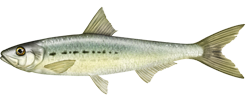
Sardinops sagax is a pelagic fish of the family Alosidae, order Clupeiformes, originally described by Jenyns in 1842 [1]. In Peru it is known as sardina and is a medium-sized neritic fish whose distribution covers the whole coast [2]. It was a major fishery resource in the 1980s, but over the last ten years its landings have been sporadic and no more than 70 tonnes a year [2].
Etymology
Identification and similar species
Distribution and habitat
In the south-eastern Pacific its distribution runs from Ecuador to Chile, between 01°39' S and 42°00' S, and extends offshore to about 200 nautical miles from the coast, including the waters around the Galápagos Islands [2]. In Peru it occupies the whole coastline, with historical concentration centres off Paita, Chimbote, Callao and Ilo [2].
Between 1983 and 2003, the Peruvian Marine Institute ran 36 acoustic surveys that made it possible to follow the aggregation of sardine and anchoveta in the Peruvian Humboldt Current system [3]. The 21 years of data fall into three distinct stretches, separated by changes around 1992 and 1997-1998, and sardine and anchoveta differed greatly in abundance and aggregation between them [3]. Over the last ten years the presence of sardine has been concentrated mostly in nearshore areas and in semi-enclosed bays [2].
Biology
It is a gonochoristic species, meaning the sexes are separate, and a batch spawner: it can reproduce throughout the year, with a main period in winter (July to September) and a secondary one in summer (February and March) [2]. The fecundity of the Peruvian sardine was determined for the first time by counting hydrated oocytes, and batch fecundity varies widely among females of the same weight [4].
In November 2025 the Pelagic Fishery Monitoring Program of the Peruvian Marine Institute found at Pisco a sardine with a two-lobed gonad, one orange ovarian lobe and one pale pink testicular lobe [2]. Histology showed vitellogenic oocytes in the ovarian lobe and few spermatocytes in the testicular one, and the authors present it as the first documented case of hermaphroditism in this species in Peruvian waters [2].
Ecology
Sardine and anchoveta (Engraulis ringens) share the Humboldt Current ecosystem; in the 1983 to 2003 acoustic surveys the aggregation indexes were related to season, temperature anomaly and year, and the two species differed greatly in abundance and aggregation between the three stretches of the period [3]. An analysis of acoustic biomass series for anchoveta and sardine species of Peru and Chile found that El Niño events seem to favour these populations with a delay, and that their dynamics can be chaotic or nearly chaotic [5].
At the Lagunillas landing site in Pisco, the catch of an artisanal vessel on 28 November 2025 contained, besides sardine, machete (Ethmidium maculatum), lorna (Sciaena deliciosa), chub mackerel (Scomber japonicus) and a single specimen of cojinoba (Seriolella violacea) [2].
Conservation
Sardine landings in Peru fell sharply after the peak of the 1980s; over the last four decades the changes in the sardine have been related mainly to environmental factors and fishing pressure [2]. A pre-image analysis of the acoustic series found that, for the Peruvian sardine, the population equilibrium and growth rate began to fall about ten years before that study (2020), and its author recommends acting before a drastic reduction occurs [5]. In the last decade landings have not exceeded 70 tonnes a year and are concentrated near the coast and in semi-enclosed bays [2].
Human relevance
Where to see it in Peru
The only recent record the source describes is from November 2025: one specimen caught about 600 m from the shore off Punta Prieta, in Pisco, within an artisanal catch landed at Lagunillas [2]. Historical concentration centres were off Paita, Chimbote, Callao and Ilo, but over the last ten years the resource has appeared only sporadically in landings, mainly in the coastal zone and in semi-enclosed bays [2]. These are fishery data, not underwater sightings [2].
References (5)
- WoRMS Editorial Board (2026). Sardinops sagax (Jenyns, 1842). World Register of Marine Species. https://www.marinespecies.org/aphia.php?p=taxdetails&id=217452 (accessed 2026-10-25)
- Bouchon, M., Calderón, J., Cahuín, S. et al. (2026). Registro de hermafroditismo en sardina (Sardinops sagax) capturada en Pisco, Perú. Boletín del Instituto del Mar del Perú. doi:10.53554/boletin.v41i1.462 (accessed 2026-10-25)
- Gutiérrez, M., Swartzman, G., Bertrand, A. (2007). Anchovy (Engraulis ringens) and sardine (Sardinops sagax) spatial dynamics and aggregation patterns in the Humboldt Current ecosystem, Peru, from 1983–2003. Fisheries Oceanography. doi:10.1111/j.1365-2419.2006.00422.x (accessed 2026-10-25)
- Alheit, J., Alegre, B. (1986). El nuevo método para la determinación de la fecundidad de la Sardina peruana (Sardinops sagax). Boletín del Instituto del Mar del Perú 10(3), 63-90. https://revistas.imarpe.gob.pe/index.php/boletin/article/view/208 (accessed 2026-10-25)
- Ortiz, M. (2020). Pre-image population indices for anchovy and sardine species in the Humboldt Current System off Peru and Chile: Years decaying productivity. Ecological Indicators. doi:10.1016/j.ecolind.2020.106844 (accessed 2026-10-25)