
Marine life guide of Peru · Scombridae
Pacific bonito
Sarda chiliensis (Cuvier, 1832)
- Names in Peru
- Bonito · Aguadito · Bonito del Pacifico oriental · Cerrajón · Chaucha · Chauchilla · Monillo · Monito · Mono
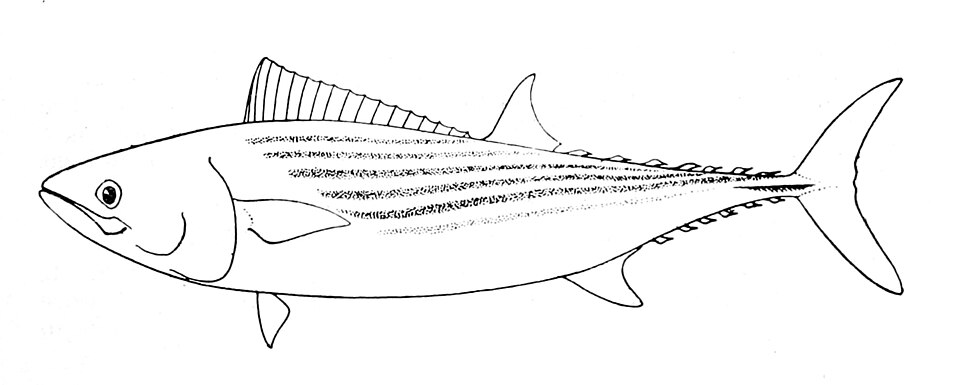
Species account
Summary
Sarda chiliensis is a fish of the family Scombridae, the tunas and mackerels [1]. It is a coastal species of the eastern Pacific, and the southern population lives from Máncora, in Peru, to Talcahuano, in Chile [2]. In Peru it is called bonito, aguadito, cerrajón, chaucha, monillo, monito or mono [2]. Its global IUCN Red List category is Least Concern [3].
Etymology
Cuvier described it as Pelamys chiliensis in the work by Cuvier and Valenciennes on the natural history of fishes, in volume 8, and the type locality is Valparaíso, in Chile [2]. Its old synonyms include Pelamys lineolata, a name later applied to the northern population, and Sarda stockii [2]. The FAO catalogue also records that over time the epithet was spelled in two ways, with and without the i, and that the species was sometimes treated as a subspecies of another species of the genus [2].
Identification and similar species
It has 18 to 30 teeth in the upper jaw and 14 to 25 in the lower, and no teeth on the vomer [2]. The first gill arch carries 23 to 27 gill rakers [2]. The first dorsal fin has 17 to 19 spines, the dorsal finlets are usually 8, the anal fin has 12 to 15 rays and the anal finlets are 6 or 7 [2]. The pectoral fins carry 22 to 26 rays, usually 24 or 25, and the total number of vertebrae is 42 to 46 [2].
The dark stripes on the back are slightly oblique [2]. It reaches at least 79 cm fork length in the southern hemisphere, and the smallest mature individuals measured between 47 and 53 cm [2]. In fish caught with purse seines by artisanal fishers at Pozo de Lisas, near Ilo, in southern Peru, the mean weight was 905 g and the mean standard length 39.4 cm according to the study's table (41.2 cm according to its discussion) [4].
Similar species
- Sarda australis: Sarda australis has 19 to 21 gill rakers on the first arch, 25 to 27 pectoral rays and usually 7 dorsal finlets, and its dorsal stripes are closer to horizontal than in the other species of the genus; it lives in south-eastern Australia and Norfolk Island, far from Peru [2].
- Sarda orientalis: Sarda orientalis has only 8 to 13 gill rakers on the first arch, 12 to 20 teeth in the upper jaw and 14 to 16 rays in the anal fin, and its dorsal stripes are oblique; the FAO catalogue also records it on the American Pacific coast as far as the Gulf of Guayaquil [2].
Distribution and habitat
It is found only in the eastern Pacific [2]. The southern population ranges from Máncora, in Peru, just south of the Gulf of Guayaquil, to Talcahuano, in Chile [2]. The northern population runs from off Alaska to Cabo San Lucas, in Baja California, and the two are separated by a tropical population of another species of the genus [2].
It is an epipelagic, neritic fish, that is, one of surface waters near the coast [2]. Work in Chile and southern Peru confirms that coastal setting: the fish studied were caught by artisanal fishers with purse seines near Ilo, Arica and Iquique [4]. The authors of a study in northern Chile describe the stretch between Iquique and Mejillones as a primary fishing ground for the species [5].
Biology
It reaches sexual maturity at about 2 years of age [2]. In the southern hemisphere it spawns in nearshore waters between September and December, in batches, and the number of eggs it releases in a season grows exponentially with the size of the female [2]. The FAO catalogue estimates about 500000 eggs in a season for a 3 kg specimen [2].
In a study of 444 specimens from the cove of Chanavayita, in northern Chile, caught between December 2013 and June 2014, total length ranged from about 40 to 50 cm [5]. None of the 224 females was mature, and the great majority were immature; by contrast, 104 of 205 males were mature [5]. The authors point out that this sampling window is too short to reconstruct the full reproductive cycle, and note that earlier work described intense gonadal development from October to March and a breeding period from September to March [5].
Ecology
In an analysis of 1404 stomachs from 3 localities, including Pozo de Lisas, near Ilo, the main prey were the squat lobster Pleuroncodes monodon and the anchoveta Engraulis ringens [4]. At Pozo de Lisas, the squat lobster made up about 33 % of prey by number and about 48 % of weight, and the anchoveta about 30 % and 19 % respectively [4]. Across the whole sample, more than 71 % of the stomachs were empty, and the fullest ones were those from autumn [4].
The authors describe a diet with little diversity, centred on a few prey, although they conclude that the species tends to be a generalist, and link the reduction in the mean size of bonito to the decline of the anchoveta, its preferred prey [4].
Conservation
Its global IUCN Red List category is Least Concern [3].
In Peru catches fell from a peak of about 110000 t a year in the early 1960s to about 40000 t in the mid-1970s [2]. A recent study cites about 92 t landed in Peru according to PRODUCE in 2020, and reports a decline of Peruvian bonito since 1987 [4]. In 2024 the Ministry of Production authorised IMARPE to carry out exploratory fishing for bonito with a cap of 750 t and 30 days, in order to gather data on its biology and fishery [6]. According to the authors of a 2025 study, in Chile the species has no catch restrictions and is not listed as protected or endangered [5].
Human relevance
Peruvian fishing of the southern population rose from almost nothing in 1940 to a peak of about 110000 t a year in the early 1960s [2]. In Chile, between Iquique and Antofagasta, the fishery changed from almost entirely artisanal to industrial in the mid-1960s [2]. In Peru, the list of local names recorded by FAO includes aguadito, bonito, cerrajón, chaucha, monillo, monito and mono, and chauchilla for the fish of 1 year [2].
The 2024 rule limits exploratory fishing to artisanal vessels with a hold of up to 10 m3, which must use a purse seine or a curtain net, and requires a fishing logbook to be handed in on landing [6]. Recent landings were about 92 t in Peru (2020 data) and about 131 t in northern Chile (2019 data) [4].
Where to see it in Peru
The Peruvian literature on bonito deals mostly with fishing, not with watching it. The fish studied in southern Peru were sampled between December 2013 and June 2014 in the Pozo de Lisas area, near Ilo, and were caught by artisanal fishers with purse seines [4]. The southern population reaches as far north as Máncora [2].
References (6)
- WoRMS Editorial Board (2026). Sarda chiliensis (Cuvier, 1832). World Register of Marine Species. https://www.marinespecies.org/aphia.php?p=taxdetails&id=293729 (accessed 2026-10-25)
- Collette, B.B., Nauen, C.E. (1983). FAO species catalogue. Vol. 2. Scombrids of the world. An annotated and illustrated catalogue of tunas, mackerels, bonitos and related species known to date. FAO Fisheries Synopsis No. 125, Vol. 2. FAO, Rome. https://www.fao.org/docrep/pdf/009/ac478e/ac478e08.pdf (accessed 2026-10-25)
- Collette, B.B., Canales Ramirez, C., Hinton, M. et al. (2021). Sarda chiliensis: Collette, B.B., Canales Ramirez, C., Hinton, M., Serra, R. & Yanez, E. The IUCN Red List of Threatened Species 2023: e.T170352A170089277. doi:10.2305/IUCN.UK.2023-1.RLTS.T170352A170089277.en (accessed 2026-10-25)
- Pepe-Victoriano, R., Aravena-Ambrosetti, H., Huanacuni, J.I. et al. (2022). Feeding Habits of Sarda chiliensis chiliensis (Cuvier, 1832) in Northern Chile and Southern Perú. Animals. doi:10.3390/ani12070930 (accessed 2026-10-25)
- Pepe-Victoriano, R., Godoy, M., Kush, K. et al. (2025). First Gonadal Stages of Bonito, Sarda chiliensis (Perciformes: Scombridae) on the Pacific Coast of Northern Chile. F1000Research. doi:10.12688/f1000research.173271.1 (accessed 2026-10-25)
- Ministerio de la Producción (2024). Resolución Ministerial N.° 000363-2024-PRODUCE. Autorizan al IMARPE la ejecución de pesca exploratoria del recurso bonito (Sarda chiliensis chiliensis). El Peruano, 8 September 2024. https://busquedas.elperuano.pe/dispositivo/NL/2322815-1 (accessed 2026-10-25)