
Marine life guide of Peru · Echeneidae
Remora
Remora remora (Linnaeus, 1758)
- Names in Peru
- Rémora
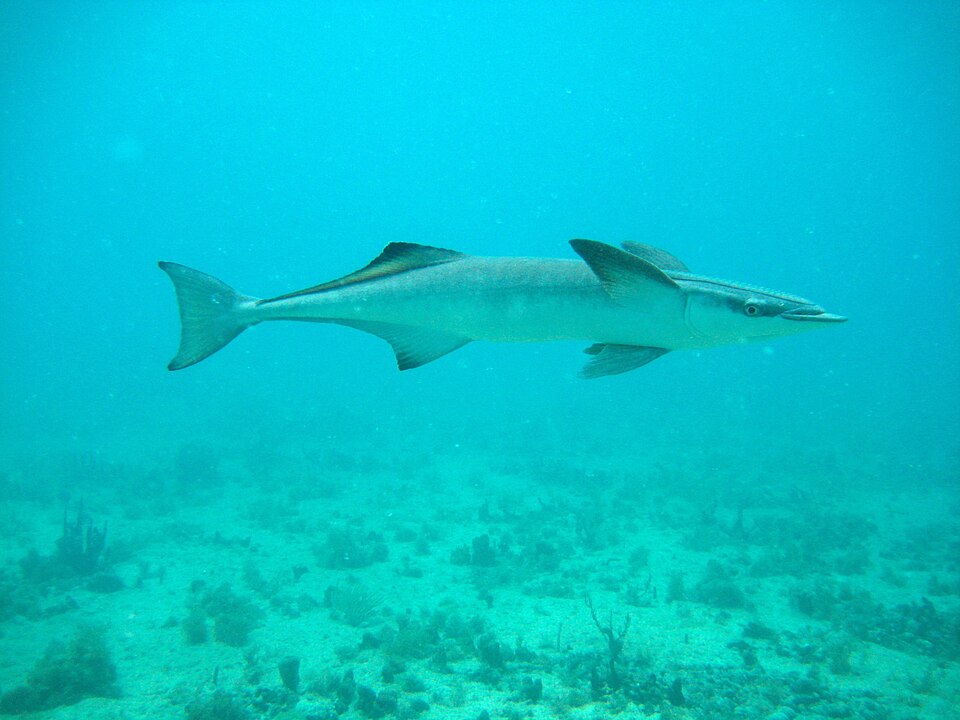
Species account
Summary
Remora remora is a fish of the family Echeneidae, whose members travel attached to other marine animals by an adhesive disc derived from the dorsal fin [1]. Its accepted scientific name is Remora remora (Linnaeus, 1758) [2]. It is a pelagic specialist: it has been recorded with about 30 different hosts, mostly sharks and mobulids [3]. Its global IUCN category is Least Concern [4].
Identification and similar species
It is dark brownish grey, with no spines in the dorsal or anal fins; it has 22 to 26 dorsal soft rays and 22 to 24 anal rays, and a maximum recorded length of 86.4 cm [5].
The anterior dorsal fin has become a suction disc. In the remoras studied, the disc holds up to 26 pectinated lamellae arranged on both sides, and rows of thin spinules on them touch the host surface [6].
The fleshy rim of the disc carries putative push-rod mechanoreceptor complexes. In this species 17 to 24 per cm² were counted on the anterior part of the rim and 11 to 15 per cm² on the posterior part [1].
Similar species
Distribution and habitat
It is cosmopolitan in warm waters, between 60° N and 36° S, and is listed with a depth range of 0 to 200 m [5].
That depth limit falls short when the host dives. Off Santa Maria island in the Azores, a remora rode a whale shark down to 1460 m, where the water was at 3.6 °C, during a dive in August 2020. The maximum depth confirmed before was 140 m [3].
Records from the southwest Atlantic come only from oceanic islands and the open sea, none from the coast [7].
Biology
Ecology
It is associated with about 30 hosts, most often sharks and mobulids [3]. In the Maldives, a mean of 1.5 ± 0.5 individuals per sighting was counted with the oceanic manta, and remoras were more likely to be present with females [8].
In the Galapagos it is seen on almost all whale sharks sighted in the islands [9].
It is also associated with sea turtles: in the southwest Atlantic two remora species were recorded on four sea turtle species, although the association seems rare there [7].
Who gains from the association remains debated: the remora saves transport energy and gets protection and food, but it can cause drag and skin abrasion on the host, so the relationship may be mutualistic, commensal or antagonistic depending on the case [3].
Conservation
Human relevance
References (9)
- Cohen, K.E., Flammang, B.E., Crawford, C.H. et al. (2020). Knowing when to stick: touch receptors found in the remora adhesive disc. Royal Society Open Science, 190990. doi:10.1098/rsos.190990 (accessed 2026-10-25)
- WoRMS Editorial Board (2026). Remora remora (Linnaeus, 1758). World Register of Marine Species. https://www.marinespecies.org/aphia.php?p=taxdetails&id=126853 (accessed 2026-10-25)
- Fontes, J., Castellano-González, G., Macena, B.C.L. et al. (2023). Hitchhiking to the abyss. Ecology and Evolution, e10126. doi:10.1002/ece3.10126 (accessed 2026-10-25)
- Curtis, M., Williams, J.T., Collette, B. et al. (2012). Remora remora: Curtis, M., Williams, J.T., Collette, B., Smith-Vaniz, W.F. & Pina Amargos, F. The IUCN Red List of Threatened Species 2015: e.T198651A15544903. doi:10.2305/IUCN.UK.2015-4.RLTS.T198651A15544903.en (accessed 2026-10-25)
- Froese, R., Pauly, D. (2026). Remora remora (Linnaeus, 1758). FishBase. https://www.fishbase.se/summary/Remora-remora.html (accessed 2026-10-25)
- Kenaley, C.P., Stote, A., Ludt, W.B. et al. (2019). Comparative Functional and Phylogenomic Analyses of Host Association in the Remoras (Echeneidae), a Family of Hitchhiking Fishes. Integrative Organismal Biology. doi:10.1093/iob/obz007 (accessed 2026-10-25)
- Sazima, I., Grossman, A. (2006). Turtle riders: remoras on marine turtles in Southwest Atlantic. Neotropical Ichthyology, 123-126. doi:10.1590/s1679-62252006000100014 (accessed 2026-10-25)
- Nicholson-Jack, A.E., Harris, J.L., Ballard, K. et al. (2021). A hitchhiker guide to manta rays: Patterns of association between Mobula alfredi, M. birostris, their symbionts, and other fishes in the Maldives. PLOS ONE. doi:10.1371/journal.pone.0253704 (accessed 2026-10-25)
- Green, S.M., Hearn, A., Green, J.R. (2023). Species associated with whale sharks Rhincodon typus (Orectolobiformes, Rhincodontidae) in the Galapagos Archipelago. Biodiversity Data Journal. doi:10.3897/bdj.11.e97864 (accessed 2026-10-25)