
Marine life guide of Peru · Pyuridae
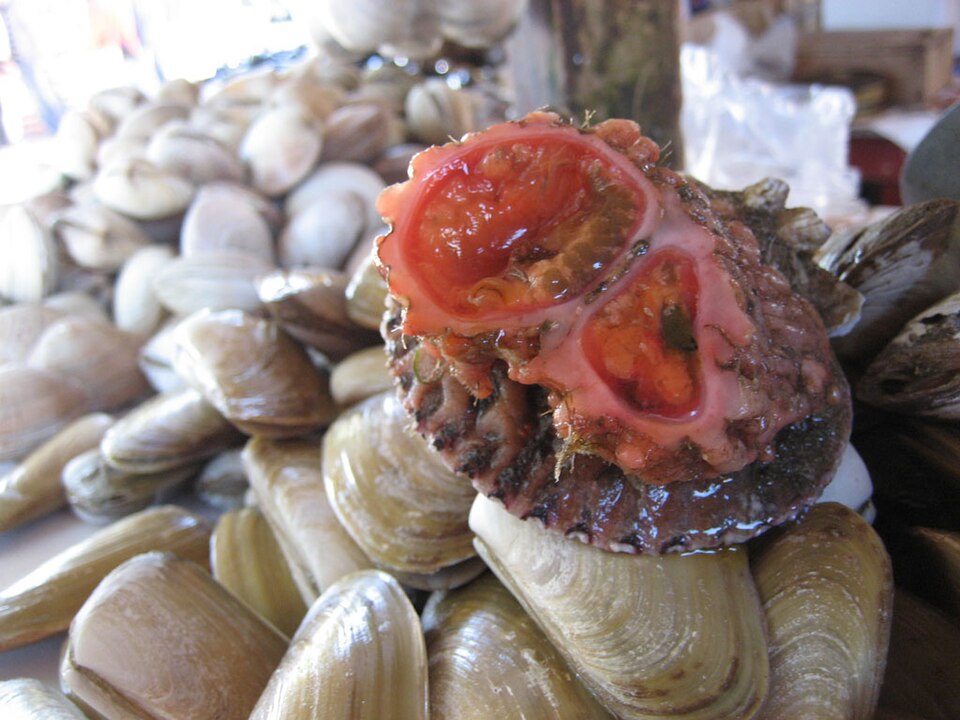
Red sea squirt
Pyura chilensis Molina, 1782
Species account
Summary
Pyura chilensis is an edible solitary ascidian that lives attached to rock along the southeastern Pacific coast between 10°S and 44°S, often forming compact masses of individuals [1],[2]. The reference taxonomic source accepts it as a valid species of the family Pyuridae, described by Molina in 1782 [3]. Its range includes the Peruvian coast, and in Chile it is harvested as food [4].
Identification and similar species
The body is pear-shaped: one face is fixed to the substrate and the opposite face carries the oral and atrial siphons [4]. In the field the siphons are often hidden by epibionts, so measuring the distance between them is difficult [4].
The outer tunic is strong and cemented to the substrate, so grouped individuals form a matrix [1],[4]. On rocky shores it occurs as isolated individuals or as patches of barrel-shaped individuals, and below the low-tide line it can form three-dimensional matrices holding thousands of individuals [4].
Distribution and habitat
It has been recorded from the low intertidal to the subtidal, and between 10°S and 44°S along the Humboldt Current System [1],[2],[5]. Two experimental studies state that it occurs on the coasts of Chile and Peru [4],[5].
It grows on rock, and also on ropes, buoys, boat hulls and other floating structures that offer hard substrate [1]. Artisanal fishers often see it on the hulls of their boats, which has led to the suggestion that transport by vessels is an additional means of dispersal, although this has not been tested in this species [2].
Genetic analysis of 268 sequences of the mitochondrial COI gene revealed 3 haplotype groups whose divergence was estimated at 260000 and 470000 years ago (estimates the authors say must be interpreted cautiously), and 2 of them expanded about 100000 years ago [1]. Using single-nucleotide polymorphisms (SNPs) in 6 populations between 24°S and 42°S, a strongly divergent lineage appeared at 39°S and a north-south separation at 30°S [2].
Biology
It is a digonic, protandrous hermaphrodite: individuals under 1 cm in maximum diameter had only male function, and those over 1 cm had sperm and mature oocytes at the same time [4]. It releases its gametes into the water; cross-fertilization is the rule, but after long periods of reproductive isolation it self-fertilizes, with equally successful settlement and metamorphosis [4].
The larva is a free-swimming tadpole that spends 12 to 24 hours in the water column, so its intrinsic dispersal capacity is low [1],[2]. In laboratory experiments larvae settled faster on surfaces treated with extract of adults of their own species, and preferred shaded areas [5].
In a mussel farm at Calbuco, at 41°43'S, a 12-month follow-up found 40% to 100% of individuals with gonads in stage II or III, which suggests continuous gametogenesis [6]. Recruits appeared between November and June, and larvae settled more on a dark rough mesh than on a plastic surface [6].
Ecology
Although solitary, it is almost always found in dense aggregations and rarely alone [5]. On rocky shores most newly settled individuals were on adults of their own species, in shaded microhabitats and around the holdfasts of the kelp Lessonia nigrescens [5].
Its matrices shelter an associated community of macroinvertebrates and microinvertebrates [5]. Its presence also favors the commercially valuable gastropod Concholepas concholepas [1].
It also colonizes artificial substrates readily: it appears as part of the fouling fauna on mollusc culture lines, where it can reduce the growth efficiency of the cultured animals [6].
Health, toxicological and chemical relevance
Not medical advice. For a sting, a poisoning or an allergy, seek medical care.
During an outbreak of amnesic shellfish poisoning at Bahía Inglesa, Chile, domoic acid was measured in this ascidian, a neurotoxin produced by diatoms of the genus Pseudo-nitzschia [7]. The edible tissues contained between 8.7 and 15.5 µg of domoic acid per gram, and the gut contents between 13.6 and 32.7 µg per gram [7].
The authors note that this was the first record of the toxin in a tunicate that coastal people eat regularly, and they recommend including it in marine toxin monitoring programmes [7]. In the same outbreak, the mussels and clams tested were below the toxic level, at between 4.7 and 6.4 µg per gram [7].
Human relevance
In Chile it is harvested intensively for human consumption, especially toward the south of its range, and it supports a small-scale artisanal fishery [1],[5]. It is subject to regulations and management practices, and in Chile the fishers' associations in charge of a management area can request restocking programmes [1].
In marine aquaculture it can be a problem, because it attaches to culture lines and can affect the growth efficiency of the cultured molluscs [6].
References (7)
- Haye, P.A., Muñoz-Herrera, N.C. (2013). Isolation with differentiation followed by expansion with admixture in the tunicate Pyura chilensis. BMC Evolutionary Biology. doi:10.1186/1471-2148-13-252 (accessed 2026-10-25)
- Segovia, N.I., Gallardo-Escárate, C., Poulin, E. et al. (2017). Lineage divergence, local adaptation across a biogeographic break, and artificial transport, shape the genetic structure in the ascidian Pyura chilensis. Scientific Reports. doi:10.1038/srep44559 (accessed 2026-10-25)
- Ascidiacea World Database editors (2026). Pyura chilensis Molina, 1782. World Register of Marine Species. https://www.marinespecies.org/aphia.php?p=taxdetails&id=251256 (accessed 2026-10-25)
- Manríquez, P.H., Castilla, J.C. (2005). Self-fertilization as an alternative mode of reproduction in the solitary tunicate Pyura chilensis. Marine Ecology Progress Series. doi:10.3354/meps305113 (accessed 2026-10-25)
- Manríquez, P.H., Castilla, J.C. (2007). Roles of larval behaviour and microhabitat traits in determining spatial aggregations in the ascidian Pyura chilensis. Marine Ecology Progress Series. doi:10.3354/meps332155 (accessed 2026-10-25)
- Pérez Valdés, M., Figueroa Aguilera, D., Rojas Pérez, C. (2019). Ciclo reproductivo de la ascidia Pyura chilensis (Urochordata: Ascidiacea) procedente de líneas de cultivo de mitílidos. Revista de Biología Marina y Oceanografía. doi:10.4067/s0718-19572017000200012 (accessed 2026-10-25)
- López-Rivera, A., Pinto, M., Insinilla, A. et al. (2009). The occurrence of domoic acid linked to a toxic diatom bloom in a new potential vector: The tunicate Pyura chilensis (piure). Toxicon. doi:10.1016/j.toxicon.2009.05.033 (accessed 2026-10-25)