
Marine life guide of Peru · Procellariidae
Masatierra petrel
Pterodroma defilippiana (Giglioli & Salvadori, 1869)
- Names in Peru
- Petrel de Masatierra
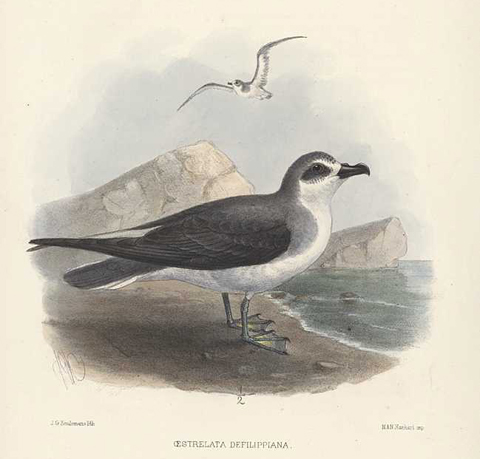
Species account
Summary
Pterodroma defilippiana is a petrel of the family Procellariidae, described by Giglioli and Salvadori [1]. In Peru it is called «petrel de Masatierra» [2]. It nests only on oceanic islands of Chile, in the Desventuradas and the Juan Fernández archipelago, and reaches Peruvian waters as a rare winter visitor that does not breed here [2].
At sea it is a bird of oceanic waters, far from the coast, that accompanies predatory fish such as tuna [3]. On crossings from 2014 to 2017 between mainland Chile and Rapa Nui it was the second most common of the seabirds that breed in that region [4]. Its global category is Vulnerable [5].
Etymology
The epithet defilippiana carries the surname of Filippo De Filippi (1814–1867), a naturalist who became director of the Turin university museum of zoology in 1848 and sailed on the round-the-world voyage of the Italian warship Magenta, from 1865 to 1867, until his death in Hong Kong [6]. On his death Enrico H. Giglioli, aged 22, took charge of the scientific team; Giglioli and Tommaso Salvadori later described several new petrels gathered on that expedition [6].
The original name was Aestrelata defilippiana, and the Turin museum keeps 2 syntypes, mounted skins that Giglioli obtained in the South Pacific in 1867 [6]. Because of a separately printed pamphlet dated 1868, the Turin type catalogue dates the species to that year, while the World Register of Marine Species keeps 1869 [6],[1].
Distribution and habitat
According to the management plan of the Dorsal de Nasca National Reserve, it has colonies on San Félix and San Ambrosio, in the Desventuradas, and on Santa Clara and Robinson Crusoe, in the Juan Fernández archipelago, and at sea it occurs off Peru and northern and central Chile [2]. A review of the seabirds of Rapa Nui, Salas y Gómez and the Desventuradas lists it among the species that breed on the latter [7], and another synthesis gave it as a breeder known only from that archipelago and possibly Juan Fernández [8].
On 14 cruises made between 1980 and 1995 in waters within 370 km of the South American coast, between 3° S and 50° S, 518 individuals were counted, and it was among the regular species in both summer and winter, at about 7.4 birds per 100 km² in each season [3]. Its highest densities, 19.1 birds per 100 km² over the slope and 37.8 in pelagic waters, were between 25° S and 35° S, and over the slope it was seen regularly as far as the sector from 35° S to 42.5° S [3].
Between September 2014 and September 2017, on 11 cruises between the coast of mainland Chile and Rapa Nui, it was the second most common of the 6697 birds recorded of species that breed in that area, at 9.82 % of the total [4]. Over the Salas y Gómez and Nazca submarine ridges, a region that reaches north-east to near the Peru-Chile Trench, it was also the second most abundant, with 574 individuals counted on 11 surveys from 2014 to 2017 [9].
Biology
According to the management plan of the Dorsal de Nasca National Reserve, it lays in May and June on San Félix, San Ambrosio, Santa Clara and Robinson Crusoe, and its nests are burrows dug into gullies and slopes facing the sea, sheltered by vegetation [2].
Among the seabirds collected in the eastern tropical Pacific from 1983 to 1991 there were 7 specimens of this species, and 43 % of them had in their stomachs marine insects of the genus Halobates, the only insects known from the open ocean; the authors warn that large samples are needed to judge how much this prey weighs in the diet [10].
Ecology
In the Humboldt Current it forms, with Puffinus bulleri and Pterodroma externa, a group of oceanic-water species that follow predatory fish such as tuna and are present almost all year at middle and lower latitudes [3]. Those species also grouped together by their association with strongly stratified waters [3].
In an analysis of the functional traits of the seabirds of the Salas y Gómez and Nazca ridges it was classed, by its way of life, as a generalist, and counted among the species that nest in that region [9].
Conservation
Its global category is Vulnerable [5]. In Chile's national classification it is also listed as Vulnerable [11].
Access to the Desventuradas Islands is fully restricted because of a Chilean Navy base, and no systematic study of their birds has been made since the 1960s [7]. Light pollution affects it little, as far as is known: in San Juan Bautista, on Robinson Crusoe Island, groundings of birds drawn to the lights are very sporadic, with at most 2 individuals per season [11].
The study area over the Salas y Gómez and Nazca ridges, where it was the second most abundant seabird, takes in the Nazca-Desventuradas Marine Park, the Juan Fernández marine park and Peru's Dorsal de Nasca National Reserve. Even so, 73 % of that region is high seas, outside any national jurisdiction, where its seabirds are exposed to fishing without regulation, to plastics and to possible mining of the seabed [9].
Where to see it in Peru
The 2024-2029 management plan of the Dorsal de Nasca National Reserve includes it among the birds of that marine reserve and describes it as a rare visitor to Peru in the winter months, from May to October, that does not breed in the country [2].
On the 1980 to 1995 cruises it was seen regularly, at 5 or more birds per 100 km², in pelagic waters between 15° S and 25° S, but not among the regular species of the sector from 3° S to 15° S [3]. In that study it belonged to a group of species of waters far from the coast [3].
References (11)
- WoRMS Editorial Board (2026). Pterodroma defilippiana (Giglioli & Salvadori, 1869). World Register of Marine Species. https://www.marinespecies.org/aphia.php?p=taxdetails&id=225941 (accessed 2026-10-20)
- Servicio Nacional de Áreas Naturales Protegidas por el Estado (SERNANP) (2024). Plan Maestro de la Reserva Nacional Dorsal de Nasca 2024-2029. SERNANP; aprobado por RP N.° 000040-2024-SERNANP. https://cdn.www.gob.pe/uploads/document/file/5997712/5313081-anexo.pdf (accessed 2026-10-20)
- Spear, L.B., Ainley, D.G. (2008). The Seabird Community of the Peru Current, 1980-1995, with Comparisons to Other Eastern Boundary Currents. Marine Ornithology, 125-144. doi:10.5038/2074-1235.36.2.781 (accessed 2026-10-20)
- Serratosa, J., Hyrenbach, K.D., Miranda-Urbina, D. et al. (2020). Environmental Drivers of Seabird At-Sea Distribution in the Eastern South Pacific Ocean: Assemblage Composition Across a Longitudinal Productivity Gradient. Frontiers in Marine Science, 838. doi:10.3389/fmars.2019.00838 (accessed 2026-10-20)
- BirdLife International (2018). Pterodroma defilippiana: BirdLife International. The IUCN Red List of Threatened Species 2018: e.T22697990A132617737. doi:10.2305/IUCN.UK.2018-2.RLTS.T22697990A132617737.en (accessed 2026-10-20)
- Aimassi, G., Pulcher, C., Ghiraldi, L. (2020). Type specimens of Birds in the Museo Regionale di Scienze Naturali (Torino, Italy). Journal of the National Museum (Prague), Natural History Series, 65-154. doi:10.37520/jnmpnhs.2020.007 (accessed 2026-10-20)
- Flores, M.A., Schlatter, R.P., Hucke-Gaete, R. (2014). Seabirds of Easter Island, Salas y Gomez Island and Desventuradas Islands, southeastern Pacific Ocean. Latin American Journal of Aquatic Research, 752-759. doi:10.3856/vol42-issue4-fulltext-6 (accessed 2026-10-20)
- Friedlander, A.M., Ballesteros, E., Caselle, J.E. et al. (2016). Marine Biodiversity in Juan Fernández and Desventuradas Islands, Chile: Global Endemism Hotspots. PLOS ONE, e0145059. doi:10.1371/journal.pone.0145059 (accessed 2026-10-20)
- Núñez, P., Luna-Jorquera, G. (2026). The Salas y Gomez and Nazca Ridges EBSA support a highly functional diversity of seabirds. Scientific Reports, 22517. doi:10.1038/s41598-026-58849-5 (accessed 2026-10-20)
- Cheng, L., Spear, L., Ainley, D.G. (2010). Importance of Marine Insects (heteroptera: Gerridae, Halobates Spp) as Prey of Eastern Tropical Pacific Seabirds. Marine Ornithology, 91-95. doi:10.5038/2074-1235.38.2.892 (accessed 2026-10-20)
- Silva, R., Medrano, F., Tejeda, I. et al. (2020). Evaluación del impacto de la contaminación lumínica sobre las aves marinas en Chile: diagnóstico y propuestas. Ornitología Neotropical, 13-24. doi:10.58843/ornneo.v31i1.575 (accessed 2026-10-20)