
Marine life guide of Peru · Rhinobatidae
Pseudobatos prahli
Pseudobatos prahli (Acero P. & Franke, 1995)
Species account
Summary
Pseudobatos prahli is a guitarfish of the family Rhinobatidae, in the order Rhinopristiformes [1]. It was described in 1995, and its type specimen comes from Gorgona Island, in the Colombian Pacific [2]. It lives near the seabed, over sand and rock next to coral reefs, from southern Mexico to Peru [3]. Very little is known about it: when it was assessed for the Red List, in 2007, only 3 specimens were known [4]. Its global category on the IUCN Red List is Vulnerable [5].
Etymology
Acero and Franke described it in 1995 in the genus Rhinobatos, and in the 2015 checklist of Peruvian chondrichthyans it is still listed as Rhinobatos prahli [6]. The species name honours Henry von Prahl (1948-1989), a Colombian marine biologist who studied Gorgona Island, where the type specimen comes from [2]. In English it is called the Gorgona guitarfish, and a study carried out in Ecuador gives it the Spanish name raya guitarra punteada [3].
Identification and similar species
It has the elongated body of the guitarfishes, and its rostral cartilage, which supports the snout, widens towards the tip [2]. The front flaps of the nostrils reach their inner edge, and behind each spiracle there are 2 folds, the inner one being barely developed [2]. Along the midline of the back, from the nape to the first dorsal fin, runs a row of about 77 small thorns; it also bears 3 or 4 on the shoulders, some tubercles on the snout and tiny thorns on the front rim of the eye sockets [2].
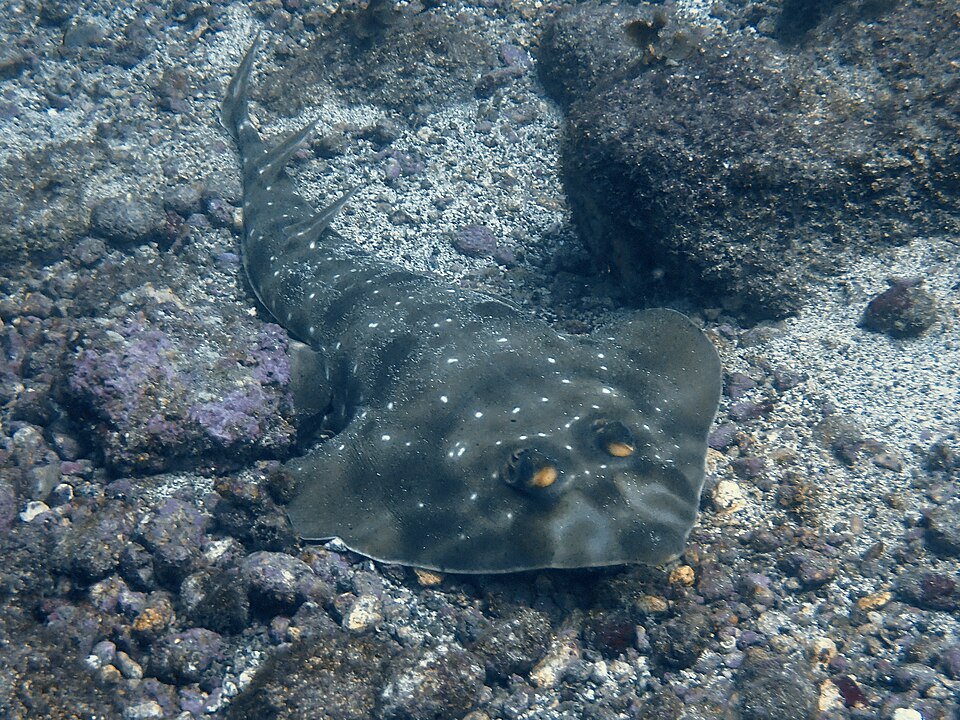
Its upper side is brown with about 80 white spots 3 to 5 mm across; its underside is white except for a black diamond-shaped blotch beneath the snout that extends backwards along the sides [2]. The largest recorded specimen measured 90 cm in total length [2], and in the landings at Santa Rosa, Ecuador, females measured 51 to 86 cm and males 51 to 78 cm [3]. Embryos change in appearance as they grow: at first they are pink with brown spots, and in the final stages their back is already brown with white dots [3].
In the 2015 checklist of Peruvian chondrichthyans it appears under its original name alongside 3 other guitarfishes then placed in Rhinobatos and Zapteryx exasperata, so it is not the only species of this shape recorded for the country [6].
Distribution and habitat
It is a tropical Eastern Pacific species, known from southern Mexico to Peru [3]; the records compiled by FishBase fall between 14° north and 6° south latitude [2]. After its description, other studies dealt with its distribution in the Colombian Pacific and in the southern Mexican Pacific [3].
It lives close to the bottom, over sand and rock near coral reefs; in the Colombian Pacific it lives mainly between 18 and 24 m deep, and it has been found down to 70 m [3]. In Peru, Béarez recorded a male of 71 cm total length in 2000 [3], and the species is included in the updated checklist of the country's chondrichthyans [6].
Biology
It is viviparous: the embryos first feed on their yolk sac and later absorb a fluid rich in proteins and fats secreted by special structures in the mother's uterus [3]. Its reproduction was first described from 96 females and 165 males landed at Santa Rosa, Santa Elena province (Ecuador), between January 2013 and January 2014 [3]. In that sample, half the females were mature at 65.9 cm total length and half the males at 61.8 cm; almost 2 males were landed for every female, whereas the embryos showed an even sex ratio, which suggests that free-living fish segregate by sex [3].
The cycle is annual and gestation lasts about 12 months: ovarian follicles grow from November to February, embryos were only found from December to February, and birth would take place around March, when the young measure about 22.5 cm [3]. Each female carried 1 to 10 follicles ready to ovulate and 1 to 6 embryos, 2.9 on average; larger mothers tended to carry slightly more, although the relationship was weak [3]. Comparing its size at maturity, gestation and number of young with those of related species, the authors conclude that it ranks among the least biologically productive members of its genus [3].
Ecology
It turns up rarely in surveys: in the Pacific waters of Costa Rica, of 430 baited underwater video stations analysed, set between December 2016 and June 2019, at depths of 1 to 60 m, it appeared on only 4, and never more than one individual at a time [7].
Conservation
Its global category on the IUCN Red List is Vulnerable [5]. According to that assessment, as summarised by a 2022 study, its population is suspected to have fallen by 30 to 49 % over the last 3 generations, about 15 years, because of intense fishing throughout its range, particularly in Ecuador, which appears to be the core of its distribution [3].
The rocky bottoms it lives on would give it some refuge from trawl nets, but over most of its range fishing lacks adequate management and enforcement [3]. In Ecuador there are no up-to-date landing statistics for this species, so its population cannot be assessed [3]. It is also one of the least known guitarfishes: when it was assessed for the Red List, in 2007, only 3 specimens were known, and few further records have been published since [4].
Human relevance
It is taken as bycatch in shrimp trawling, both industrial and small-scale, and in small-scale gillnets and longlines [3]. In Santa Elena province, Ecuador, it is sometimes targeted because it is well liked as local food; it is sold fresh or frozen and can also go into fishmeal, and there it is regarded as a resource of low to medium commercial importance [3].
Where to see it in Peru
Very little has been published about this ray in Peru: the updated checklist of the country's chondrichthyans, from 2015, includes it on the basis of the annotated catalogue of marine fishes by Chirichigno and Cornejo from 2001, without giving specific localities [6].
References (7)
- Froese, R., Pauly, D. (2026). Pseudobatos prahli (Acero P. & Franke, 1995). World Register of Marine Species. https://www.marinespecies.org/aphia.php?p=taxdetails&id=1043465 (accessed 2026-10-25)
- Froese, R., Pauly, D. (2026). Pseudobatos prahli, Gorgona guitarfish. FishBase. https://www.fishbase.se/summary/54454 (accessed 2026-10-25)
- Prieto-Veloz, M.C., Calle-Morán, M.D., Tovar-Ávila, J. (2022). Reproductive biology of the Gorgona guitarfish Pseudobatos prahli in the central-eastern Pacific Ocean. Revista de Biología Marina y Oceanografía 57 (especial), 68-79. doi:10.22370/rbmo.2022.57.Especial.3333 (accessed 2026-10-25)
- Moore, A.B.M. (2017). Are guitarfishes the next sawfishes? Extinction risk and an urgent call for conservation action. Endangered Species Research 34, 75-88. doi:10.3354/esr00830 (accessed 2026-10-25)
- Kyne, P.M., Charvet, P., Areano, E.M. et al. (2020). Pseudobatos prahli: Kyne, P.M., Charvet, P., Areano, E.M., Cevallos, A., Espinoza, M., González, A., Herman, K., Mejía-Falla, P.A., Morales-Saldaña, J.M., Navia, A.F. & Velez-Zuazo, X. The IUCN Red List of Threatened Species 2020: e.T63158A124463727. doi:10.2305/IUCN.UK.2020-3.RLTS.T63158A124463727.en (accessed 2026-10-25)
- Cornejo, R., Vélez-Zuazo, X., González-Pestana, A. et al. (2015). An updated checklist of Chondrichthyes from the southeast Pacific off Peru. Check List, 1809. doi:10.15560/11.6.1809 (accessed 2026-10-25)
- Espinoza, M., Araya-Arce, T., Chaves-Zamora, I. et al. (2020). Monitoring elasmobranch assemblages in a data-poor country from the Eastern Tropical Pacific using baited remote underwater video stations. Scientific Reports 10, 17175. doi:10.1038/s41598-020-74282-8 (accessed 2026-10-25)