
Marine life guide of Peru · Procellariidae
Black petrel
Procellaria parkinsoni Gray, 1862
- Names in Peru
- Petrel de Parkinson
Species account
Summary
Procellaria parkinsoni is a seabird of the family Procellariidae, described by Gray in 1862 [1]. In Peru it is known as «petrel de Parkinson» [2]. It nests on just two islands in northern New Zealand, Great Barrier (Aotea) and Little Barrier (Te Hauturu-o-Toi), and once breeding is over it heads to the eastern tropical Pacific; in Peruvian waters it gathers in the north, over the continental slope [3]. The IUCN Red List classifies it as Vulnerable in its 2018 assessment [4], and Peru's official list of threatened wild fauna, approved in 2014, also places it in the Vulnerable category [2].
Identification and similar species
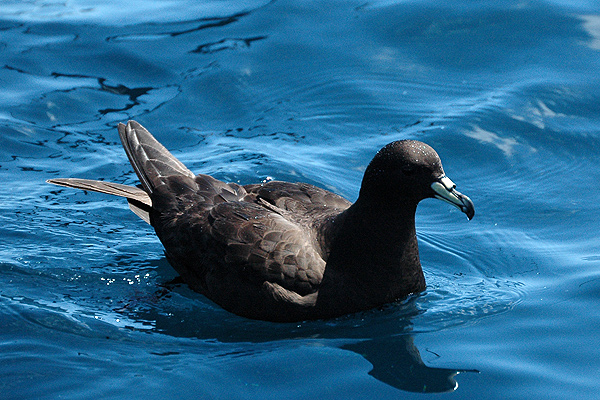
It is the smallest member of its genus and the one that breeds farthest north [5]. Its plumage is dark all over, a brownish black, and the bill has sharply defined black tips on both the upper and the lower mandible [6]. The bill plates are pale greenish yellow in adults and ivory with a grey tinge in fledglings [5]. Birds recorded off northern Chile between 2008 and 2010 showed worn plumage, with brown coverts paler than the flight feathers, and, compared with Procellaria aequinoctialis, a rounder head and wings projecting farther beyond the tail when they sat on the water [7].
A breeding adult weighs about 700 g [8]. On Great Barrier, 22 adults rearing chicks averaged 741.6 g, ranging from 640 to 941 g, in 2013 and 2014 [9]. On Little Barrier, 5 females weighed within 12 hours of laying ranged from 714 to 791 g [5].
Similar species
- Procellaria aequinoctialis: Its bill shows no dark colour at all, being pale grey to greenish white, and Procellaria parkinsoni is only about 75 % of its size [6].
- Procellaria westlandica: It also has black bill tips and is more heavily built; Procellaria parkinsoni is about 75 % of its size, so the difference is clear when the two are together and hard to judge on a lone bird [6].
Distribution and habitat
It used to breed on New Zealand's North Island and in the northern South Island too, in at least 4 places reported since European arrival [5]. While breeding it ranges far to the north and east of the North Island and west across the Tasman Sea, as far as Australia [5]. GPS units fitted in 2006 to chick-rearing birds on Great Barrier showed that those feeding near the colony worked the shelf edge, over water 600 to 1000 m deep, and that one of them travelled at least 1128 km from the island [8].
On 28 cruises run from 1976 to 1990 in the eastern tropical Pacific, 618 birds were recorded, close to shore from southern Mexico (about 15° N) to northern Peru (about 5° S) and offshore along the equator, through the Galápagos, to at least 110° W; they were seen in every month except January [10]. Its southern limit on the mainland coast lay near 5° S, where the cooler Peru Current turns away from the coast towards the west [10].
On 15 cruises from 1980 to 1995, 179 individuals were counted between 8.02° N and 13.93° S; it was most abundant between 3° S and 9° S and favoured the continental slope, although in the austral autumn it was also abundant over the shelf [6]. For that period about 38 000 birds were estimated in autumn and about 12 400 in spring within the study area [6].
On an IMARPE cruise in February and March 2020, between the borders with Ecuador and Chile and out to 80 nautical miles from the coast, 96 % of the records fell between 3° 40′ S and 6° 40′ S, and 94.7 % of the birds were seen over the continental slope, at a mean depth of 2073 m [3].
Farther south the records are scattered. A dead bird turned up in February 1983 on a beach near Lurín (12° 16′ S), during the strong 1982-1983 El Niño [10]. Off northern Chile, observers aboard industrial swordfish longliners saw 10 birds between latitudes 23° 00′ S and 32° 49′ S in the austral winters of 2008 to 2010, in water of 17 to 18 °C [7].
Biology
The breeding season lasts from October to July, with eggs laid roughly between 10 November and 20 January, mostly in early December [5]. On Little Barrier every nest was in a burrow 1 to 3 m long, dug in the peaty soil of the ridges, under tree bases or in banks; on Great Barrier it also nested in hollow logs, under banks and among roots [5].
Nine eggs averaged 69.3 mm by 50.5 mm and weighed 98.8 g [5]. Both parents incubate; the male takes the first long shift, of about 17 to 18 days, and the only incubation period timed lasted 56.5 days [5].
At about a month old, chicks were fed on 38 % of nights, with meals averaging 120.6 g [5]. Six chicks took on average 107.3 days to leave the nest (96 to 122); departures ran from mid-April to late July, peaking around 20 May, and many chicks came out to the surface for about 10 nights beforehand to exercise their wings [5].
Some young birds come back to the colony at 5 years old and breed at 6 [5]. One banded adult lived at least 17 years, and established pairs laid an egg every year unless death or divorce broke the pair; pairs that failed to rear a chick split up more often [5].
In 2013 and 2014, 1706 dives were logged from 22 adults on Great Barrier: the deepest reached 34.3 m, 86.8 % went no deeper than 5 m, 92.7 % took place by day; dives lasted 6.8 seconds on average, with a maximum of 78 [9]. A bird collected on 11 February 1977 off northern Peru (5° 52′ S, 82° 50′ W), while feeding beside dolphins, had the remains of a freshly swallowed squid in its stomach, probably of the genus Octopoteuthis [10].
Ecology
In the eastern tropical Pacific, 469 of 618 birds (76 %) were with herds of 10 dolphin species, on 55 occasions [10]. Above all it joined two uncommon species: it was with 33.3 % of the herds of Peponocephala electra and with 25.7 % of those of Pseudorca crassidens; the largest flock, of about 300 birds, followed a mixed herd of Pseudorca crassidens, Tursiops truncatus and Grampus griseus [10]. It kept away, on the other hand, from the large flocks that feed with tunas and with Stenella attenuata and Stenella longirostris [10].
The authors concluded that it dives to retrieve scraps of large prey that those dolphins tear apart below the surface; on one occasion a pair of birds with pilot whales stayed underwater for up to 20 seconds to recover sinking pieces of squid that the researcher himself had thrown to them [10]. Some 8 % of the birds followed ships to pick through garbage, bait and fishing discards [10]. Between 1980 and 1995 off South America, of 16 birds seen feeding, 56 % were eating dead cephalopods floating at the surface, 25 % were beside fishing boats, 13 % beside South American sea lions Otaria flavescens and 6 % beside cetaceans [6].
On the 2020 cruise off northern Peru, associations with cetaceans were recorded, all over the slope, among them with 250 to 300 short-beaked common dolphins Delphinus delphis about 40 km off Paita, with 2 sperm whales Physeter catodon 35 km offshore and with 75 common dolphins about 30 km southwest of Lobos de Tierra island [3]. Nets in that area brought up small squids of the genus Abraliopsis and the paper nautilus Argonauta nouryi, possible prey, which were more abundant over the slope and the trench between 4° S and 7° S [3].
Off northern Chile it took discards and waste from the longliners, contesting them with other seabirds; the commonest birds around it were Daption capense (37 % of birds), Procellaria aequinoctialis (22 %) and Thalassarche melanophris (4 %) [7].
Conservation
Its global category is Vulnerable [4]. In Peru it is classified as Vulnerable [2].
It is regarded as the seabird at greatest risk from commercial fishing in New Zealand waters, and 96.2 % of the 78 birds caught there between 2002 and 2013 were taken on longlines [9]. Since it rarely goes below 10 m, unprotected hooks need to sink past that depth; earlier work showed that achieving it requires setting at 6 knots, with a line sink rate of 0.3 m per second and 100 m bird-scaring lines [9].
On Little Barrier feral cats were the main cause of breeding failure: the birds linked to the study burrows fell from 39 in 1971-1972 to 14 in 1976-1977, until the cats were eradicated between 1977 and 1980 [5]. On Great Barrier, logging of the kauri forests between 1920 and 1935 and the burning of what was left destroyed the peat, logs and tree bases where it nested [5]. Around 1987 there were thought to be 50 to 100 breeding pairs on Little Barrier and 500 to 1000 on Great Barrier [5].
It is also caught in South America: recovered bands document bycatch in northern Peru and Ecuador [11], and in December 1991 a bird was reported caught about 40 km off Paita [3]. The authors of the 2020 cruise warn that the birds spending the austral summer off northern Peru face bycatch, pollution and climate change, and propose a marine Important Bird Area in those waters and mitigation measures on fishing vessels [3].
Human relevance
Where to see it in Peru
In February and March 2020, at the height of the austral summer, nearly all the records fell between 3° 40′ S and 6° 40′ S, and nearly all the birds were over the continental slope rather than the shelf; the associations with dolphins were seen about 40 km off Paita and about 30 km southwest of Lobos de Tierra island [3]. In October 2018, 2 birds were photographed, one 26 km off the coast of Tumbes and the other 20 km off the coast of northern Piura [3].
On the 1980 to 1995 cruises it was frequent off northern Peru between 3° S and 6° S, if one assumes, as the authors did, that the black-tipped-billed petrels seen north of 12° S were this species [12]. South of 6° S, the only record known in 1992 to the authors of another study was the dead bird found near Lurín in 1983, during El Niño [10].
References (12)
- WoRMS Editorial Board (2026). Procellaria parkinsoni Gray, 1862. World Register of Marine Species. https://www.marinespecies.org/aphia.php?p=taxdetails&id=225914 (accessed 2026-10-20)
- Ministerio de Agricultura y Riego (2014). Decreto Supremo N.° 004-2014-MINAGRI: actualización de la lista de clasificación y categorización de las especies amenazadas de fauna silvestre legalmente protegidas. El Peruano (08-04-2014); ficha en SINIA, Ministerio del Ambiente. https://sinia.minam.gob.pe/normas/lista-especies-amenazadas-fauna-silvestre-legalmente-protegidas (accessed 2026-10-20)
- Quiñones, J., Calderon, J., Mayaute, L. et al. (2020). Black petrel (Procellaria parkinsoni) congregations at sea off Perú during the Austral summer. Notornis, 573-576. doi:10.63172/375823lslzfg (accessed 2026-10-20)
- BirdLife International (2018). Procellaria parkinsoni: BirdLife International. The IUCN Red List of Threatened Species 2018: e.T22698150A132629374. doi:10.2305/IUCN.UK.2018-2.RLTS.T22698150A132629374.en (accessed 2026-10-20)
- Imber, M.J. (1987). Breeding ecology and conservation of the black petrel (Procellaria parkinsoni). Notornis, 19-39. doi:10.63172/679521vhlaej (accessed 2026-10-20)
- Spear, L.B., Ainley, D.G., Webb, S.W. (2005). Distribution, abundance, habitat use and behaviour of three Procellaria petrels off South America. Notornis, 88-105. doi:10.63172/586467dgweep (accessed 2026-10-20)
- Cabezas, L.A., Ruiz, J., Yates, O. et al. (2012). The black petrel (Procellaria parkinsoni) in pelagic waters off northern Chile: a southern extension to the known distribution and interactions with the pelagic longline fishery. New Zealand Journal of Marine and Freshwater Research, 537-544. doi:10.1080/00288330.2012.661746 (accessed 2026-10-20)
- Freeman, R., Dennis, T., Landers, T. et al. (2010). Black Petrels (Procellaria parkinsoni) Patrol the Ocean Shelf-Break: GPS Tracking of a Vulnerable Procellariiform Seabird. PLoS ONE, e9236. doi:10.1371/journal.pone.0009236 (accessed 2026-10-20)
- Bell, E.A. (2016). Diving behaviour of black petrels (Procellaria parkinsoni) in New Zealand waters and its relevance to fisheries interaction. Notornis, 57-65. doi:10.63172/486737uqkoau (accessed 2026-10-20)
- Pitman, R.L., Ballance, L.T. (1992). Parkinson's Petrel Distribution and Foraging Ecology in the Eastern Pacific: Aspects of an Exclusive Feeding Relationship with Dolphins. The Condor, 825-835. doi:10.2307/1369280 (accessed 2026-10-20)
- Gaskin, C.P., Harrison, P., Baird, K.A. et al. (2016). An opportunistic sighting of a flock of black petrels (Procellaria parkinsoni) at Galápagos Islands, Ecuador. Notornis, 54-56. doi:10.63172/361948gomvzo (accessed 2026-10-20)
- Spear, L.B., Ainley, D.G. (2008). The Seabird Community of the Peru Current, 1980-1995, with Comparisons to Other Eastern Boundary Currents. Marine Ornithology, 125-144. doi:10.5038/2074-1235.36.2.781 (accessed 2026-10-20)