
Marine life guide of Peru · Pomacanthidae
Cortez angelfish
Pomacanthus zonipectus (Gill, 1862)
- Names in Peru
- Pez ángel
Species account
Summary
Identification and similar species
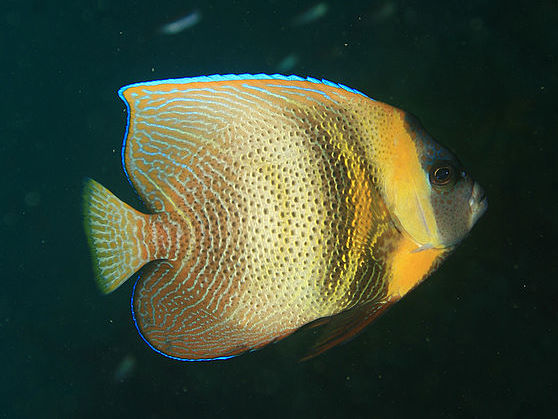
The body is short and deep, flattened from side to side [3]. A fish caught in 2021 in Baja California, which matched earlier descriptions of the species, had 11 spines and 25 soft rays in the dorsal fin, 3 spines and 20 rays in the anal fin and 19 rays in each pectoral fin; it also showed a hump on the head, a dorsal fin drawn out into a point and a stout spine on the lower edge of the gill cover [5].
In that same fish the front of the head was greyish and a broad yellow stripe ran from top to bottom across the gill cover; behind the pectoral fin a second yellow stripe sat between two black stripes, and the tail was pale yellow [5]. In DNA barcodes of reef fishes from northern Peru, samples of Pomacanthus zonipectus differed from one another by at most 0.31 %, and the closest of the species analysed, the angelfish Holacanthus passer, lay 18.2 % away [6].
Distribution and habitat
Its range runs from the northern Gulf of California, in Mexico, to Peru [5]. Inside the gulf it reaches north to Puerto Peñasco, and on the Pacific side of Baja California, to north of Bahía Magdalena [3]. Some authors also include the Galápagos Islands in its range [7].
It is reported at depths of 6 to 12 m [3], and also down to 50 m [5]. On the Pacific coast of Baja California it has turned up farther north than usual: on 25 August 2016 in Laguna Ojo de Liebre, during the warming of 2013 to 2016, and on 15 May 2021 in Bahía de San Quintín, some 355 km farther north, a lagoon kept cold by constant upwelling, with the coastal sea at 12.8 to 12.9 °C and 16.1 °C inside the bay [5]. The author of that record links it to that warming or to the moderate El Niño of 2018 to 2019 [5].
Northern Peru marks the southern end of the tropical eastern Pacific, a region that reaches Cabo Blanco, in Piura; rocky reefs, the habitat of this area's reef fishes, have been described between Cabo Blanco and Punta Sal [6].
Biology
It reaches 46 cm in total length, although about 26 cm is usual [3]. The San Quintín fish measured 25.5 cm in total length and 22.9 cm in standard length, and weighed 748 g [5].
At Espíritu Santo Island, in the Gulf of California, the breeding season runs from June to November; 27 females were speared there by breath-hold divers between 2 and 10 m, but only 5 had ovaries suitable for measuring fecundity [7]. Each of those females carried between 25,372 and 62,422 hydrated oocytes, ready for one spawning, with a mean diameter of 675 µm, and the count rose exponentially with the size of the fish [7].
The authors of that study take such high fecundity to fit eggs released into open water and, because the species spawns in batches over a long season, they think its reproductive potential may be greater still [7]. Adults move about the reef in twos or in loose groups, whereas juveniles live alone and hold a territory; a change from female to male has been proposed, but it is not yet confirmed [3].
Ecology
In Mazatlán and Banderas bays, on the Mexican Pacific coast, of 13 fish species examined only the angelfishes Pomacanthus zonipectus and Holacanthus passer had sponge remains in their stomachs; Pomacanthus zonipectus had eaten 15 sponge species, 8 of them of the order Hadromerida, and the authors regard it as mainly a sponge eater [8]. Other work describes it as omnivorous and opportunistic, and small planktonic crustaceans have also been found in its stomach contents, which might explain why the San Quintín fish took sabiki-type hooks [5].
At Los Órganos, on 10 October 2022, at 5 to 8 m depth, 8 individuals fed on the organisms growing on the shell of a green turtle; they favoured the centre of the shell and gathered to feed, on a turtle that was missing a flipper and whose shell was heavily overgrown with algae [9]. It was the first time this species had been recorded cleaning Chelonia mydas [9].
Conservation
The IUCN Red List classes it as Least Concern [4].
Off Espíritu Santo Island it is a scarce fish, between 0.01 and 0.1 of all fish counted, and the authors warned that taking it could put that population at risk [7]. Its arrival in the temperate waters of Baja California has been put forward as a biological sign of ocean warming events [5].
Human relevance
Because of the bright colours of its juveniles it is one of the species most in demand in the international aquarium trade, where a single fish can sell for up to 100 US dollars [7].
It is taken in subsistence fisheries and for the aquarium trade [3]. Sport anglers usually release it, and fishers sometimes keep it to eat themselves [5].
Where to see it in Peru
A study published in 2025 included this species among the rocky reef fishes of northern Peru whose DNA it sequenced; its specimens were collected by diving in three areas of the Reserva Nacional Mar Tropical de Grau, Isla Foca, the coast between Cabo Blanco and Los Órganos and the Punta Sal reefs, and the study notes that sampling and reaching those reefs is difficult [6].
On 10 October 2022 it was seen cleaning a green turtle at Los Órganos, at the dive site known as La Vuelta or Arrecifes de Punta Veleros, a rocky reef covered mainly by red and green algae, soft corals and sponges, between 5 and 10 m deep [9].
References (9)
- WoRMS Editorial Board (2026). Pomacanthus zonipectus (Gill, 1862). World Register of Marine Species. https://www.marinespecies.org/aphia.php?p=taxdetails&id=276028 (accessed 2026-10-20)
- Froese, R., Pauly, D. (2026). Common names of Pomacanthus zonipectus. FishBase. https://www.fishbase.se/ComNames/CommonNamesList.php?ID=8328&GenusName=Pomacanthus&SpeciesName=zonipectus&StockCode=8642 (accessed 2026-10-20)
- Froese, R., Pauly, D. (2026). Pomacanthus zonipectus (Gill, 1862). Cortez angelfish. FishBase. https://www.fishbase.se/summary/8328 (accessed 2026-10-20)
- Pyle, R., Allen, G., Myers, R. et al. (2009). Pomacanthus zonipectus: Pyle, R., Allen, G., Myers, R., Zapata, F., Barraza, E., Robertson, R., Rocha, L.A. & Craig, M.T. The IUCN Red List of Threatened Species 2010: e.T165889A6158436. doi:10.2305/IUCN.UK.2010-4.RLTS.T165889A6158436.en (accessed 2026-10-20)
- Rosales-Casián, J.A. (2022). Biological indicator of warming events: Presence of the Cortez angelfish Pomacanthus zonipectus at temperate conditions of Bahía de San Quintín, Baja California, México. Aquatic Research, 165-170. doi:10.3153/AR22016 (accessed 2026-10-20)
- Zavala, E., Britzke, R., Siccha-Ramírez, Z. et al. (2025). DNA barcoding of marine rocky reef fishes from northern Peru suggests a parapatric speciation in the Tropical Eastern Pacific. Ecology and Evolution, e70125. doi:10.1002/ece3.70125 (accessed 2026-10-20)
- Arellano-Martínez, M., Ceballos-Vázquez, B.P., Hernández-Olalde, L. et al. (2006). Fecundity of Cortez angelfish Pomacanthus zonipectus (Teleostei: Pomacanthidae) off Espiritu Santo Island, Gulf of California, Mexico. Ciencias Marinas, 65-71. doi:10.7773/cm.v32i1.64 (accessed 2026-10-20)
- Verdín, C.J., Carballo, J.L., Camacho, M.L. (2010). A Qualitative Assessment of Sponge-Feeding Organisms from the Mexican Pacific Coast. The Open Marine Biology Journal, 39-46. doi:10.2174/1874450801004010039 (accessed 2026-10-20)
- Cuba, D., Zavala, A., Epstein, M. (2023). Primeros registros de relación simbiótica entre la tortuga verde (Chelonia mydas) y peces de arrecife en el norte del Perú. South Sustainability, e086. doi:10.21142/SS-0402-2023-e086 (accessed 2026-10-20)