
Marine life guide of Peru · Threskiornithidae
Roseate spoonbill
Platalea ajaja Linnaeus, 1758
Species account
Summary
Platalea ajaja is a bird of the family Threskiornithidae, which WoRMS places in the order Ciconiiformes [1]. Of the 6 spoonbill species in the world, it is the one that occurs in the Americas [2]. It lives in shallow wetlands, breeds in colonies, and its plumage turns pink over the first 2 years of life [2]. In Peru it is rare: it has been seen mainly in the Amazon and on the far north coast, with exceptional records farther south [3]. Its global category on the IUCN Red List is Least Concern [4].
Identification and similar species
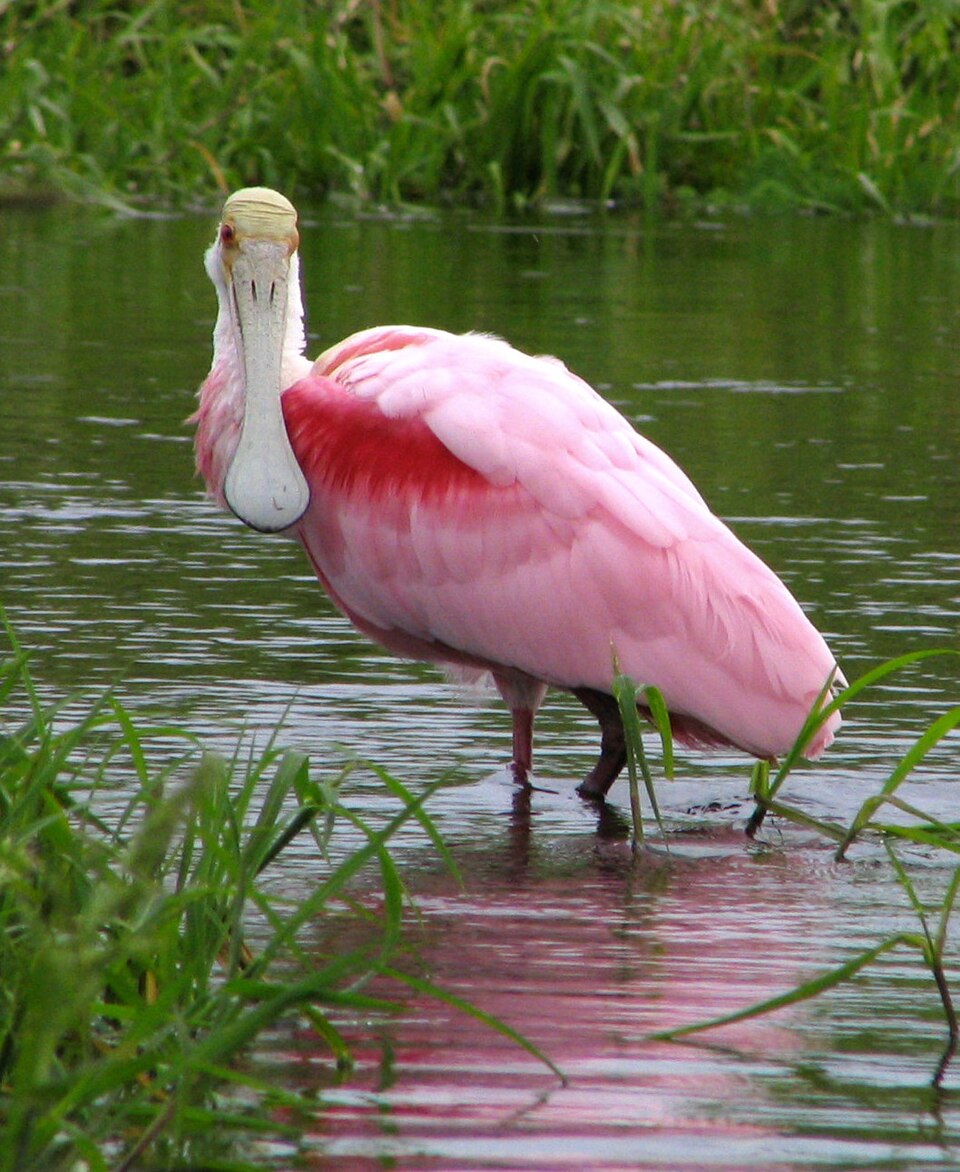
Like other spoonbills, it has a straight, flattened bill with a widened spatula-shaped tip; the species of the genus are told apart by plumage colour and by bill design [2]. The bill is credited with a specialisation for sifting bottom silt, where the small invertebrates it feeds on live [2].
Its look changes with age. A first-year bird is almost entirely white and its legs carry no pink; in the second year the body is still pale pink, but the legs are already a deep pink [2]. Adults have pink plumage with some yellowish tones, and males are slightly larger than females in bill and body [2].
Distribution and habitat
Its range runs from the southern United States to the tropics of Central and South America, including Ecuador, both sides of the Andes in Peru, Chile, central Argentina, Paraguay and Uruguay [2]. The species breeds from the southeastern United States to central Argentina [5]. In Peru it is rare: it has been observed mainly in the Amazon and on the far north coast, with exceptional records on the central and southern coast and on high-Andean lakes above 4000 m in Puno [3].
It is closely tied to wetlands and continental islands, and to open, shallow, slow-flowing sites that it uses for nesting, rearing young and moulting; outside the breeding season most populations disperse to mangroves and estuaries [2]. It feeds in habitats from hypersaline ponds and marine environments to freshwater lakes, but prefers fresh water [6]. In Brazil its colonies are in freshwater and estuarine settings in Amapá state, in the freshwater Pantanal wetland, and in the coastal lagoons of Rio Grande do Sul [5].
Biology
It nests in colonies; the authors note that stork, heron and spoonbill nests in the Pantanal and Amapá colonies are built in trees as tall as 20 m [5]. The typical clutch is 3 eggs (range 1 to 5); both parents incubate for 22 days and share the care of the young, which are semi-altricial and depend on their parents for food until about 67 days of age [5].
In Brazilian colonies the breeding cycle of waterbirds lasts about 5 months in the Pantanal, 6 in Amapá and 4 in Rio Grande do Sul [5]. It was long thought to be monogamous on the basis of observations of a single pair; kinship analysis of 193 nestlings sampled between 2006 and 2008 found, among the nestling pairs from the same nest that could be classified, 5 % half-siblings and 24 % unrelated nestlings, which suggests extra-pair paternity and brood parasitism [5].
The authors cite that it is young birds that seek out and colonise new areas [2]. In La Paz Bay, in Mexico, they saw 5 young birds on 25 May 2012 and kept seeing one or two until 23 July, with temperatures of 20 to 25 °C; the birds were not seen again once it rose to 40 or 45 °C (up to 48 °C on some days), and the authors suppose the heat played a part [2].
Ecology
Its diet is mainly fish, but it also includes crustaceans, insects and other aquatic invertebrates [6]. It is a tertiary consumer that feeds opportunistically and may swallow sediment from the bottom of water bodies [6].
According to ecological observations the authors call limited, in Rio Grande do Sul, in the 2008/9 season, 54 % of nests failed; 73 % of those failures were due to egg predation and 25 % to problems in nestling development [5]. Recent estimates gave 1508 birds in the colonies of Rio Grande do Sul and 2163 in those of the Pantanal [5].
Conservation
Its global category on the IUCN Red List is Least Concern [4].
In Peru, the authors of a note on the Ite Wetlands mention it, together with Phoenicoparrus andinus, among the species considered threatened in the national legislation of 2004 [3]. In northwestern Mexico 4 important nesting areas are documented [2].
Health, toxicological and chemical relevance
Not medical advice. For a sting, a poisoning or an allergy, seek medical care.
In a study in the Magdalena River basin of northern Colombia, 15 adults of this species were caught in mist nets, in field sampling in April and December 2019, to measure metals in blood and feathers [6]. Total mercury in blood was 811.00 ± 349.60 µg per litre, the highest of the 3 species studied, and the authors note that adverse effects on the birds may be possible [6].
In feathers, the mean total mercury concentration was below 5 µg per gram, the background level the authors use as a reference, and only one individual exceeded it, with 6.17 µg per gram [6]. In spoonbill feathers there was also a positive correlation between arsenic and mercury [6]. For blood mercury, the authors attribute the difference between species to foraging habits and trophic position [6].
Where to see it in Peru
In Peru it has been recorded at the Ite Wetlands, in Tacna, 90 km northwest of the city of Tacna and at sea level, a site identified as an Important Bird Area [3]. It was a single bird, resting on the shore of the southern lagoon on 29 April 2009 and seen around the lagoons until 14 June 2009 [3]. The authors consider the species rare in Peru and the sighting the most extreme on the country's southern coast [3].
References (6)
- WoRMS Editorial Board (2026). Platalea ajaja Linnaeus, 1758. World Register of Marine Species. https://www.marinespecies.org/aphia.php?p=taxdetails&id=422584 (accessed 2026-10-25)
- Guerrero-Cárdenas, I., Tovar-Zamora, I., Cruz-Andrés, O.R. et al. (2013). Veinte años de ausencia: avistamientos recientes de la espátula rosada (Platalea ajaja) en la Bahía de la Paz, Baja California Sur, México. Huitzil. Revista Mexicana de Ornitología, 105-109. doi:10.28947/hrmo.2013.14.2.200 (accessed 2026-10-25)
- Vizcarra, J.K., Hidalgo, N., Chino, E. (2009). Adiciones a la avifauna de los Humedales de Ite, costa sur de Perú. Revista Peruana de Biología, 221-225. doi:10.15381/rpb.v16i2.211 (accessed 2026-10-25)
- BirdLife International (2025). Platalea ajaja: BirdLife International. The IUCN Red List of Threatened Species 2025: e.T22697574A281037780. doi:10.2305/IUCN.UK.2025-2.RLTS.T22697574A281037780.en (accessed 2026-10-25)
- Miño, C.I., Russello, M.A., Mussi Gonçalves, P.F. et al. (2011). Reconstructing genetic mating systems in the absence of parental information in colonially breeding waterbirds. BMC Evolutionary Biology, 196. doi:10.1186/1471-2148-11-196 (accessed 2026-10-25)
- Bjedov, D., Bernal-Alviz, J., Buelvas-Soto, J.A. et al. (2024). Elevated Heavy Metal(loid) Blood and Feather Concentrations in Wetland Birds from Different Trophic Levels Indicate Exposure to Environmental Pollutants. Archives of Environmental Contamination and Toxicology, 127-143. doi:10.1007/s00244-024-01085-7 (accessed 2026-10-25)