
Marine life guide of Peru · Mytilidae
Perumytilus purpuratus
Perumytilus purpuratus (Lamarck, 1819)
- Names in Peru
- Chorito
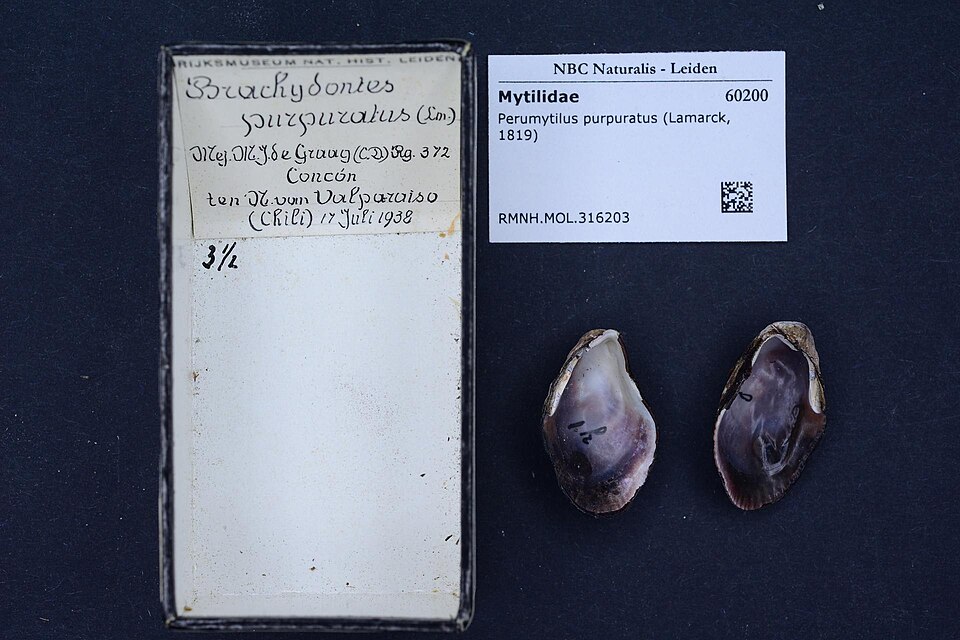
Species account
Summary
Distribution and habitat
A genetic study reports that its range runs along the Pacific coast from 2° S, in Ecuador, to 56° S, in Chile, and rounds Cape Horn to about 41° S in Argentine Patagonia [3]. A study on the health of these mussels describes it, with a slightly different northern limit, from northern Peru to southern Chile [4].
On rocky shores it occupies the mid intertidal [2]. In Ancón Bay, in central Peru, it is found in rock crevices of the upper and mid intertidal and forms dense beds in the mid zone, with an associated community of up to 87 species [2].
Biology
Its development is lecithotrophic and the larva lasts 14 to 18 days in the laboratory, unlike most marine mussels, whose planktotrophic larva stays in the plankton much longer, so its dispersal capacity is limited [3]. That limit, together with the Pleistocene separation of Atlantic and Pacific populations, would explain why the species is split into two populations, a south-eastern and a northern one, with a genetic discontinuity near 40° S in the Pacific [3].
It is a bivalve with doubly uniparental inheritance of mitochondria: females pass on one mitochondrial genome and males carry a second one as well, which goes mostly to their sons [3]. That work presented both genomes of the species for the first time, and the distance between their lineages proved greater than in the Mytilus edulis complex [3].
In the Ancón beds, mean density was 89.3 individuals per 100 cm² [2]. The experiments in that work used small mussels, 6 to 17 mm long, and large ones, over 30 mm, to represent the natural size variation of the area [2].
Ecology
Beds of Perumytilus purpuratus create a complex habitat in which many organisms live [2]. At Ancón the associated species are mostly sessile filter-feeding invertebrates, such as barnacles and anemones, followed by grazers such as chitons and limpets [2]. The experiment found 26 taxa, a figure the authors consider an underestimate, and up to 92 associated species have been recorded in beds in Peru and Chile [2].
Between April and June 2008, slow-release fertilizer was added to 10 plots of the bed, and neither algal biomass nor the abundance or composition of the associated fauna changed [2]. Mussel size, by contrast, did matter: among small mussels, whose gaps were more than threefold smaller, there were more predators, grazers and mobile organisms, and the barnacle Jehlius cirratus was more abundant on large ones [2]. Because the study was done at a single site, its authors note that experiments at larger spatial scales are needed to learn whether the results hold in other nutrient-rich areas [2].
Health, toxicological and chemical relevance
Not medical advice. For a sting, a poisoning or an allergy, seek medical care.
Perumytilus purpuratus has been used as a sentinel species to assess pollution in northern Chile [4]. A study in San Jorge Bay, in Antofagasta, compared mussels from 5 sites and found parasites and pathogens, among them trematode metacercariae of the genus Renicola in the mantle and ciliates in the gills [4].
The authors link the heavier load of parasites, pathogens and lesions, found at 3 of the 5 sites, to elevated pH, salinity, copper and cadmium in the water, and suggest that both chemical and abiotic factors induce changes in the immune system of the species [4]. All of these data come from San Jorge Bay, in northern Chile [4].
Where to see it in Peru
A survey of 21 localities on the Peruvian coast between 3.5° and 13.5° S, with 41 sites on wave-sheltered rocky platforms, carried out from February to May 2015, recognised the mid intertidal by the presence of barnacles and mussels, and this species was among the sessile taxa that best explained the variation of the community along latitude [5].
A study with data from 2007 and 2008 worked on the rocks south of Ancón Bay (11°46′ S), on the central coast, where the species forms beds in the mid zone of the intertidal [2].
References (5)
- MolluscaBase eds. (2026). Perumytilus purpuratus (Lamarck, 1819). World Register of Marine Species. https://www.marinespecies.org/aphia.php?p=taxdetails&id=600490 (accessed 2026-10-21)
- Firstater, F.N., Hidalgo, F.J., Lomovasky, B.J. et al. (2011). Habitat structure is more important than nutrient supply in modifying mussel bed assemblage in an upwelling area of the Peruvian coast. Helgoland Marine Research, 187-196. doi:10.1007/s10152-010-0214-3 (accessed 2026-10-21)
- Śmietanka, B., Lubośny, M., Przyłucka, A. et al. (2018). Mitogenomics of Perumytilus purpuratus (Bivalvia: Mytilidae) and its implications for doubly uniparental inheritance of mitochondria. PeerJ, e5593. doi:10.7717/peerj.5593 (accessed 2026-10-21)
- Montenegro, D., González, M.T. (2025). Impact of multiple-factors on health and infections in marine mussels (Perumytilus purpuratus) inhabiting contaminated sites in the Humboldt Current System. Scientific Reports, 6333. doi:10.1038/s41598-025-89117-7 (accessed 2026-10-21)
- Ibanez-Erquiaga, B., Pacheco, A.S., Rivadeneira, M.M. et al. (2018). Biogeographical zonation of rocky intertidal communities along the coast of Peru (3.5–13.5° S Southeast Pacific). PLOS ONE, e0208244. doi:10.1371/journal.pone.0208244 (accessed 2026-10-21)