
Marine life guide of Peru · Hydrobatidae
Wilson's storm petrel
Oceanites oceanicus (Kuhl, 1820)
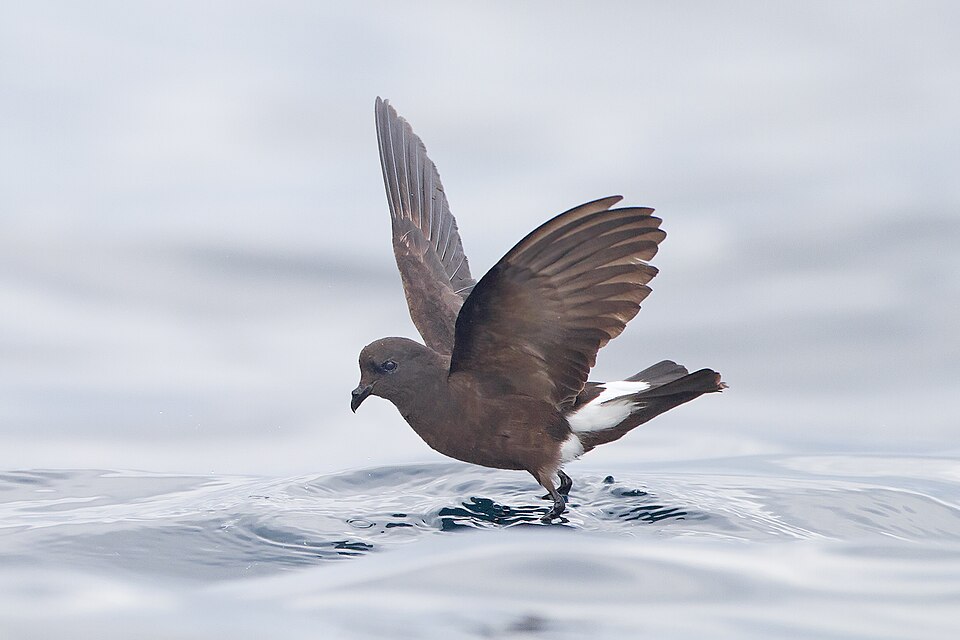
Species account
Summary
Oceanites oceanicus is a storm petrel described by Kuhl in 1820 [1]. The larger nominate form breeds on subantarctic islands and around Antarctica and belongs to a complex of southern forms; the birds examined so far from the Humboldt Current region belong to the Chilean form, not the nominate one [2]. The IUCN Red List classifies it as Least Concern [3].
Identification and similar species
The species belongs to a complex whose taxonomy is unresolved: the larger nominate form breeds on subantarctic islands and around Antarctica, whereas the smaller chilensis breeds in Chile and perhaps in the Falkland Islands, and has been treated provisionally as a separate species [2].
Another form, described from near Chiloé Island, is separated mainly by the extent of white on the wings and belly, a feature that may overlap with that of the Chilean form [2]. In the waters of south-central Chile many birds could not be assigned to one form or the other from the field views available [2].
Distribution and habitat
It is a trans-equatorial migrant: the nominate form spends the austral winter in the North Atlantic and North Pacific; adults reach the Northern Hemisphere between April and May, head back south in September and October, and return to the breeding grounds around November [2]. During migration it appears to cross over offshore oceanic waters [2].
Off Chile and Peru the situation is different: there are no confirmed records of the nominate form from the Humboldt Current region, where all specimens are attributed to the Chilean form [2]. Some birds of the Chilean form may move north through Humboldt Current waters as far as Peru, and rarely to the Gulf of Panama [2].
Biology
In the nominate form eggs are laid mainly from mid-December through January, hatching peaks in February, and fledglings leave mainly in April [2]. The nest is usually in cavities beneath rocks, moss mats and soil; the chamber is generally about 30 cm below the surface, although at Cierva Point on the Antarctic Peninsula some chambers were 1 m deep [4].
Flight over a colony at Cierva Point, on the Antarctic Peninsula, peaked between 22h00 and 01h00 [4]. In an area of 12 × 12 m with 16 known nests, an infrared sensor detected all 16 [4].
Adult wing molt is relatively rapid: it starts between mid-April and early June and ends between mid-August and late September [2]. Unlike other storm petrels, it adds a complete wing molt to its first cycle: first-year birds that fledged in April start molting between mid-July and early September, and finish from late October into December [2].
Ecology
In a study using video recordings and chick weighing, nest attendance by males and females was similar except in one year of very low krill, and no difference between the sexes was found in the food delivered daily to the chick [5].
In krill-poor years, females made longer foraging trips and brought heavier meals, whereas males fed more often; the authors conclude that there is no general sex-specific pattern and that investment shifts with food availability [5].
The extra first-year wing molt is also known in other aerial-feeding, long-distance migrants, such as jaegers and swallows, which suggests that it arose from prolonged exposure to strong sunlight during migrations between hemispheres [2].
Conservation
The IUCN classifies Oceanites oceanicus as Least Concern in its 2018 global assessment [3].
The species is sensitive to handling at the nest, especially during incubation: breeding failure and nest desertion have been reported as a result, so study methods that avoid touching the birds reduce disturbance [4].
Where to see it in Peru
References (5)
- WoRMS Editorial Board (2026). Oceanites oceanicus (Kuhl, 1820). World Register of Marine Species. https://www.marinespecies.org/aphia.php?p=taxdetails&id=137190 (accessed 2026-10-25)
- Howell, S.N.G. (2024). Wing-molt phenology in Wilson's, Fuegian, and Pincoya Storm Petrels, the Southern-breeding Oceanites oceanicus complex. Marine Ornithology, 229-233. doi:10.5038/2074-1235.52.2.1586 (accessed 2026-10-25)
- BirdLife International (2018). Oceanites oceanicus: BirdLife International. The IUCN Red List of Threatened Species 2018: e.T22698436A132646007. doi:10.2305/IUCN.UK.2018-2.RLTS.T22698436A132646007.en (accessed 2026-10-25)
- Orgeira, J.L. (1997). An Infrared Device for Finding Wilson's Storm Petrel Oceanites Oceanicus Nests. Marine Ornithology, 75-76. doi:10.5038/2074-1235.25.1.387 (accessed 2026-10-25)
- Gladbach, A., Braun, C., Nordt, A. et al. (2009). Chick provisioning and nest attendance of male and female Wilson's storm petrels Oceanites oceanicus. Polar Biology, 1315-1321. doi:10.1007/s00300-009-0628-z (accessed 2026-10-25)