
Marine life guide of Peru · Hydrobatidae
Elliot's storm petrel
Oceanites gracilis (Elliot, 1859)
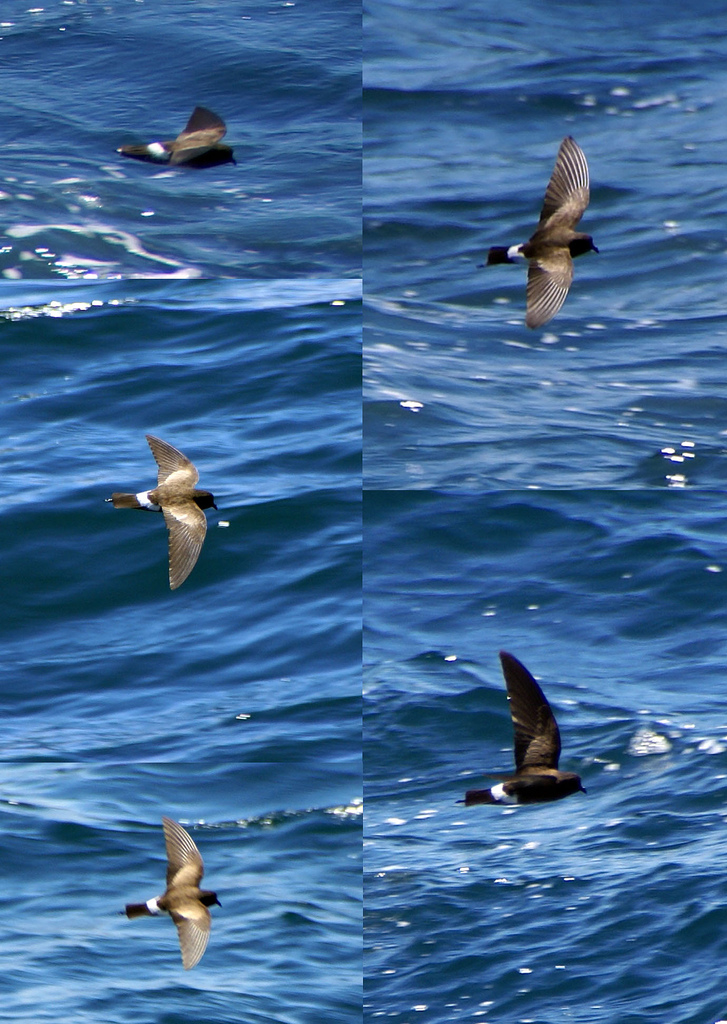
Species account
Summary
Oceanites gracilis is a storm petrel of the family Hydrobatidae, described by Elliot in 1859 [1]. It is known from the coastal zones of the Pacific from southern Colombia to central Chile, and a subspecies described from Galápagos material is resident in the Galápagos Islands [2]. Very little is known about its breeding, since until 2000 only one nest was known, found in Chile [2]. The IUCN Red List classifies it as Data Deficient [3].
Identification and similar species
It is so similar to Oceanites oceanicus that two specimens of Oceanites gracilis in the Museo Argentino de Ciencias Naturales had been filed among a series of that species and were published under its name [2]. On re-examination, the belly and undertail coverts proved to be white with irregular brown spots, the pale wing bar was more conspicuous, the underwing coverts were white with a dark brown leading edge, and the nasal tubes were almost vertical [2].
Both species have yellow webbing between the toes, so that feature does not separate them [2]. Murphy described in 1936 another character of Oceanites gracilis: the shafts of the two outer pairs of tail feathers are pure white, and in the specimens re-examined this colouring covered three quarters of the feather's length [2]. The Galápagos subspecies is somewhat larger, and that difference in size is the only constant one that has been pointed out between it and the nominal subspecies [2].
Similar species
- Oceanites oceanicus: It shares the yellow toe webbing, but in Oceanites gracilis the belly and undertail coverts are white with brown spots, the underwing coverts are white with a dark leading edge, and the nasal tubes are almost vertical [2].
Distribution and habitat
The species is known from the coastal zones of the Pacific from southern Colombia, through Ecuador and Peru, to central Chile [2]. The known southern limit of the nominal subspecies was Valparaíso, at about 33° S [2]. The Galápagos subspecies is considered resident in that archipelago, although the movements of seabirds are unpredictable and El Niño may influence them [2].
There is one record far outside that range: two specimens collected at El Bolsón, in Río Negro, Argentina, taken in February 1972 and in November 1983, at about 42° S and about 950 km south of its known distribution [2]. The author suspects they came from the Pacific, pushed by El Niño and by low-pressure fronts with strong winds that would have forced them across low Andean passes [2]. He also considers it possible that the birds came from the Galápagos, that larger individuals exist in the Humboldt Current, or that an undiscovered larger population lives farther south [2].
Biology
Its breeding biology is almost unknown. Until 2000 the only known nest was the one found in August 1979 on Isla Chungungo, in northern Chile [2].
The movements of seabirds are hard to predict, and El Niño may alter them; one of the Argentine specimens was collected in 1983, a year in which that phenomenon was very pronounced [2].
A study by IMARPE recalls that little is known about the storm petrels that inhabit Peru, because they spend most of their time on the open sea and their colonies are in remote places, such as islands or the desert [4].
Conservation
Its global category on the IUCN Red List is Data Deficient [3]. The same IMARPE study notes that the lack of information on Peru's storm petrels places several species of the group in threat categories on international and national lists [4].
That study includes Oceanites gracilis among the species with proven breeding sites in Peru, and refers to a 2008 paper for it [4]. That paper, however, describes a colony of a different species, Oceanodroma tethys kelsalli, on Santa Island [5]. For its part, the only Oceanites gracilis nest known until 2000 was in Chile [2].
References (5)
- WoRMS Editorial Board (2026). Oceanites gracilis (Elliot, 1859). World Register of Marine Species. https://www.marinespecies.org/aphia.php?p=taxdetails&id=343961 (accessed 2026-10-21)
- Pearman, M. (2000). Primeros registros del Paiño de Elliot (Oceanites gracilis) en la Argentina. El Hornero, 141-143. doi:10.56178/eh.v15i2.935 (accessed 2026-10-21)
- BirdLife International (2018). Oceanites gracilis: BirdLife International. The IUCN Red List of Threatened Species 2018: e.T22698442A132647135. doi:10.2305/IUCN.UK.2018-2.RLTS.T22698442A132647135.en (accessed 2026-10-21)
- Romero, C. (2021). Distribución espacio-temporal de la golondrina de mar de Markham Oceanodroma markhami (Salvin, 1883) y la golondrina de mar acollarada O. hornbyi (Gray, 1854) en Perú. 2019. Boletín del Instituto del Mar del Perú, 68-84. doi:10.53554/boletin.v36i1.320 (accessed 2026-10-21)
- Ayala, L., Sanchez-Scaglioni, R., Amoros, S. et al. (2008). Una colonia reproductiva de la Golondrina de la Tempestad Peruana, Oceanodroma tethys kelsalli (Lowe 1925), en la Isla Santa, Perú. Revista peruana de biología, 117-120. doi:10.15381/rpb.v15i1.1687 (accessed 2026-10-21)