
Marine life guide of Peru · Pectinidae
Scallop
Nodipecten subnodosus (G. B. Sowerby I, 1835)
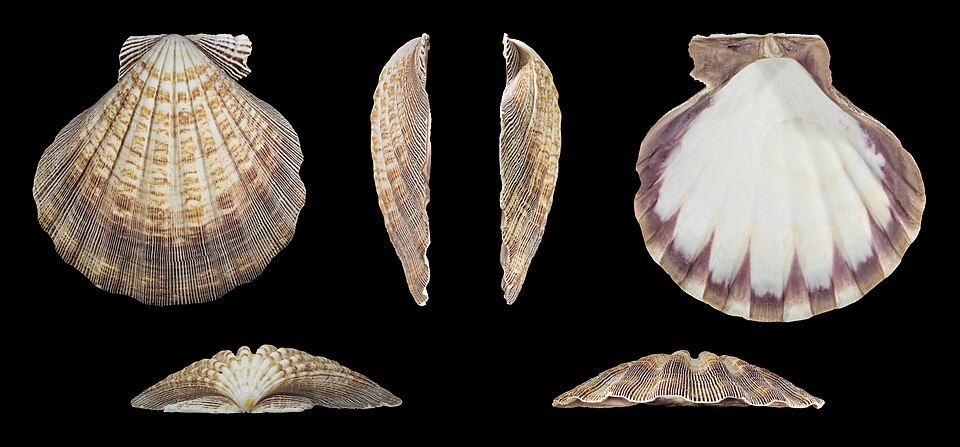
Species account
Summary
Nodipecten subnodosus is a large scallop of the family Pectinidae, in the order Pectinida [1]. It lives in the eastern Pacific, and its range is described as running from Ojo de Liebre lagoon, on the Pacific coast of the Baja California peninsula, to the coast of Peru [2]. In Mexico it supported a regional fishery that collapsed in 2011 [2]. The adductor muscle is the part that is eaten [3].
Etymology
Sowerby described it in 1835 as Pecten subnodosus; it is now accepted in the genus Nodipecten [1]. Its synonyms include Lyropecten subnodosus, Lyropecten intermedius of Conrad (1867) and Pecten arthriticus of Reeve (1853) [1]. WoRMS records the English common name «giant lion's-paw» [1]. The sources consulted do not explain where the epithet comes from [1].
Identification and similar species
It is a large scallop: it can reach 20 cm in length [4], and it is reported to reach 22 cm in height by about 5 years of age [3]. At that age the adductor muscle, the edible portion, weighs about 250 g [3].
In the natural beds of Ojo de Liebre lagoon, between 2013 and 2015, the mean length of the scallops collected was 8, 9.4, 10.2 and 11.7 cm depending on the bed [4]. Shells can be riddled by the boring sponge Cliona californiana [4]; in general, sponges of this family excavate galleries in the shell and make it brittle [4]. The sources consulted do not describe diagnostic shell features or similar species [4].
Distribution and habitat
It occurs in the central-eastern Pacific, from Ojo de Liebre lagoon, on the Pacific coast of the Baja California peninsula, to the coast of Peru, including the central and southern Gulf of California [2]. It typically lives on sandy bottoms, mostly in coastal lagoons and bays [2]. The sources consulted do not say where in Peru it has been recorded [2].
Ojo de Liebre lagoon, where the species is concentrated in Mexico, covers 366 km2 and is 5 to 12 m deep, with sand in the channels, silt and clay in the interior and wide seagrass areas [4]. In general, the species occurs in the subtidal zone, usually less than 5 m deep, under moderate wave action and not exposed to air [4].
The two best-studied Mexican populations live under different thermal regimes: at Ojo de Liebre the water ranges from 13.1 to 26.4 °C, with a long-term average of 19.4 °C, and at Bahía de Los Ángeles, in the Gulf of California, from 12.8 to 32.3 °C, averaging 22.7 °C [2].
Biology
It is a long-lived bivalve that grows fast: it reaches up to 22 cm in about 5 years [2]. In the laboratory broodstock spawned at 25 °C, and the larvae were reared at that temperature until they were 5 to 10 mm long [2].
Its thermal tolerance is limited. In the laboratory it withstands acclimation between 15 and 22 °C, but at 26 and 30 °C up to 27 and 91 % mortality, respectively, has been recorded [4]. Juveniles of 29.2 to 35.0 mm exposed for 96 h to fixed temperatures from 5 to 35 °C showed a lower lethal temperature of about 6.6 °C in both populations, and an upper lethal temperature of 30.58 °C at Ojo de Liebre and 32.13 °C at Bahía de Los Ángeles [2]. About 20 °C is regarded as the optimum for growth [2].
After scallops taken fresh from the lagoon were held at 21, 24 and 28 °C, steady or oscillating, the adductor's ATP, glycogen, total carbohydrates and muscle yield index fell relative to initial values; only temperature level affected glycogen, and those kept at 28 °C differed from those at 21 and 24 °C, so the authors conclude that 28 °C was the most harmful [3]. Year-long records at potential culture sites showed temperatures from 15 to 32 °C, with daily swings of up to 8 °C [3].
Ecology
The two populations studied, the one on the Pacific coast and the one in the Gulf of California, are genetically separated [2]. At Ojo de Liebre, between January 2013 and October 2015, 1082 scallops from 4 beds were examined, and between 45.7 and 60.1 % were infested by the boring sponge Cliona californiana, with no relation to their size [4].
Infestation was highest in spring and summer in three beds, peaking at 80.7 %, 83.3 % and 90.8 %, and in winter in the fourth, where it reached 100 % [4]. Sponges can damage the hinge and the site where the adductor attaches, making it harder to close the valves; even so, at Ojo de Liebre they did not appear to affect the scallops' size [4]. It has been proposed that environmental changes weakened the species' immune response and let opportunistic epibionts infest it [2].
Conservation
The sources consulted include neither a global conservation assessment nor a Peruvian national category [2].
The Ojo de Liebre fishery began in 1995 to replace that of the catarina scallop (Argopecten ventricosus), which collapsed in the late 1980s [4]. The catch rose from 5 t in 1995 to a record 320 t in 2009, was 280 t in 2010 and fell to 80 t in 2011 after heavy mortality [4]. The minimum catch size is 14 cm and it may only be taken with a development and quota permit [4]. The fishery has remained closed since then [2]. The cause of the collapse is not known with certainty and is attributed to exploitation and to environmental factors [4].
Human relevance
The part that is eaten is the adductor muscle, valued for its size, flavour, weight and price [3]. Its production in Baja California and Baja California Sur rose from 35 t in 1993 to 270 t in 2009 [3].
These traits and its fast growth raised interest in farming it; one company and several social organisations farm it in lagoons of Baja California and Baja California Sur [3]. However, it is stated that no robust commercial culture of the species exists today [2].
Where to see it in Peru
According to a 2025 study, the species' range reaches the coast of Peru, but the sources consulted give no Peruvian locality and no observation data for the country [2]. The field data available come from Mexico: Ojo de Liebre lagoon lies within a biosphere reserve where harvesting is only allowed under permit [4].
References (4)
- MolluscaBase contributors (2026). Nodipecten subnodosus (G. B. Sowerby I, 1835). World Register of Marine Species. https://www.marinespecies.org/aphia.php?p=taxdetails&id=394383 (accessed 2026-10-25)
- Monge-Quevedo, A., Carreño-León, D.P., Vázquez-Sánchez, R.I. et al. (2025). Lethal temperatures in two populations of lion's paw scallop Nodipecten subnodosus off the Baja California Peninsula, Mexico. CICIMAR Oceánides, 27-34. doi:10.37543/oceanides.v40i1-2.324 (accessed 2026-10-25)
- Ocaño-Higuera, V.M., Maeda-Martínez, A.N., Castillo-Yáñez, F.J. et al. (2020). Efecto de la temperatura constante y oscilante sobre la condición fisiológica de la almeja mano de león Nodipecten subnodosus//ffect of constant and oscillating temperature on the physiological condition of the lion’s paw scallop Nodipecten subnodosus. Biotecnia, 103-109. doi:10.18633/biotecnia.v22i2.1251 (accessed 2026-10-25)
- González-Ortiz, L., Hernández-Alcántara, P. (2021). Infestación de Nodipecten subnodosus (Mollusca: Bivalvia) por la esponja perforadora Cliona californiana en la laguna Ojo de Liebre, noroeste de México. Revista Mexicana de Biodiversidad, e923460. doi:10.22201/ib.20078706e.2021.92.3460 (accessed 2026-10-25)