
Marine life guide of Peru · Epinephelidae
Broomtail grouper
Mycteroperca xenarcha Jordan, 1888
- Names in Peru
- Mero · Mero cola de retama · Mero negro
Species account
Summary
Identification and similar species
Body depth is less than head length and goes 2.9 to 3.1 times into standard length. The preopercle is angular, with a well-marked serrated lobe at the angle, and the rear nostrils are not much larger than the front ones [2]. It has 29 to 33 gill rakers in total, not counting rudiments, 11 spines and 15 or 16 soft rays in the dorsal fin, 3 spines and 10 or 11 rays in the anal fin, and 16 to 18 rays in each pectoral [2]. From about 20 cm the soft part of the dorsal fin ends in a point, and the straight-edged tail has some rays projecting beyond its margin [2].
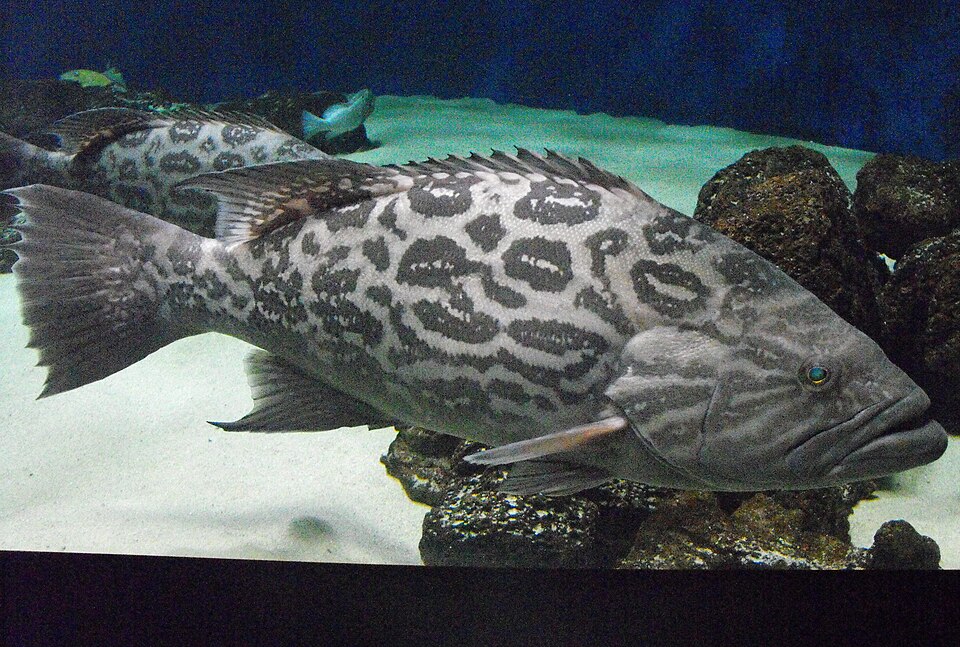
It has two colour patterns. In the blotched one, oblong dark blotches, most with a pale line inside, are scattered over a brown, grey or greyish-green ground; in juveniles they are crowded and leave a pale maze-like network between them, while in adults they spread apart and the pale ground takes over [2]. Juveniles also carry a striking black saddle-shaped mark on the caudal peduncle [2]. The other pattern is plain, uniform grey or brown, with darker fins edged in white; large adults usually look plain, but can show the blotched pattern for brief moments [2].
Similar species
- Mycteroperca jordani: It has a projecting bony lobe at the corner of the preopercle, fewer gill rakers (21 to 26 in total) and no elongated rays in the median fins [2].
- Mycteroperca prionura: It has more gill rakers (34 to 38 in total) and a body covered in small dark reddish-brown spots [2].
- Mycteroperca rosacea: It has more gill rakers (38 to 43) and its fins have no rays projecting beyond the margin [2].
Distribution and habitat
It lives in the eastern Pacific, from southern California, with a single sight record from San Francisco Bay, and from Baja California and the Gulf of California south to Peru [2]. The holotype gives James Island, in the Galapagos, as its locality, but the species has never been found there again, and it has been suggested that its label may have been mixed up with that of another specimen from Paita [2]. Adults and juveniles live in shallow water, and adults are also found down to 60 m [2].
An IMARPE paper, citing earlier literature, describes it as a fish of coastal rocky areas, algae-covered rocks, caves and mangrove lagoons, and gives its range as San Francisco Bay to Paita, with occasional arrivals as far as Callao [6]. In 2015 that team gathered 110 juveniles averaging 27.7 cm total length off the coast of Tumbes and in tidal channels in the mangroves [6]. A 2023 study of spearfishing in Peru states that its main range is the north and part of the centre of the country, and that it behaves mostly as a shallow reef fish, although in some areas it is caught on deeper reefs and, only in the north, around oil rigs [7].
Biology
Based on what is known of the reproduction and behaviour of other Mycteroperca species, the authors of a Peruvian study consider it most likely a sequential hermaphrodite, so that part of the older and larger fish would change sex [7].
At IMARPE's Coastal Laboratory in Tumbes, wild juveniles were slow to adapt to captivity: in the first months they refused all food and only from the third month did they gradually begin to eat prawns, squid and pieces of fish, and later formulated feed [6]. By the fourth month the larger fish had imposed a hierarchy, especially at feeding time, injuring the fins and stripping scales from the smaller ones; PVC pipes placed as shelters reduced the aggression [6]. Under stress their colour changed and blotches appeared on the body [6].
In a 9-month trial in 2016 with 105 juveniles, those given fresh food grew more: they gained 0.31 g per day on fresh food alone and 0.28 g per day on formulated feed plus fresh food, against 0.18 and 0.09 g per day on the two formulated feeds alone [6]. All of them survived, 100 % in the 4 treatments [6].
Ecology
It is linked to mangroves: according to a work cited in the FAO grouper catalogue, it prefers mangrove estuaries [2]. A study at San Bartolo, Lima, treats it as a species of the Panamanian province: in dives made in 1999 and 2000, after the 1997-98 El Niño, it was recorded as rare, and the species of that province that had reached the bay gradually stopped being seen as time went by [4].
The fishers interviewed recalled that in the 1960s it reached as far as Paracas; however, they did not describe the southward expansion the authors expected in the warm years of the 1990s, and during the 1980s and 1990s its range only shrank towards the north [7].
Conservation
Its global category on the IUCN Red List is Data Deficient [5]. In Peru, 40 spearfishers interviewed in 2020 about the period 1960-2019 described a marked decline: the coastline where it was part of the habitual catch went from 1311 km and 12 fishing grounds in the 1980s to 673 km and 7 grounds in the 2010s, 49 % less [7]. By the end of that period, its average daily catch was 25 % of the historical maximum [7].
The authors read these data as signs of overfishing and sequential depletion, though less severe than in other species studied, and suggest that its management could rely on size limits [7]. An IMARPE study notes, citing a 2013 report by the institute, that the species is under heavy extraction, visible in the fall of its catches [6].
The problem is not only Peruvian: in California, Scripps researchers noticed as early as the late 1940s that the species had been depleted in southern La Jolla Bay and off Point La Jolla, which led to repeated calls for a marine reserve [8].
Human relevance
Its large size makes it attractive to anglers and spearfishers [2]. In northern Peru it is an important source of income for harpoon divers and for artisanal handline fishers, thanks to local demand for the quality of its meat in cooking [6]. IMARPE has trialled farming it in Tumbes, with the aim of adding species to aquaculture in that region [6].
Besides spearfishing, it is caught by small bottom-trolling and handline fisheries working mainly off Lobitos, Cabo Blanco, El Ñuro and Los Órganos, between 5 and 210 m deep, and by handline fisheries off Cancas and Punta Mero, over reefs of 15 to 20 m [7]. Official landings recorded zero in many years, even though it is served daily in restaurants across the country [7].
Where to see it in Peru
The 2023 master plan of the Santuario Nacional Los Manglares de Tumbes includes it, as «mero», in its list of fishes [3]. According to a study published in 2023, the fisheries that catch it operate mainly in the north, off Lobitos, Cabo Blanco, El Ñuro, Los Órganos, Cancas and Punta Mero [7]. Further south, at San Bartolo, Lima, it was recorded as rare in dives made in 1999 and 2000, after the 1997-98 El Niño [4].
References (8)
- WoRMS Editorial Board (2026). Mycteroperca xenarcha Jordan, 1888. World Register of Marine Species. https://www.marinespecies.org/aphia.php?p=taxdetails&id=273886 (accessed 2026-10-20)
- Heemstra, P.C., Randall, J.E. (1993). FAO species catalogue. Vol. 16. Groupers of the world (Family Serranidae, Subfamily Epinephelinae). An annotated and illustrated catalogue of the grouper, rockcod, hind, coral grouper and lyretail species known to date. FAO Fisheries Synopsis No. 125, Vol. 16. FAO, Rome, 280-281. https://www.fao.org/3/t0540e/t0540e00.htm (accessed 2026-10-20)
- Servicio Nacional de Áreas Naturales Protegidas por el Estado (2023). Plan Maestro del Santuario Nacional Los Manglares de Tumbes 2023-2027. SERNANP, RP N.° 064-2023-SERNANP. https://cdn.www.gob.pe/uploads/document/file/4137567/RESOLUCION%20PRESIDENCIAL%20N%20064-2023-SERNANP.pdf.pdf (accessed 2026-10-20)
- Gárate, A., Pacheco, A. (2016). Cambios en la distribución y abundancia de la ictiofauna de aguas someras en San Bartolo (Lima, Perú) después del ENSO 1997-98. Ecología Aplicada 3(1-2) (número de 2004), 148-153. doi:10.21704/rea.v3i1-2.284 (accessed 2026-10-20)
- Erisman, B., Craig, M.T. (2016). Mycteroperca xenarcha: Erisman, B. & Craig, M.T. The IUCN Red List of Threatened Species 2018: e.T132811A100571174. doi:10.2305/IUCN.UK.2018-2.RLTS.T132811A100571174.en (accessed 2026-10-20)
- Robles, J., Siccha-Ramirez, R., Cisneros, P. (2019). Acondicionamiento, evaluación de dietas comerciales para crecimiento en cautiverio de juveniles del mero Mycteroperca xenarcha Jordan, 1888. Tumbes, Perú. Boletín Instituto del Mar del Perú 34(1), 115-127. https://revistas.imarpe.gob.pe/index.php/boletin/article/view/16 (accessed 2026-10-20)
- Castagnino, F., Estévez, R.A., Caillaux, M. et al. (2023). Local ecological knowledge (LEK) suggests overfishing and sequential depletion of Peruvian coastal groundfish. Marine and Coastal Fisheries 15(6), e210272. doi:10.1002/mcf2.10272 (accessed 2026-10-20)
- Parnell, P.E., Lennert-Cody, C.E., Geelen, L. et al. (2005). Effectiveness of a small marine reserve in southern California. Marine Ecology Progress Series, 39-52. doi:10.3354/meps296039 (accessed 2026-10-20)