
Marine life guide of Peru · Triakidae
Humpback smoothhoun
Mustelus whitneyi Chirichigno F., 1973
- Names in Peru
- Tollo común · Piruche · Tollo prieto
Species account
Summary
Mustelus whitneyi is a shark of the family Triakidae, in the order Carcharhiniformes [1]. It lives on the bottom of the South American Pacific continental shelf, between Peru and southern Chile, and is grey with no spots [2]. It is one of the six most landed shark species in Peru, and almost all of what reaches the country's main ports is landed in the north [3]. Its global category on the IUCN Red List is Critically Endangered [4].
Etymology
Chirichigno described it in 1973 in a report of the Instituto del Mar del Perú; the holotype is an adult male of 645 mm held in that institution's collection as IMARPE 1210, caught off Paita at a depth of 92 m [2]. Its English name, humpback smooth-hound, and the Spanish name FAO gives it, musola prieta, appear in that organisation's catalogue of sharks, which describes its body as stocky and almost humpbacked [2].
Identification and similar species
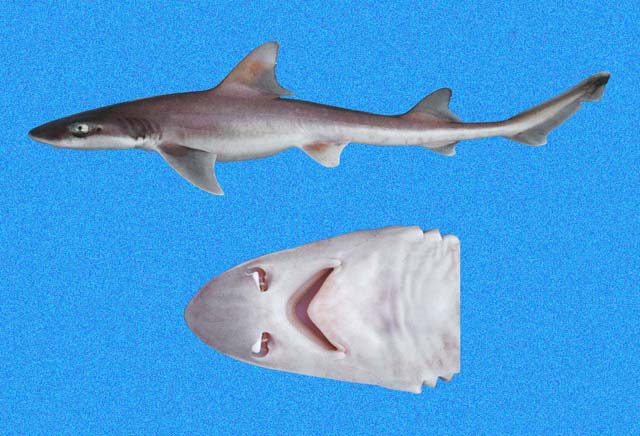
It is a thick-bodied Mustelus with a somewhat arched back, a moderately long snout that looks angular in profile, fairly large eyes and a very wide space between the nostrils [2]. Its teeth have a well-marked main cusp and sometimes smaller cusplets, and the scales on its flanks are lance-shaped, with ridges running from end to end [2]. The rear edge of both dorsal fins is bare, frayed and dark-rimmed, and the tail stalk is short [2].
It is plain grey or grey-brown above and paler below, without white or dark dots and without bars [2]. According to the FAO catalogue, adults measure 68 to 87 cm, the smallest adult male measured 68 cm and the smallest adult female 74 cm [2]. In northern Peru, however, pregnant females of up to 118 cm total length have been measured [5].
Sharks of this genus look very much alike and their characters partly overlap, so that even specialists find them hard to tell apart [6]. 6 species of Mustelus have been recorded in Peru [7].
Similar species
- Mustelus mento: Mustelus mento has a back sprinkled with numerous white dots, rounded teeth without a cusp and the rear edge of the dorsal fins covered in scales, without the bare dark fringe of Mustelus whitneyi [2].
- Mustelus lunulatus: Mustelus lunulatus is also unspotted, but its fins are strongly falcate, its upper labial furrows are shorter than the lower ones and the edge of its dorsal fins is not bare [2]; in northern Peru it has been landed by mistake under the name of Mustelus whitneyi [6].
Distribution and habitat
It is a Southeast Pacific species, reported from Peru to southern Chile [2]. It is on the updated list of chondrichthyans of the Peruvian sea [7], and in northern Chile it is landed together with Mustelus mento by small-scale gillnet fisheries [8].
It lives on the bottom of the continental shelf, away from the shore, between 16 and 211 m deep, though it is most frequent between 70 and 100 m, and it favours rocky bottoms around islands [2]. Between 1996 and 2010, of what was landed at the 7 main ports of Peru, 99 % came ashore at the northern ones: Talara, Paita and San José [3].
Biology
It is viviparous [2], and a study in northern Peru showed that it is a placental live-bearer, that is, the young are nourished through a placenta [5]. That work examined 41 pregnant females, 73 to 118 cm in total length, 386 embryos visible in the uterus and 16 newborns; each litter held 6 to 18 embryos, 10 on average, and larger females tended to carry more, although the relationship was weak [5].
Gestation lasts at least 7 months and the cycle is synchronous: births take place in September, and the pups are 21 to 22 cm long at birth [5]. The FAO catalogue had given somewhat different figures, 5 to 10 pups per litter and about 25 cm at birth [2]. That study was the first to describe its embryonic development [5].
Ecology
Conservation
Its global category on the IUCN Red List is Critically Endangered [4].
Measuring the catch is difficult because in Peruvian markets the different Mustelus are sold together as tollos, and official statistics treat tollo as a single species [6]. DNA barcoding showed in 2019 that, of 8 samples of this group taken at landing sites in Piura and Tumbes, 6 were Mustelus whitneyi and 2 were Mustelus lunulatus, a species absent from the statistics that had been landed under the name of the former; its catch figures may therefore be biased by those of other species [6].
Ministerial Resolution 209-2001-PE sets a minimum landing size of 60 cm for this species and for Mustelus mento [3], with a tolerance of 20 % of individuals below that size [8]. Its landings in Peru showed no significant trend between 2000 and 2010 [3].
Human relevance
In Peru it is known as «tollo común», «piruche» or «tollo prieto» [9],[6]. It is an important fishery resource: between 1996 and 2010 it was the fourth most landed shark in the country, with 7 % of the total, behind the blue shark, the mako and the smooth hammerhead Sphyrna zygaena [3].
Between 1996 and 2000, 85 % of what was landed of this species was caught with gillnets [3]. In northern Chile it is landed under the commercial category of tollo, together with other coastal sharks [8].
Where to see it in Peru
It is a bottom shark known mostly from fisheries: the holotype was caught off Paita at a depth of 92 m, and the species usually lives between 70 and 100 m [2]. According to statistics from 1996 to 2010, almost all of what is landed at the country's main ports comes ashore at those of northern Peru: Talara, Paita and San José [3], and in 2019 it was identified with DNA at small-scale landing sites in Piura and Tumbes [6].
References (9)
- Froese, R., Pauly, D. (2026). Mustelus whitneyi Chirichigno F., 1973. World Register of Marine Species. https://www.marinespecies.org/aphia.php?p=taxdetails&id=271395 (accessed 2026-10-20)
- Compagno, L.J.V. (1984). FAO species catalogue Vol. 4. Sharks of the world. An annotated and illustrated catalogue of shark species known to date. Part 2. Carcharhiniformes. FAO Fisheries Synopsis No. 125, Vol. 4, Part 2. FAO, Rome, 425-426. https://www.fao.org/4/ad123e/ad123e00.htm (accessed 2026-10-20)
- Gonzalez-Pestana, A., Kouri J., C., Velez-Zuazo, X. (2016). Shark fisheries in the Southeast Pacific: A 61-year analysis from Peru. F1000Research, 164. doi:10.12688/f1000research.4412.2 (accessed 2026-10-20)
- Dulvy, N.K., Acuña, E., Bustamante, C. et al. (2020). Mustelus whitneyi: Dulvy, N.K., Acuña, E., Bustamante, C., Cevallos, A., Herman, K. & Velez-Zuazo, X. The IUCN Red List of Threatened Species 2020: e.T63129A124461599. doi:10.2305/IUCN.UK.2020-3.RLTS.T63129A124461599.en (accessed 2026-10-20)
- Gonzalez-Pestana, A., Alfaro-Shigueto, J., Mangel, J.C. (2019). Aspects of reproductive biology of the humpback smooth-hound shark (Mustelus whitneyi) off northern Peru. Marine and Freshwater Research, 1185-1188. doi:10.1071/MF18382 (accessed 2026-10-20)
- Marín, A., Gozzer-Wuest, R., Grillo-Nuñez, J. et al. (2021). DNA barcoding reveals overlooked shark and bony fish species in landing reports of small-scale fisheries from northern Peru. Marine and Fishery Sciences, 307-314. doi:10.47193/mafis.3522022010502 (accessed 2026-10-20)
- Cornejo, R., Vélez-Zuazo, X., González-Pestana, A. et al. (2015). An updated checklist of Chondrichthyes from the southeast Pacific off Peru. Check List, 1809. doi:10.15560/11.6.1809 (accessed 2026-10-20)
- Tapia, K., Mancilla, A., Brizuela, L. et al. (2026). Reproductive Biology of the Speckled Smooth-Hound Shark Mustelus mento (Carcharhiniformes: Triakidae) from the Southeastern Pacific. Fishes, 28. doi:10.3390/fishes11010028 (accessed 2026-10-20)
- Froese, R., Pauly, D. (2026). Mustelus whitneyi, Humpback smooth-hound. FishBase. https://www.fishbase.se/summary/5939 (accessed 2026-10-20)