
Marine life guide of Peru · Triakidae
Sicklefin smoothhound
Mustelus lunulatus Jordan & Gilbert, 1882
- Names in Peru
- Tollo
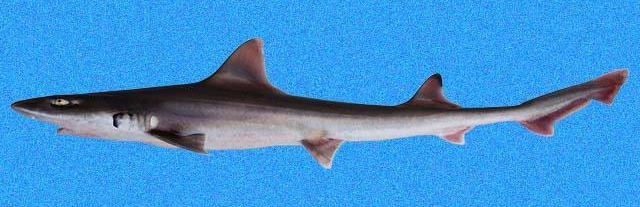
Species account
Summary
Mustelus lunulatus is a shark of the family Triakidae that lives near the seabed on the continental shelf of the eastern Pacific [1],[2]. In Peru it is placed in the far north, between the Ecuadorian border and Talara [3], and in 2019 DNA analysis confirmed that it is landed in Tumbes [4]. Its global IUCN Red List category is Near Threatened [5].
Etymology
Jordan and Gilbert described it from a 620 mm syntype kept at the United States National Museum of Natural History under number USNM 29211, with Mazatlán, Mexico, as the type locality [2]. FAO calls it the sicklefin smooth-hound in English and musola segadora in Spanish, and stresses that its fins are strongly falcate, that is, curved like a sickle [2].
Identification and similar species
It is a Mustelus with a fairly slender body and a short head, a snout of moderate length that looks angular from the side, relatively large eyes and a wide gap between the nostrils [2]. The mouth is long, the upper lip furrows are shorter than the lower ones, and the teeth are molariform and asymmetric, their cusp reduced to a low point [2]. The fins are markedly falcate, as is the lower lobe of the tail in adults, and the rear edge of the dorsal fins is covered in denticles, leaving the ceratotrichia unexposed [2].
The colour is uniform grey or brownish grey above and pale below, without white or dark spots and without bars [2]. Adults measure from 70 to over 110 cm [2], and in Ecuador specimens of up to 135 cm total length have been measured [6]. It has between 74 and 82 vertebrae in front of the tail [2].
6 species of Mustelus have been recorded in Peru; they resemble one another and their features overlap, so even specialists find them hard to separate [4]. Neither of the 2 identification guides to commercial Peruvian sharks cited in that work includes this species [4].
Similar species
- Mustelus mento: Mustelus mento has a stockier body, many white spots on its back and symmetric teeth with rounded crowns and no cusp, whereas Mustelus lunulatus has no spots and its teeth are asymmetric [2].
- Mustelus whitneyi: In 2019 2 specimens of Mustelus lunulatus were landed at Cancas, Tumbes, labelled with the common name of Mustelus whitneyi, and only DNA revealed their identity [4].
Distribution and habitat
It is an eastern Pacific species of warm-temperate and tropical waters; the FAO catalogue placed it from southern California to Panama [2], and its type locality is Mazatlán, Mexico [2]. The checklist of cartilaginous fishes of the Peruvian sea includes it with records between the Ecuadorian border and Talara, in Piura [3].
It lives over the bottom of the continental shelf, from very close to shore to well offshore [2]. An Ecuadorian note, relying on earlier works, places it between 10 and 200 m deep [6].
Biology
The FAO catalogue treated it as viviparous while leaving its mode of reproduction uncertain, and gave a size at birth of 32 to 35 cm [2]. The same note, citing an Ecuadorian field guide, reports 6 to 19 pups per litter [6].
In a sample of 199 individuals landed at Manta, Ecuador, between June and November 2013, with total lengths of 41 to 135 cm, the sex ratio did not differ from 1:1 and males and females showed the same type of growth, isometric [6]. Judging by how calcified the claspers were, half of the males reach maturity at 97.2 cm total length, and most of the males in the sample were immature [6]. That size exceeds the 70 to 83 cm range given by the FAO catalogue [2],[6].
Ecology
According to earlier work summarised in the Ecuadorian note, it feeds mostly on crustaceans [6].
In Colombia no spatial separation between the sexes was seen from about 50 cm total length onward [6]. It has also been proposed that the Gulf of California holds a breeding and nursery area for several shark species, this one among them [6].
Conservation
Its global IUCN Red List category is Near Threatened, according to the 2025 assessment [5].
Measuring what is caught is hard in Peru: Mustelus sharks are sold as tollos and the official statistics treat the tollo as a single species, so this one never appeared under its own name in landing records [4]. Before 2019 the country had no record of the species in landings confirmed by DNA [4]. The authors recall that sharks, Mustelus included, grow slowly, mature late and have few pups, and warn that misidentifications could also affect IUCN categories [4].
Human relevance
In Ecuador it is the most important demersal shark in small-scale fishery landings, and it is caught mostly as bycatch [6]. The FAO catalogue noted that in the Gulf of California it was often taken on longlines and used for human consumption [2].
In Peru IMARPE listed it among commercial species in the 1990s, yet it was never recorded under its own name in landings [4]. It is known as «tollo», the name under which all Mustelus are sold in domestic markets [4]. Two molecular studies found it in markets and supermarkets in Lima and Tumbes in 2017, and in 2019 2 specimens were identified at the Cancas landing site, in Tumbes [4].
Where to see it in Peru
References (6)
- Froese, R., Pauly, D. (2026). Mustelus lunulatus Jordan & Gilbert, 1882. World Register of Marine Species. https://www.marinespecies.org/aphia.php?p=taxdetails&id=271389 (accessed 2026-10-21)
- Compagno, L.J.V. (1984). FAO species catalogue Vol. 4. Sharks of the world. An annotated and illustrated catalogue of shark species known to date. Part 2. Carcharhiniformes. FAO Fisheries Synopsis No. 125, Vol. 4, Part 2. FAO, Rome, 425-426. https://www.fao.org/4/ad123e/ad123e00.htm (accessed 2026-10-21)
- Cornejo, R., Vélez-Zuazo, X., González-Pestana, A. et al. (2015). An updated checklist of Chondrichthyes from the southeast Pacific off Peru. Check List, 1809. doi:10.15560/11.6.1809 (accessed 2026-10-21)
- Marín, A., Gozzer-Wuest, R., Grillo-Nuñez, J. et al. (2021). DNA barcoding reveals overlooked shark and bony fish species in landing reports of small-scale fisheries from northern Peru. Marine and Fishery Sciences, 307-314. doi:10.47193/mafis.3522022010502 (accessed 2026-10-21)
- Rigby, C.L., Saldaña Ruiz, L., Rohner, C.A. (2025). Mustelus lunulatus: Rigby, C.L., Saldaña Ruiz, L. & Rohner, C.A. The IUCN Red List of Threatened Species 2025: e.T161640A124519657. doi:10.2305/IUCN.UK.2025-2.RLTS.T161640A124519657.en (accessed 2026-10-21)
- Briones-Mendoza, J., Pincay-Espinoza, J.E., Palma-Chávez, J. et al. (2018). Notas sobre la biología del tiburón mamona Mustelus lunulatus (Carcharhiniformes: Triakidae) en el Pacífico Central ecuatoriano. Revista de Biología Marina y Oceanografía, 279-284. doi:10.22370/rbmo.2018.53.2.1301 (accessed 2026-10-21)