
Marine life guide of Peru · Molidae
Sunfish
Mola mola (Linnaeus, 1758)
- Names in Peru
- Pez sol · Pez cabeza
Species account
Summary
Mola mola is a bony fish of the family Molidae, in the order Tetraodontiformes [1], to which the pufferfishes also belong [2]. In Peru it is recorded under the names «pez sol» and «pez cabeza» [3]. Instead of a tail fin it has a broad, stiff lobe, the clavus, and it swims by moving its dorsal and anal fins in step [2].
The IUCN Red List classifies it as Vulnerable worldwide [4]. Off the Peruvian coast, sunfishes of the genus Mola are caught in the gillnets and longlines of small-scale fisheries, as bycatch [5].
Etymology
Identification and similar species
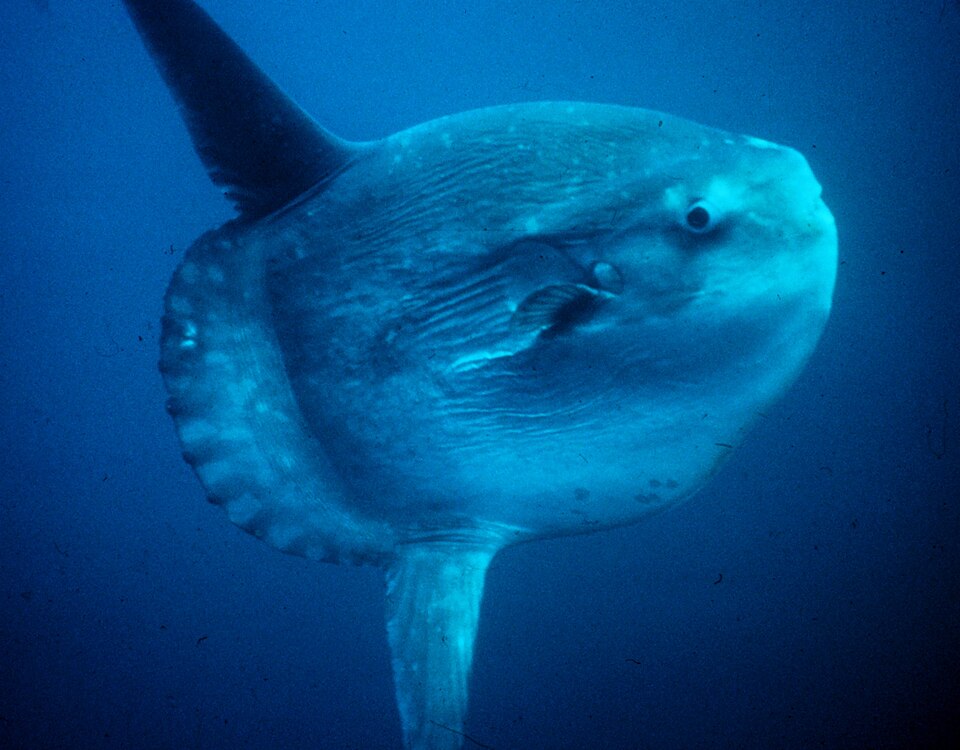
Its body is very deep and short, without scales and covered by a thick, elastic skin [6]. The dorsal and anal fins are very tall with a short base, with 15 to 18 and 14 to 17 soft rays respectively and no spines; the pectoral fins are small and rounded [6]. The mouth is tiny and its teeth are fused into a kind of beak, each gill opening is reduced to a little hole where the pectoral fin joins the body, and the adult has no swim bladder [6].
Its skeleton is largely cartilaginous, and under the skin it carries a thick layer of light, gelatinous tissue that probably helps it float [2]. The backbone is so reduced that the tail fin disappears and is replaced by the clavus; it swims by moving the dorsal and anal fins together, which push it forward in a way that recalls a bird in flight [2]. Before taking this shape it passes through 2 larval stages: the first looks like a tiny pufferfish, with spines and a tail, and in the second the tail is fully absorbed [2].
Females grow larger than males [6]. The greatest total length published for the species is 333 cm, and the greatest published weight is 1.3 t [6].
Similar species
- Mola tecta: In Peru it was at first mistaken for Mola mola; it is recognised by a rounded clavus with an indent, a smooth band with a marked back-fold at that indent and 5 to 7 small ossicles on the edge of the clavus, features that in the Peruvian study could only be checked by close inspection of photographs [5].
- Mola alexandrini: It shares physical features with Mola mola; the 2019 Peruvian study notes that it had not yet been recorded in Peruvian waters, but some unidentified sunfishes with a rounded clavus caught in Peru may have belonged to it [5]. A 2744 kg specimen from the North Atlantic is the heaviest bony fish on record [7].
- Masturus lanceolatus: The clavus of this species bears a long projection, whereas in the genus Mola the clavus is rounded [5],[8].
Distribution and habitat
It is a marine, pelagic, open-ocean species found in the tropical and temperate zones of every ocean [6]. However, when specimens from Australia and New Zealand were checked with genetics and morphology, Mola mola turned out to be fairly scarce there, with 3 other species of the family dominating, so the bycatch data attributed to it there were in fact a mix of species [9].
In the eastern Pacific, 15 fish fitted with satellite tags off southern California between 2003 and 2010 never strayed more than about 300 km from shore, and nearly all of them travelled with the seasons into waters off Baja California, Mexico [10]. It is known to descend to at least 472 m [11], and the fish tagged off California made occasional dives deeper than 500 m [10].
For Peru, the annotated catalogue of marine fishes by Chirichigno and Cornejo, published by IMARPE in 2001, already listed Mola mola [5],[8]. Between 2005 and 2017, observers of the small-scale fisheries reported sunfishes along the coast, in both coastal and oceanic waters, although most could not be identified beyond the genus Mola [5].
Biology
It is the most fecund vertebrate known: a female of 137 cm was estimated to hold about 300 million eggs [2]. Oocytes at different stages in the ovary suggest that it spawns several times [6]. It grows very fast: one fish in captivity put on about 400 kg in 15 months, an average of 0.82 kg per day [2].
It is not a fish that merely drifts with the current. A 1 m fish tagged off southern Portugal travelled more than 1800 km in 92 days, reaching waters off Morocco and West Africa [11]. The fish tagged off California showed a daily vertical migration, and the largest, of 2 m, followed upwelling fronts along a route of more than 800 km [10].
Ecology
In the northeast Atlantic it feeds mostly on large jellyfish such as Rhizostoma octopus, Chrysaora hysoscella and Cyanea capillata, although juveniles and sub-adults seem to have a broader diet; for this reason it is seen as a predator that may help keep jellyfish blooms in check [12]. Off Baja California, plankton sampling in the area used by the tagged fish found dense salp populations near upwelling fronts, which appear to offer it good feeding grounds [10].
Besides jellyfish, fishes, molluscs, crustaceans, zooplankton and brittle stars have been reported in the diet of adults [6]. Juveniles are eaten by California sea lions in Monterey Bay [6]. It hosts many parasites: a juvenile identified by genetics in the Tyrrhenian Sea carried 46 parasites of 10 different species, on the gills and skin and in the gut and liver [13].
Conservation
The IUCN assessed it in 2011 and classified it as Vulnerable worldwide [4]. That category reflects local declines and heavy bycatch in parts of its range [12]. In the California drift gillnet fishery it is the species that turns up most often as bycatch [10].
In Peru, observers recorded 114 sunfishes in the small-scale gillnet and longline fisheries between 2005 and 2017, 77 % of them in gillnets [5]. From these data the Salaverry fleet was estimated to catch about 23 a year and the Ancón and Chorrillos fleet about 352, and the authors reckoned that the national gillnet fleet could be catching thousands each year [5]. Of the 52 whose condition is known, 61 % were released or seen alive, but how many survive the injuries left by the gear is unknown; there are also signs of sunfish bycatch in the industrial anchoveta purse-seine fishery, with no data yet [5].
Health, toxicological and chemical relevance
Not medical advice. For a sting, a poisoning or an allergy, seek medical care.
In the European Union it is forbidden to place on the market fishery products of the family Molidae, which the regulation groups with the pufferfishes as poisonous fish [14]. FishBase likewise flags it as dangerous to eat and notes that fishes of this family may carry the same toxin as pufferfishes [6].
Peruvian small-scale fishers who were interviewed said they do not eat it because of its heavy load of parasites [5]. In a specimen from the Mediterranean, among other parasites, a larva of the nematode Anisakis simplex, in the broad sense, was found [13].
Human relevance
In Peru no directed fishery for sunfishes was observed, but at least 2 dead bycaught fish were kept to be sold as food [5]. Elsewhere in the world it has minor commercial importance: it is generally not used as food, although in some places it is regarded as a delicacy and certain parts are used in Chinese medicine [6].
Where to see it in Peru
The data published in 2019 come from onboard and port-based observers of the small-scale fisheries between 2005 and 2017, at ports from Zorritos and Máncora to Ilo; 53 of the 114 sunfish reports came from gillnet fishers at Salaverry, in northern Peru [5]. Sunfishes were caught or sighted all year round, especially in the austral summer, from January to March, and in spring, from October to December [5].
References (14)
- WoRMS Editorial Board (2026). Mola mola (Linnaeus, 1758). World Register of Marine Species. https://www.marinespecies.org/aphia.php?p=taxdetails&id=127405 (accessed 2026-10-20)
- Pan, H., Yu, H., Ravi, V. et al. (2016). The genome of the largest bony fish, ocean sunfish (Mola mola), provides insights into its fast growth rate. GigaScience, 36. doi:10.1186/s13742-016-0144-3 (accessed 2026-10-20)
- Froese, R., Pauly, D. (2026). Common names of Mola mola. FishBase. https://www.fishbase.se/comnames/CommonNamesList.php?ID=1732&GenusName=Mola&SpeciesName=mola (accessed 2026-10-20)
- Jing, L., Zapfe, G., Shao, K.-T. et al. (2011). Mola mola: Jing, L., Zapfe, G., Shao, K.-T., Leis, J.L., Matsuura, K., Hardy, G., Liu, M., Robertson, R. & Tyler, J. The IUCN Red List of Threatened Species 2015: e.T190422A1951231. doi:10.2305/IUCN.UK.2015-4.RLTS.T190422A1951231.en (accessed 2026-10-20)
- Mangel, J.C., Pajuelo, M., Pasara-Polack, A. et al. (2019). The effect of Peruvian small-scale fisheries on sunfishes (Molidae). Journal of Fish Biology, 77-85. doi:10.1111/jfb.13862 (accessed 2026-10-20)
- Froese, R., Pauly, D. (2026). Mola mola, Ocean sunfish. FishBase. https://www.fishbase.se/summary/Mola-mola.html (accessed 2026-10-20)
- Gomes-Pereira, J.N., Pham, C.K., Miodonski, J. et al. (2022). The heaviest bony fish in the world: A 2744-kg giant sunfish Mola alexandrini (Ranzani, 1839) from the North Atlantic. Journal of Fish Biology, 290-293. doi:10.1111/jfb.15244 (accessed 2026-10-20)
- Moreno-Méndez, A., Campos-León, S., Béarez, P. (2020). First record of a stranded specimen of the sharptail mola, Masturus lanceolatus (Actinopterygii: Tetraodontiformes: Molidae), from the central coast of Peru. Acta Ichthyologica et Piscatoria, 103-106. doi:10.3750/AIEP/02762 (accessed 2026-10-20)
- Nyegaard, M., Loneragan, N., Hall, S. et al. (2018). Giant jelly eaters on the line: Species distribution and bycatch of three dominant sunfishes in the Southwest Pacific. Estuarine, Coastal and Shelf Science, 1-15. doi:10.1016/j.ecss.2018.03.017 (accessed 2026-10-20)
- Thys, T.M., Ryan, J.P., Dewar, H. et al. (2015). Ecology of the Ocean Sunfish, Mola mola, in the southern California Current System. Journal of Experimental Marine Biology and Ecology, 64-76. doi:10.1016/j.jembe.2015.05.005 (accessed 2026-10-20)
- Sims, D.W., Queiroz, N., Humphries, N.E. et al. (2009). Long-Term GPS Tracking of Ocean Sunfish Mola mola Offers a New Direction in Fish Monitoring. PLoS ONE, e7351. doi:10.1371/journal.pone.0007351 (accessed 2026-10-20)
- Breen, P., Cañadas, A., Ó Cadhla, O. et al. (2017). New insights into ocean sunfish (Mola mola) abundance and seasonal distribution in the northeast Atlantic. Scientific Reports, 2025. doi:10.1038/s41598-017-02103-6 (accessed 2026-10-20)
- Santoro, M., Palomba, M., Mattiucci, S. et al. (2020). New Parasite Records for the Sunfish Mola mola in the Mediterranean Sea and Their Potential Use as Biological Tags for Long-Distance Host Migration. Frontiers in Veterinary Science, 579728. doi:10.3389/fvets.2020.579728 (accessed 2026-10-20)
- European Parliament, Council of the European Union (2004). Regulation (EC) No 853/2004 of the European Parliament and of the Council of 29 April 2004 laying down specific hygiene rules for food of animal origin (consolidated text 27.01.2026). Official Journal of the European Union L 139, 30.4.2004; FAOLEX copy. https://faolex.fao.org/docs/pdf/eur63427.pdf (accessed 2026-10-20)