
Marine life guide of Peru · Modiolidae
Modiolus capax
Modiolus capax Conrad, 1837
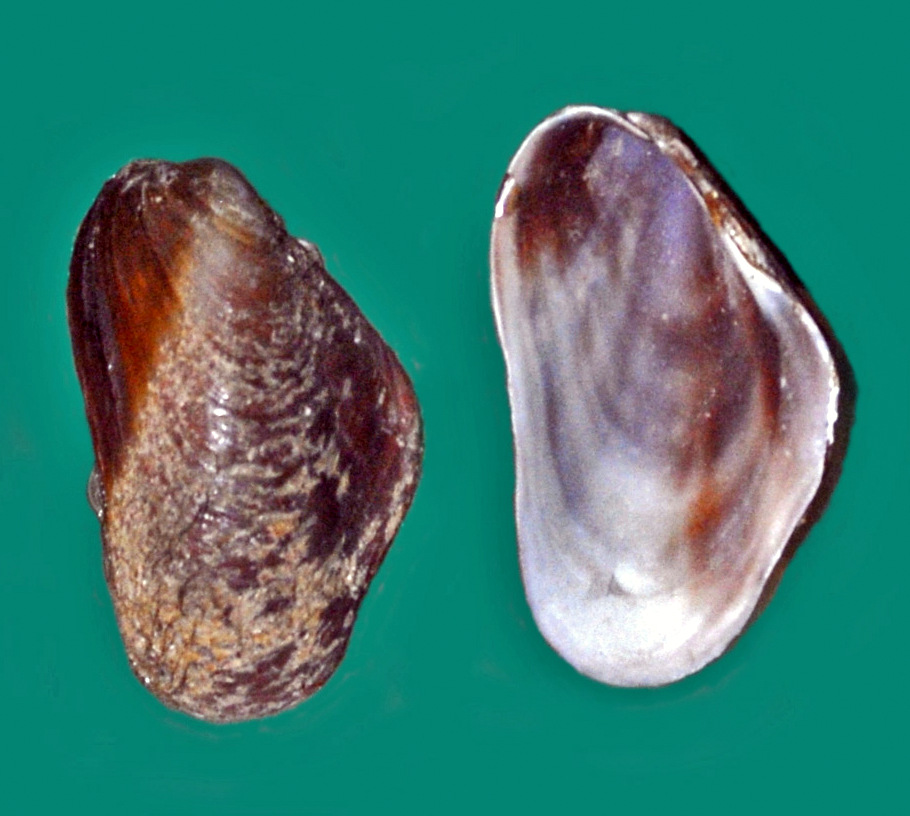
Species account
Summary
Modiolus capax is a marine bivalve of the family Modiolidae, order Mytilida [1]. It lives in the eastern Pacific from California to northern Peru [2]. In the Gulf of California it is abundant in Baja California Sur and forms important beds, which have been studied both as a fishery resource and as an environmental indicator [3],[4],[5]. It releases gametes almost all year round, has separate sexes, and its size at maturity (half of the animals mature) is about 72–74 mm of shell length in two beds at La Paz [4].
Identification and similar species
The shell of Modiolus capax is that of a large mussel: in a sample from Santa Rosalía, in the southwestern Gulf of California, the mean shell height was 100.08 mm and the mean total weight was 126.60 g [3]. Shell shape changes between populations. Mussels from Santa Rosalía, further north, had a more elongated shell, while those from La Paz Bay had a more compact and convex one [3].
The Peruvian checklist of marine bivalves includes other species of the same genus, such as Modiolus americanus, Modiolus eiseni and Modiolus tumbezensis [2]. The sources consulted give no shell feature that separates them from Modiolus capax, so this account offers no field identification key [2].
Distribution and habitat
The known range runs from California, in the United States, through the Gulf of California and Sonora, in Mexico, with records from Cocos Island, in Costa Rica, and the Galápagos Islands, in Ecuador [2]. In Peru, the annotated checklist of marine bivalves records it as far as Paita, in Piura, and on the Lobos de Tierra Islands, in Lambayeque [2]. Another study places the southern limit of the range at Paita [6].
The habitat runs from the intertidal zone down to about 35 m, over sandy bottoms, according to the Peruvian checklist [2]. At La Paz, Mexico, one intertidal bed occupied sand with dead coral and sandstone, at no more than 1 m depth, and another bed grew at 5 m on a sunken ship, the base of an artificial reef created in 1974 [4]. At Santa Rosalía and in La Paz Bay, mussels were collected from rocky bottom, at mean depths of 3 m and 1.9 m respectively [3].
The species is gregarious and is relatively abundant in some areas and scarce in others, so that its occurrence is interrupted by long stretches with no individuals [6].
Biology
The sexes are separate, and the ratio of females to males did not depart from 1:1 in two beds of the Ensenada de La Paz, where 276 females and 273 males were examined in one bed and 141 females and 137 males in the other [4]. The length at which half of the animals are mature was 74.12 mm of shell length in the intertidal bed and 71.74 mm in the 5 m bed [4].
Gametes were released during almost the whole sampling period, from 2008 to 2010, with spawning peaks in March 2009 and May 2010 in the intertidal bed and in January 2009 in the 5 m bed [4]. The authors note that these peaks do not match earlier studies, which had found maximum spawning in summer, from June to August, and that environmental conditions can modify the reproductive periodicity of bivalves [4].
At Bahía de los Ángeles, Baja California, wild mussels had only just begun post-spawning in September and were close to the end of post-spawning or resting by December [7]. Kept in the laboratory at 19 ± 2 °C with food rations above maintenance level, mature mussels did not spawn spontaneously, although by eight weeks their gonads already showed early resorption; the authors propose that the natural cycle, in which most spawning happens in summer and the gonad rests from late autumn into early winter, may be what limits their capacity to hold on to ripe gametes [7]. Between two populations of the Gulf of California about 1100 km apart, allozyme frequencies differ little but significantly (FST = 0.049), which suggests gene flow over long distances with slight local divergence, attributed to factors acting on larval dispersal and settlement [6].
Ecology
In an experiment at Bahía de los Ángeles, Baja California, young mussels settled with some abundance on mesh and nylon strings immersed for more than two months, covered by a filamentous epibiosis formed chiefly by a hydroid of the genus Obelia; on tyre-rubber strings settlement was scarce [8]. The authors conclude that recruitment was scarce and growth slow [8].
Parasites and gonadal lesions are frequent in the beds of La Paz. In the intertidal bed, 44 % of the males and 43 % of the females (parasitized and atretic) were parasitized, and in the 5 m bed 22 % of the males and 82 % of the females; a coccidian was also seen in a male gonad [4]. At Santa Rosalía, presumptive hypnospores of the protozoan Perkinsus marinus were detected in almost 20 % of the mussels analysed [9]. The authors conclude that the species has low susceptibility to this parasite and that its health is not compromised, because prevalence and load were low [9].
The state of the gonad was related to the environment: in the intertidal bed at La Paz, the gonadosomatic index rose together with chlorophyll a [4].
Health, toxicological and chemical relevance
Not medical advice. For a sting, a poisoning or an allergy, seek medical care.
In La Paz Bay, 16 polycyclic aromatic hydrocarbons were measured in the sediment and in the tissues of Modiolus capax from three sites with increasing human pressure. In the sediment the totals were 18.9 to 94.5 ng/g dry weight, below the effect range low at every site; concentrations in the mussels, from 147.01 to 271.09, were higher than those in the sediment and similar to those of mussels from other moderately contaminated sites, and their origin was mostly petrogenic [5]. In the mussels of two of the sites benzo(a)pyrene was present in some animals, one of the most toxic hydrocarbons, and the authors present the study as a baseline and state that further studies are needed to rule out risks to human health [5].
At Santa Rosalía, of the samples with presumptive hypnospores of Perkinsus marinus only 5 % were confirmed by PCR, and the intensity of infection ranged from negative to light [9].
Human relevance
The Peruvian checklist of marine bivalves marks Modiolus capax as a species of commercial use [2]. In northwestern Mexico it is regarded as a commercially important fishery resource, with potential for fishing and aquaculture, although few studies of its reproduction exist [4]. Other authors point out that in the southwestern Gulf of California its consumption is limited compared with higher-value molluscs [3].
Farming has obstacles. At Bahía de los Ángeles, scarce recruitment and slow growth made it hard to culture, although the share of meat in total weight was higher than in other cultured mussels [8]. Tissues of this species have also been analysed to estimate pollution, such as the hydrocarbons of La Paz [5].
Where to see it in Peru
The Peruvian literature consulted, an annotated checklist published in 2016, places Modiolus capax at Paita, in Piura, and on the Lobos de Tierra Islands, in Lambayeque, between the intertidal zone and 35 m depth, over sandy bottom [2]. The checklist does not say whether those places are hard to reach or restricted, nor does it give abundance data, so it cannot be said that the species is easy to see [2].
References (9)
- MolluscaBase eds. (2026). Modiolus capax Conrad, 1837. World Register of Marine Species. https://www.marinespecies.org/aphia.php?p=taxdetails&id=506104 (accessed 2026-10-25)
- Paredes, C., Cardoso, F., Santamaría, J. et al. (2016). Lista anotada de los bivalvos marinos del Perú. Revista Peruana de Biología. doi:10.15381/rpb.v23i2.12397 (accessed 2026-10-25)
- Góngora-Gómez, A.M., Arellano-Martínez, M., Rodríguez-Figueroa, G.M. et al. (2022). Variaciones morfológicas de la concha del mejillón choro, Modiolus capax, en dos poblaciones silvestres del suroeste del Golfo de California. Revista de Biología Marina y Oceanografía. doi:10.22370/rbmo.2022.57.3.4069 (accessed 2026-10-25)
- García-Domínguez, F.A., Carvalho-Saucedo, L., Vélez-Arellano, N. (2018). Reproductive cycle of two Modiolus capax (Bivalvia: Mytilidae) beds at different depths at Ensenada de La Paz, Gulf of California, Mexico. Hidrobiológica. doi:10.24275/uam/izt/dcbs/hidro/2018v28n3/garcia (accessed 2026-10-25)
- Roldán-Wong, N.T., Kidd, K., Ceballos-Vázquez, B.P. et al. (2020). Polycyclic aromatic hydrocarbons (PAHs) in mussels (Modiolus capax) from sites with increasing anthropogenic impact in La Paz Bay, Gulf of California. Regional Studies in Marine Science. doi:10.1016/j.rsma.2019.100948 (accessed 2026-10-25)
- De la Rosa-Vélez, J., Farfán, C., Cervantes-Franco, M.A. (2000). Geographic pattern of genetic variation in modiolus capax (conrad, 1837) from the gulf of california. Ciencias Marinas. doi:10.7773/cm.v26i4.620 (accessed 2026-10-25)
- Farfán, C., Espinoza-Peralta, A.M., Tapia-Vázquez, O. (2015). Dilación del desove de Modiolus capax (Bivalvia: Mytilidae). Revista de Biología Tropical. doi:10.15517/rbt.v46i3.20124 (accessed 2026-10-25)
- Aguirre-Hinojosa, E., Bückle-Ramírez, L.F. (1992). Settlement and growth of the mussel Modiolus capax (Conrad) (Bivalvia-Mytilidae) on artificial substrates in Bahia de los Angeles, Baja California, Mexico. Ciencias Marinas. doi:10.7773/cm.v18i2.894 (accessed 2026-10-25)
- Góngora-Gómez, A.M., López-Meyer, M., Villanueva-Fonseca, L.C. et al. (2021). Detection of Perkinsus marinus in a wild population of the horsemussel Modiolus capax from the southwestern Gulf of California. Hidrobiológica. doi:10.24275/uam/izt/dcbs/hidro/2021v31n3/gongora (accessed 2026-10-25)