
Marine life guide of Peru · Mobulidae
Giant oceanic manta ray
Mobula birostris (Walbaum, 1792)
- Names in Peru
- Manta · Mortaja voladora
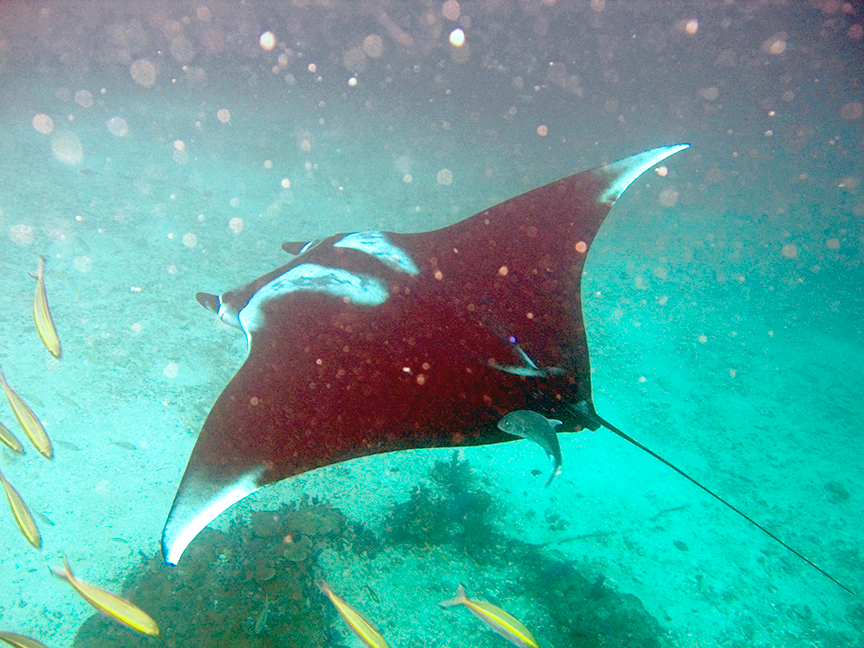
Species account
Summary
Mobula birostris is a ray of the family Mobulidae, order Myliobatiformes [1]. It is the largest of the mantas: according to the data compiled in a 2019 paper, its disc reaches at least 670 cm across, animals of 910 cm have been reported, and one individual was recorded at 2000 kg [2]. In Peru it is called «manta» and also «mortaja voladora» [3]. Since January 2016 it has been illegal to fish it in Peruvian waters or to land, transport or sell it [4]. The group living off the coast of Ecuador and northern Peru is probably the largest population in the world [5].
Etymology
Walbaum described it in 1792 as Raja birostris, and its synonyms include Manta birostris and Cephalopterus manta [1]. The genus Manta gathered so many names that it came to hold 10 generic and 25 specific synonyms; for a long time it was treated as a genus with a single species, until a 2009 study of body shape and counts split it into two species and made Manta alfredi valid again [6]. Later, an analysis of mitochondrial genomes and of about 1000 nuclear exons found that both mantas belong to the Mobula lineage; Manta was therefore dropped as a separate genus and the family Mobulidae was left with a single genus [7].
Identification and similar species
Two very similar manta species are recognised. They are separated by colour, teeth, skin denticles, the tail spine, the size at which they mature and the maximum disc width; the oceanic one is the more widely distributed [6].
A female fetus taken in Tumbes already had spots on its belly, although the authors cannot be sure that this pattern is the final one. Its belly was creamy white, slightly pink, with small black spots forming a semicircle below the fifth gill slit; the back was blackish and darker near the mouth; the cephalic fins had black-edged inner faces with white centres and mostly white outer faces; and at the base of the tail it bore a spine, which the authors single out as a key character of the species [2].
Three colour variants are described in Ecuador. The commonest has a V-shaped grey band on the underside, across the rear part of the pectoral fins; the leucistic one is pale above and has few or no belly spots; the melanistic one is black on the back and almost entirely black below, with a few white areas between the gill slits [5]. Of 2803 mantas photographed between 2005 and 2018, 65.1 % were of the first variant, 18.7 % leucistic and 16.2 % melanistic, and because each animal's belly spot pattern stays the same throughout its life, it can be used to recognise it in photographs [5].
Similar species
- Mobula alfredi: The reef manta is smaller and more tropical; it is told apart from the oceanic manta by colour, teeth, denticles, the tail spine, size at maturity and maximum disc width [6].
Distribution and habitat
It has been reported from waters all around the world: north to Rhode Island and southern California, Japan, Egypt and the Azores, and south to New Zealand, South Africa, Uruguay and Peru [6]. It tends to live in open water away from the coast, at places such as seamounts and oceanic islands [5].
Of the 5 satellite tags fitted off Tumbes in 2018, 3 sent data: two mantas stayed on or near the continental shelf and moved between the coast of Tumbes and that of Ecuador, while the third headed into the open ocean and reached the Galapagos, some 1300 km from where it was tagged [8]. That same manta went down to 648 m, although it spent 98 % of its time in the top 50 m [8]. An individual photographed at Isla de la Plata, Ecuador, in June 2009 was seen again in June 2015 by the oil platforms off Zorritos, 268 km away in a straight line, and the population is thought to span the coast of southern Ecuador and northern Peru [5].
Biology
Mantas have a single pup per birth, rarely two, after a pregnancy of about one year, which lasted 366 to 374 days at the Okinawa aquarium [9]. Their maximum population growth rate was estimated at 0.116 per year, one of the lowest among the 106 sharks and rays compared [9].
On 6 September 2017 a female with a disc 621 cm wide became tangled in a small-scale fishing net about 4 miles off Acapulco, Tumbes, and carried in her uterus a female fetus 137 cm wide weighing 23.6 kg, with its pectoral fins folded over its back [2]. The authors judge it to be a fetus at a middle or advanced stage and mention another 3 pregnant females recorded in the area between August 2012 and May 2013, which points to the north coast of Peru as a possible breeding area [2].
At two Ecuadorian sites, Isla de la Plata and the Bajo Copé seamount, 2803 mantas were identified between 2005 and 2018, with 1.67 males for every female, and 83.5 % of the identified males were adults [5]. The best-fitting model estimated a superpopulation of 22,316 individuals, and sightings peaked each year between 25 August and 15 September [5].
Ecology
Although it feeds by filtering plankton, stable isotopes in its muscle, sampled in Ecuador between 2012 and 2014, place it at a trophic level of about 3.4 and assign on average 73 % of its diet to mesopelagic prey and only 27 % to surface zooplankton [10].
The 3 mantas tagged off Tumbes swam deeper at night than by day, and each spent more than half of the day in the top 2 m; the 2 recovered tags show that at night they kept moving up and down through a strongly stratified water column, on dives in which the temperature changed by up to 10 °C [8]. The authors suggest that at night they go down to eat zooplankton that migrates vertically and come back to the surface to regain heat, so northern Peru would be a feeding area [8]. Around Isla de la Plata and the Bajo Copé seamount they are seen mostly being cleaned or cruising and seldom feeding, and 9 of the identified mantas carried wounds from shark attacks [5].
Conservation
In Peru, Ministerial Resolution N.° 441-2015-PRODUCE, published on 1 January 2016, bans taking it with any fishing gear and also bans landing, transporting, holding, processing and selling it; if one is caught by accident it must be returned to the sea at once and unharmed, and IMARPE is put in charge of studying its populations [4]. Ministerial Resolution N.° 000362-2024-PRODUCE, published on 8 September 2024, extended that protection to Mobula tarapacana, Mobula mobular, Mobula thurstoni and Mobula munkiana [11].
The Convention on Migratory Species has listed it in its Appendices I and II since 2011 [12]. All manta and devil rays are in CITES Appendix II, which aims to control their international trade, above all in the gill plates sold as a tonic in some Asian countries [5]. Because their population growth rate is among the lowest of sharks and rays, fishing can deplete their populations quickly [9].
Between January 2015 and February 2016, observers aboard the small-scale gillnet fleet of northern Peru recorded no manta caught; they saw a single entanglement, from which the animal was freed alive, and on shore just one specimen was recorded landed, at Zorritos [13]. At six landing sites in Tumbes and Piura, between April 2017 and February 2019, 4 of the 257 mobulids sampled were this species, that is 1.6 % [14]. Because it spends so much time at the surface of coastal waters, it overlaps with the drift gillnets and bottom nets set near the coast, and it runs a higher risk of being struck by boats [8]. In Ecuador, of 563 mantas whose injuries were described, 348, or 61.8 %, were entangled or bore scars from fishing lines [5].
Health, toxicological and chemical relevance
Human relevance
For small-scale fishers in northern Peru it is an unwanted catch: it damages nets and costs them fishing time while they try to free it, so they warn one another where a large manta has been seen; in one case, a crew worked for 3 days to release one that had become tangled in 8 net panels and ended up losing 3 [13]. Some fishers reckon that each encounter can cost them up to 1300 dollars in gear [8].
The authors of the Tumbes tagging study suggest the area could become a destination for community-based manta watching, provided that protocols are applied to avoid disturbing the animals, boat strikes and entanglement in dive lines and buoys [8].
Where to see it in Peru
In May and July 2018 mantas were tagged off the Tumbes region, near 3.5° S; they were found swimming at the surface by searching from boats with local fishers and were tagged by free-divers, and the authors describe the place as an aggregation site [8]. One of the known mantas from Ecuador was photographed in June 2015 by the oil platforms near Zorritos [5].
In addition, between 2017 and 2019 a few mantas turned up landed at ports in Tumbes and Piura, although they were very few among the mobulids examined [14].
References (14)
- WoRMS Editorial Board (2026). Mobula birostris (Walbaum, 1792). World Register of Marine Species. https://www.marinespecies.org/aphia.php?p=taxdetails&id=1026118 (accessed 2026-10-20)
- Cabanillas-Torpoco, M., Forsberg, K., Siccha-Ramírez, R. et al. (2019). First description of a giant manta ray fetus Mobula birostris (Walbaum 1792) from Tumbes, Peru (Southeast Pacific). Zootaxa, 397-400. doi:10.11646/zootaxa.4603.2.12 (accessed 2026-10-20)
- Froese, R., Pauly, D. (2026). Mobula birostris, Oceanic manta ray. FishBase. https://www.fishbase.se/summary/2061 (accessed 2026-10-20)
- Ministerio de la Producción (2016). Resolución Ministerial N.° 441-2015-PRODUCE: prohíben extracción de la especie Mantarraya gigante con cualquier arte o aparejo de pesca y/o cualquier otro instrumento, en aguas marinas de la jurisdicción peruana. El Peruano, Normas Legales (01-01-2016). https://busquedas.elperuano.pe/dispositivo/NL/1329586-2 (accessed 2026-10-20)
- Harty, K., Guerrero, M., Knochel, A.M. et al. (2022). Demographics and dynamics of the world’s largest known population of oceanic manta rays Mobula birostris in coastal Ecuador. Marine Ecology Progress Series, 145-159. doi:10.3354/meps14189 (accessed 2026-10-20)
- Marshall, A.D., Compagno, L.J.V., Bennett, M.B. (2009). Redescription of the genus Manta with resurrection of Manta alfredi (Krefft, 1868) (Chondrichthyes; Myliobatoidei; Mobulidae). Zootaxa, 1-28. doi:10.11646/zootaxa.2301.1.1 (accessed 2026-10-20)
- White, W.T., Corrigan, S., Yang, L. et al. (2017). Phylogeny of the manta and devilrays (Chondrichthyes: mobulidae), with an updated taxonomic arrangement for the family. Zoological Journal of the Linnean Society, 50-75. doi:10.1093/zoolinnean/zlx018 (accessed 2026-10-20)
- Andrzejaczek, S., Schallert, R.J., Forsberg, K. et al. (2021). Reverse diel vertical movements of oceanic manta rays off the northern coast of Peru and implications for conservation. Ecological Solutions and Evidence, e12051. doi:10.1002/2688-8319.12051 (accessed 2026-10-20)
- Dulvy, N.K., Pardo, S.A., Simpfendorfer, C.A. et al. (2014). Diagnosing the dangerous demography of manta rays using life history theory. PeerJ, e400. doi:10.7717/peerj.400 (accessed 2026-10-20)
- Burgess, K.B., Couturier, L.I.E., Marshall, A.D. et al. (2016). Manta birostris, predator of the deep? Insight into the diet of the giant manta ray through stable isotope analysis. Royal Society Open Science, 160717. doi:10.1098/rsos.160717 (accessed 2026-10-20)
- Ministerio de la Producción (2024). Resolución Ministerial N.° 000362-2024-PRODUCE: incorporan nuevas especies dentro de los alcances de la Resolución Ministerial N.° 441-2015-PRODUCE. El Peruano, Normas Legales (08-09-2024). https://busquedas.elperuano.pe/dispositivo/NL/2322814-1 (accessed 2026-10-20)
- Convention on the Conservation of Migratory Species of Wild Animals (2026). Mobula birostris. CMS, species page. https://www.cms.int/species/mobula-birostris (accessed 2026-10-20)
- Alfaro-Cordova, E., Del Solar, A., Alfaro-Shigueto, J. et al. (2017). Captures of manta and devil rays by small-scale gillnet fisheries in northern Peru. Fisheries Research, 28-36. doi:10.1016/j.fishres.2017.06.012 (accessed 2026-10-20)
- Rojas-Perea, S., D’Costa, N.G., Kanagusuku, K. et al. (2024). Fisheries, trade, and conservation of manta and devil rays in Peru. Environmental Biology of Fishes, 725-748. doi:10.1007/s10641-024-01647-7 (accessed 2026-10-20)