
Marine life guide of Peru · Balaenopteridae
Humpback whale
Megaptera novaeangliae (Borowski, 1781)
- Names in Peru
- Ballena jorobada · Yubarta
Species account
Summary
Megaptera novaeangliae is a baleen whale of the family Balaenopteridae, described by Borowski in 1781 [1]. In Peru it is called «ballena jorobada» or «yubarta» [2]. Whales of the Southeast Pacific travel some 8000 km from their Antarctic and Magellanic feeding grounds to tropical coastal waters, where they breed during the austral winter and spring [3]. Northern Peru's coast marks the southern end of that breeding area [4]. The IUCN Red List classifies it as Least Concern in its 2018 assessment [5].
Etymology
Identification and similar species
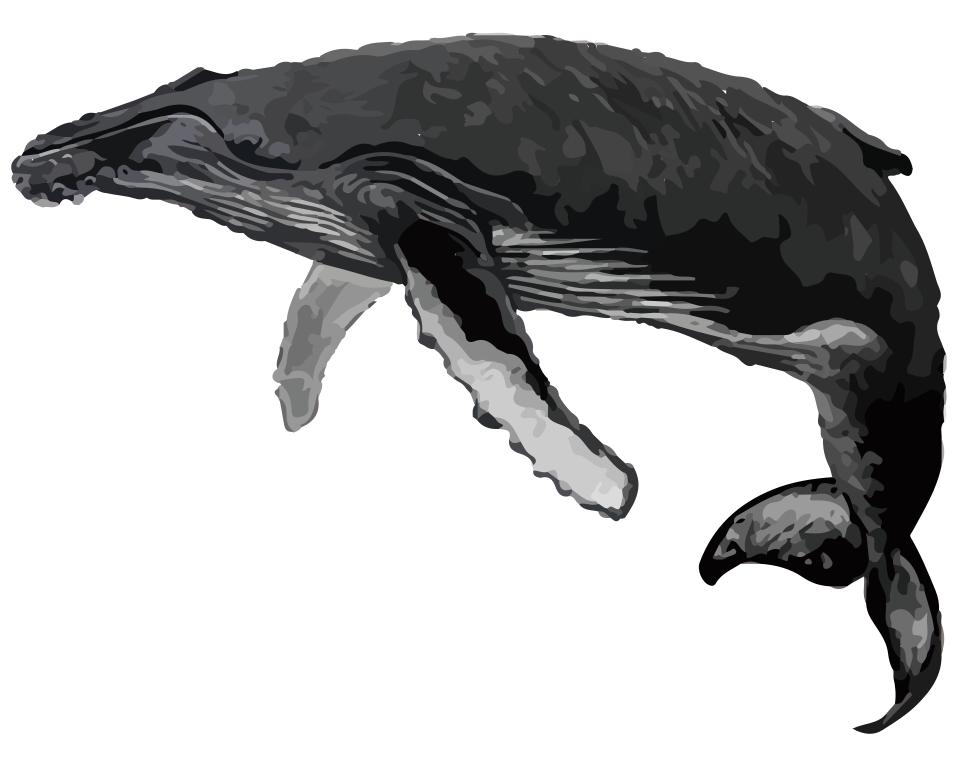
It is a large whale: adults reach about 18 m in length [6]. The body is almost entirely black, with varying amounts of white on the pectoral fins, the belly and the underside of the tail, and Southern Hemisphere whales tend to carry more white, especially on the flanks and belly [6].
The tail flukes reach about 5.5 m across, with a serrated rear edge and pointed tips [6]. The colour pattern on their underside, their shape and their scars differ from whale to whale, so they work like a fingerprint for recognising individuals in photographs [6].
In the study run from a whale-watching boat at Los Órganos, observers classed animals over 10 m as adults, those of 6 to 10 m as subadults, and those under 6 m that always swam beside a larger animal as calves [4].
Distribution and habitat
The Southeast Pacific population feeds in waters off Antarctica and the Strait of Magellan, and crosses the Equator to breed in coastal waters stretching from Ecuador to Costa Rica [3]. 7 whales coming from Antarctica, a mother with her calf among them, have been documented making a journey of about 8300 km to Central America, the longest movement known for any mammal; in those waters Southern Hemisphere humpbacks have been recorded reaching 11° N, off Costa Rica [7]. Worldwide, its wintering areas lie in warm water, from 21.1 to 28.3 °C [7].
Northern Peru's coast is the southern limit of that population's breeding area [4]. According to the master plan of the Reserva Nacional Mar Tropical de Grau, the species uses all 4 sectors of the reserve during its winter migration, is present in the Cabo Blanco – El Ñuro and Arrecifes de Punta Sal sectors from June to November and, once the season ends, heads back to feed off the Antarctic Peninsula and Chilean Patagonia [2].
Between Los Órganos and Cabo Blanco, from 2010 to 2013, 98 % of sightings were made over the continental shelf, between the shore and 200 m depth, and sea surface temperature ranged from 18.2 to 25.9 °C [3]. Mothers with calves favoured bottoms of 20 to 50 m, pairs mostly waters of 50 to 100 m, and groups of 3 or more were split between both bands [3].
Biology
Gestation lasts about 11 months and the calf is born at about 4 to 5 m long; on average a female gives birth every 2 or 3 years, although some females are known to have calved in consecutive years [6]. It reaches sexual maturity between 4 and 10 years of age and can live for about 80 to 90 years [6].
Between July and September 2009, 43 trips out of Los Órganos recorded 124 whales spread over 60 groups of 1 to 8 animals; groups of two were the most frequent, and 8 newborn calves seen in shallow water confirmed that the whales breed and nurse there [4].
Over 4 consecutive seasons, from 2010 to 2013, 487 groups were counted on the same coast: lone animals, pairs and groups of 3 or more were plentiful early in each season, while mothers with calves, escorted or not, became more common in the second half [3]. Of 53 groups of 3 or more whales, 15 were competitive groups, with repeated breaching and animals ramming one another [3].
The Peruvian regulation on approaching cetaceans lists, as signs that whales are socialising, breaching, repeated slaps of the pectoral fins, tail strikes against the surface and chases with shoving and collisions [8].
Ecology
It eats mainly small crustaceans, mostly krill, and small fish; to herd and stun its prey it uses bubbles, sounds, the seabed and its pectoral fins, and some groups coordinate curtains of bubbles to corral the fish, then lunge upward through them to engulf their prey [6].
While it stays on its breeding grounds, such as the one off northern Peru, it usually goes without food and spends the energy it has stored, which is not unlimited [9].
In northern Peru, killer whales appear to hunt humpback calves, and a male killer whale has been documented ranging along that coast during the humpback migration season [2].
Conservation
Its global category is Least Concern [5]. Peru joined the Convention on the Conservation of Migratory Species of Wild Animals through Supreme Decree N.° 002-97-RE, and that convention's Appendix I includes the humpback among migratory species threatened with extinction [8].
The whaling fleets that worked the Southeast Pacific between 1951 and 1987 killed hundreds of humpbacks, though less intensively than blue and Bryde's whales; since hunting ended in Peruvian waters in 1987, the Southeast Pacific population has grown by about 5 % a year [4].
Reports of entangled humpbacks in northern Peru have risen; between 1995 and 2012, 10 humpback strandings linked to fishing gear were documented, 9 in drift nets and 1 in a longline [10]. In 2019, of 85 fishers interviewed in Máncora and Cancas, 41 reported between 64 and 100 incidental captures of this whale in 2018 alone, and the risk analysis placed the highest risk in gillnet fishing close to shore [10].
To reduce entanglements, acoustic alarms of 3 to 20 kHz are being tested. Among artisanal gillnetters off northern Peru, between September 2022 and December 2023, 115 sets were observed with 34 whales entangled, and sets with an alarm had 52.9 % fewer entanglements than sets without one, with no loss of catch [11]. Off Los Órganos, in 2022, whales spent less time at the surface while the alarm was on, from 41 to 32 seconds, but did not change their breathing rate, dive time or paths [12].
From a cliff in northern Peru, 180 groups were tracked over 167 hours, and, by classical tests, the only significant change after meeting boats was in how straight groups with a calf swam [13]. In the same area, whales swam faster the more boats surrounded them [9].
Since October 2019, a resolution of the Ministry of Production requires boats to stay at least 100 m from cetaceans longer than 5 m, a distance that rises to 300 m when they are feeding or socialising; it also forbids heading towards or approaching a mother with a calf, or groups with calves, and requires any collision with a cetacean, or any entangled animal, to be reported to IMARPE and the maritime authority [8].
Human relevance
Tourism in the Cabo Blanco – El Ñuro sector of the Reserva Nacional Mar Tropical de Grau revolves mainly around watching cetaceans, above all this whale, and whale watching in the July to October season draws visitors to the reserve's beaches, bringing economic benefit to local people [2].
In 196 questionnaires and 20 interviews carried out before and after whale-watching trips in northern Peru, during the 2014 season, tourists showed little knowledge of which cetaceans live in the country or what threatens the sea, but on returning from the outing they said they were readier to act on behalf of cetaceans and the sea [14].
Entanglements also cost fishers money: losses are put at about 300 dollars for each net panel, on boats that carry around 30 panels [10].
Where to see it in Peru
According to the 2026 master plan of the Reserva Nacional Mar Tropical de Grau, the coast between Cabo Blanco and Punta Sal is an important breeding and nursing area, above all from July to October, and the Cabo Blanco – El Ñuro, Arrecifes de Punta Sal and Isla Foca sectors are the main places to go out and see them [2].
On whale-watching trips run in 2009 out of Los Órganos, whales were seen on 37 of 43 outings, peaking in late August; most were in water 20 to 50 m deep, and mothers with calves stayed close to shore [4]. Boats must keep at least 100 m away, may not head towards or approach a mother with a calf and, if they come upon one by chance, must slowly move off to 300 m [8].
References (14)
- WoRMS Editorial Board (2026). Megaptera novaeangliae (Borowski, 1781). World Register of Marine Species. https://www.marinespecies.org/aphia.php?p=taxdetails&id=137092 (accessed 2026-10-20)
- Servicio Nacional de Áreas Naturales Protegidas por el Estado (2026). Plan Maestro de la Reserva Nacional Mar Tropical de Grau 2026–2031. Anexo de la Resolución de Presidencia Ejecutiva N.° 000052-2026-SERNANP/PE. https://cdn.www.gob.pe/uploads/document/file/9468842/7752998-5-pm_2026-2031_rnmtg-f-f-f-f.pdf (accessed 2026-10-20)
- Guidino, C., Llapapasca, M.A., Silva, S. et al. (2014). Patterns of Spatial and Temporal Distribution of Humpback Whales at the Southern Limit of the Southeast Pacific Breeding Area. PLoS ONE, e112627. doi:10.1371/journal.pone.0112627 (accessed 2026-10-20)
- Pacheco, A.S., Silva, S., Alcorta, B. (2009). Winter distribution and group composition of humpback whales (Megaptera novaeangliae) off northern Peru. Latin American Journal of Aquatic Mammals, 33-38. doi:10.5597/lajam00131 (accessed 2026-10-20)
- Cooke, J.G. (2018). Megaptera novaeangliae: Cooke, J.G. The IUCN Red List of Threatened Species 2018: e.T13006A50362794. doi:10.2305/IUCN.UK.2018-2.RLTS.T13006A50362794.en (accessed 2026-10-20)
- NOAA Fisheries (2026). Humpback Whale. NOAA Fisheries, Species Directory. https://www.fisheries.noaa.gov/species/humpback-whale (accessed 2026-10-20)
- Rasmussen, K., Palacios, D.M., Calambokidis, J. et al. (2007). Southern Hemisphere humpback whales wintering off Central America: insights from water temperature into the longest mammalian migration. Biology Letters, 302-305. doi:10.1098/rsbl.2007.0067 (accessed 2026-10-20)
- Ministerio de la Producción (2019). Resolución Ministerial N.° 451-2019-PRODUCE: establecen las distancias mínimas de acercamiento a los cetáceos marinos. Ministerio de la Producción, Plataforma del Estado Peruano (21-10-2019). https://cdn.www.gob.pe/uploads/document/file/402534/Resoluci%C3%B3n_Ministerial_N__451-2019-PRODUCE20191023-20121-3dcmvf.pdf (accessed 2026-10-20)
- Villagra, D., García-Cegarra, A., Gallardo, D.I. et al. (2021). Energetic Effects of Whale-Watching Boats on Humpback Whales on a Breeding Ground. Frontiers in Marine Science. doi:10.3389/fmars.2020.600508 (accessed 2026-10-20)
- Costanza, A.B., Guidino, C., Mangel, J.C. et al. (2021). Participatory Risk Assessment of Humpback Whale (Megaptera novaeangliae) and Leatherback Turtle (Dermochelys coriacea) Bycatch in Northern Peru. Frontiers in Marine Science. doi:10.3389/fmars.2021.776965 (accessed 2026-10-20)
- Guidino, C., Bielli, A., Groenendijk, S.H. et al. (2025). Assessing the Effectiveness of Whale Pingers in Mitigating Large Whale Entanglements in Gillnet Fisheries in Northern Peru. Aquatic Conservation: Marine and Freshwater Ecosystems. doi:10.1002/aqc.70195 (accessed 2026-10-20)
- Galán, A.S., Guidino, C., Francia-Quiroz, J.C. et al. (2025). Evaluating humpback whale (Megaptera novaeangliae) behavioral responses to whale pingers in breeding grounds of northern Peru. Latin American Journal of Aquatic Research, 439-449. doi:10.3856/vol53-issue3-fulltext-3379 (accessed 2026-10-20)
- García-Cegarra, A.M., Villagra, D., Gallardo, D.I. et al. (2018). Statistical dependence for detecting whale-watching effects on humpback whales. The Journal of Wildlife Management, 467-477. doi:10.1002/jwmg.21602 (accessed 2026-10-20)
- García-Cegarra, A.M., Pacheco, A.S. (2017). Whale-watching trips in Peru lead to increases in tourist knowledge, pro-conservation intentions and tourist concern for the impacts of whale-watching on humpback whales. Aquatic Conservation: Marine and Freshwater Ecosystems, 1011-1020. doi:10.1002/aqc.2754 (accessed 2026-10-20)
More pictures
Humpback whales in Los Órganos: what to know first and good practice, on orkadive.com