
Marine life guide of Peru · Cheloniidae
Olive ridely
Lepidochelys olivacea (Eschscholtz, 1829)
- Names in Peru
- Tortuga golfina · Tortuga pico de loro
Species account
Summary
Lepidochelys olivacea is a marine turtle of the family Cheloniidae, described by Eschscholtz in 1829 [1]. In Peru it is known as «tortuga pico de loro» or «tortuga golfina», and it is one of the 5 marine turtle species found in Peruvian waters [2]. The turtles reaching Peru belong to the eastern Pacific population [2]. The IUCN Red List classifies it as Vulnerable in its 2008 assessment [3], and Peru's official list of threatened wildlife, approved in 2014, also places it in the Vulnerable category [4].
Identification and similar species
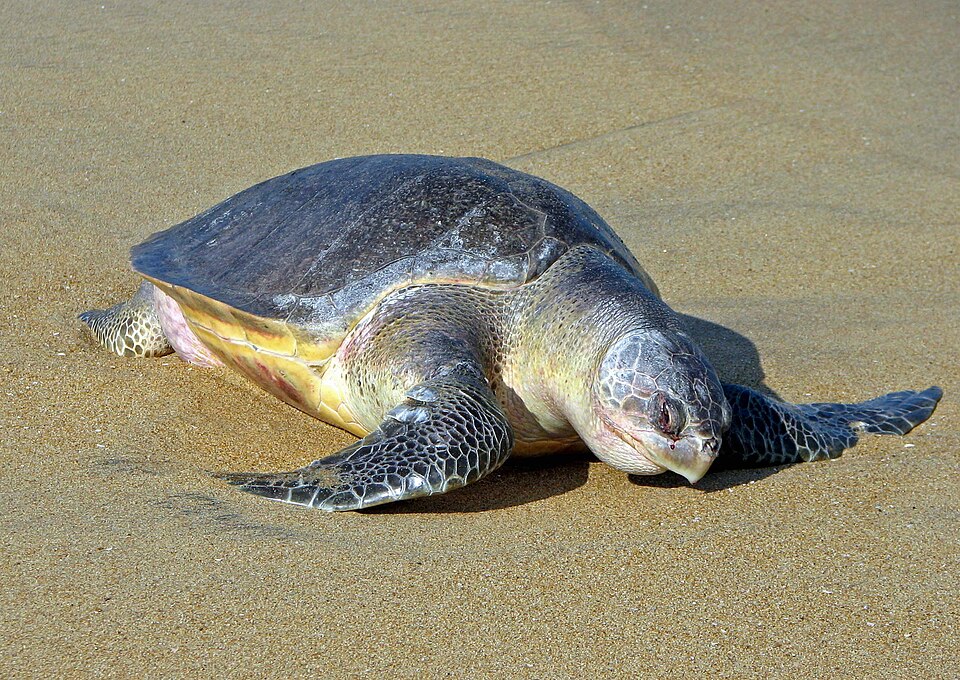
It is one of the smallest marine turtles. Its heart-shaped shell ranges from olive to greyish green and bears 5 to 9 pairs of lateral scutes; each of its 4 flippers carries 1 or 2 claws, and adults weigh up to about 45 kg [5].
In Tumbes, turtles measured between 2006 and 2011 had a curved carapace length of 45 to 75 cm, 62.5 cm on average; the authors treated those of 65 cm or more as adults, that being the mean size of females nesting on a beach in Colombia [6]. Two individuals entangled in fishing nets in the same region between 2017 and 2019 weighed 26 and 39 kg [7].
Similar species
Distribution and habitat
It lives in tropical waters of the Atlantic, Pacific and Indian oceans; it spends most of its life on the high seas, although it also enters coastal areas [5]. In the eastern Pacific, 30 adult turtles fitted with satellite transmitters, nearly all of them in Costa Rica, ranged over almost the whole region, from the Gulf of Tehuantepec in Mexico to Peruvian waters, and reached more than 4000 km west of Costa Rica, nearly always over deep water [9].
In Peru it has been recorded through bycatch, directed catch and strandings, both near the shore and far offshore, at places such as Tumbes, southern Piura, Salaverry, Chimbote, Cerro Azul, Ilo, Pisco and San Juan de Marcona [2]. Turtles interacting with the longline fishery appear from the Ecuadorian border to 18° S, with the largest catches between 6° and 8° S [2].
It is commoner in the north of the country, where the sea is warmer; in Tumbes it is, after the green turtle, the marine turtle with the most recorded strandings and incidental catches, and the authors regard that region as the most important in Peru for the species [6].
Biology
Females may nest en masse, in synchronised events called arribadas in which hundreds or thousands come ashore together, or on their own; each lays 1 to 3 clutches per season of about 100 eggs each [5]. The sex of the hatchlings depends on sand temperature during the middle third of incubation, and maturity comes at around 14 years of age [5].
In Peru it is the marine turtle with the most nesting records. In 1992, 2 newborn hatchlings were found at Punta Capones, Tumbes; in 2001, fishers at Caleta Grau guarded a nest of 70 eggs until it hatched, and in February 2010 a fisher saw 80 hatchlings emerge on Bomba beach at Negritos (Piura), the southern nesting limit then known for the species in the eastern Pacific [2].
By January 2016, 112 marine turtle nesting events had been identified in northern Peru, 75.3 % of them by this species; the beach with the most was El Bravo, between Máncora and Punta Sal, with 58 [2].
After breeding, the turtles tracked by satellite from Costa Rica used no shared routes and no fixed feeding areas: they kept moving almost all the time, stopping for days or a few weeks, and most never went back to a place they had already visited; an El Niño event during the study altered their tracks [9]. In Peru, the mitochondrial DNA of 21 turtles caught on artisanal longlines between 2003 and 2009 pointed to nesting beaches in Mexico, Costa Rica and Colombia, and a turtle tagged in September 1986 on La Escobilla beach, Mexico, was caught at Pisco in November of that year [2].
Ecology
It is omnivorous, eating algae, crustaceans, tunicates and molluscs, and it can go down to about 150 m to search for invertebrates on the bottom [5].
At San Andrés (Pisco), the stomachs of 7 turtles examined between 1999 and 2000 held crabs, molluscs such as the Peruvian scallop, and green algae. A stable-isotope analysis of 346 turtles sampled between 2003 and 2009, from the Gulf of California to Atico, placed 25 of them in Peruvian waters, mostly in oceanic areas between Puerto Chicama and Callao [2].
Off Lambayeque, between 1996 and 1998, the artisanal gillnet fleet caught 383 marine turtles, 80.4 % of them of this species, and 99 % of all of them were taken during the 1997-1998 El Niño, which brought the turtles closer to the fishing grounds; the number caught closely tracked sea temperature [10].
It is regarded as the most abundant marine turtle in the world; in the eastern tropical Pacific, ship surveys carried out between 1998 and 2006 between 5° and 25° N, off Mexico and Central America, estimated an average of 1.39 million individuals at sea [11].
Conservation
Its global category is Vulnerable [3]. In Peru it is classified as Vulnerable [4].
Bycatch in fisheries is one of the main threats to marine turtles. In Tumbes, observers aboard 160 gillnet trips between 2017 and 2019 found that 14 % of the turtles caught belonged to this species (6 individuals); the bottom net with 152 to 229 mm mesh, set for guitarfish and rays, was the deadliest, with 66.7 % mortality, and drowned both green turtles and this species [7]. The authors conclude that adults and sub-adults of this turtle have declined along the Tumbes coast in recent years [7].
Killing for meat also takes a toll. Of the 39 turtles recorded in Tumbes between 2006 and 2011, all the stranded ones were dead and 48.3 % of those had been butchered to sell their meat; of those caught in nets, 90 % were slaughtered on the beach for the same reason [6]. Sub-adults made up 64.1 % of the total, a life stage that is key to the recovery of the population [6].
Human relevance
In Peru it has been caught to be eaten. In the rubbish dumps of Pisco, between 2009 and 2015, 4.3 % of the shells identified came from this species (41), and 97.5 % of them came from turtles caught for human consumption; only 2.5 % were natural strandings [2].
Some fishers protect it too: the 58 hatchlings from the nest guarded at Caleta Grau in 2001 were reared for 9 months at an aquaculture centre in Puerto Pizarro, and the 35 young that survived were released, the only known case of marine turtle hatchlings being raised in captivity in Peru [2].
Where to see it in Peru
The literature places its records mainly on the northern coast. In Tumbes, between 2006 and 2011, most turtles were recorded at Punta Picos, Baja de Punta Mero and Canoas [6]. By January 2016, El Bravo beach, between Máncora and Punta Sal, held the most marine turtle nesting events in northern Peru [2].
References (11)
- WoRMS Editorial Board (2026). Lepidochelys olivacea (Eschscholtz, 1829). World Register of Marine Species. https://www.marinespecies.org/aphia.php?p=taxdetails&id=220293 (accessed 2026-10-20)
- SERFOR (2019). Plan Nacional de Conservación de las Tortugas Marinas en el Perú, período 2019-2029. Servicio Nacional Forestal y de Fauna Silvestre (SERFOR), Ministerio de Agricultura y Riego. https://cdn.www.gob.pe/uploads/document/file/3462540/Plan%20Nacional%20de%20Conservaci%C3%B3n%20de%20Tortugas%20Marinas%20del%20Per%C3%BA%202019-2029.pdf.pdf (accessed 2026-10-20)
- Abreu-Grobois, A., Plotkin, P. (2008). Lepidochelys olivacea: Abreu-Grobois, A & Plotkin, P. (IUCN SSC Marine Turtle Specialist Group). The IUCN Red List of Threatened Species 2008: e.T11534A3292503. doi:10.2305/IUCN.UK.2008.RLTS.T11534A3292503.en (accessed 2026-10-20)
- Ministerio de Agricultura y Riego (2014). Decreto Supremo N.° 004-2014-MINAGRI: actualización de la lista de clasificación y categorización de las especies amenazadas de fauna silvestre legalmente protegidas. El Peruano (08-04-2014); ficha en SINIA, Ministerio del Ambiente. https://sinia.minam.gob.pe/normas/lista-especies-amenazadas-fauna-silvestre-legalmente-protegidas (accessed 2026-10-20)
- NOAA Fisheries (2026). Olive Ridley Turtle. National Oceanic and Atmospheric Administration, species directory. https://www.fisheries.noaa.gov/species/olive-ridley-turtle (accessed 2026-10-20)
- Vera, M., Rosales, C.A. (2012). Estructura de tallas de tortuga pico de loro Lepidochelys olivacea (Testudines: Cheloniidae) en Tumbes, Perú. Revista Peruana de Biología, 175-180. doi:10.15381/rpb.v19i2.837 (accessed 2026-10-20)
- Vera, M., Alemán, S., Cobeñas, M. et al. (2021). Captura incidental y mortalidad de tortugas marinas en la pesca artesanal de enmalle en Tumbes, Perú. Boletín Instituto del Mar del Perú, 156-187. doi:10.53554/boletin.v36i1.325 (accessed 2026-10-20)
- NOAA Fisheries (2026). Green Turtle. National Oceanic and Atmospheric Administration, species directory. https://www.fisheries.noaa.gov/species/green-turtle (accessed 2026-10-20)
- Plotkin, P.T. (2010). Nomadic behaviour of the highly migratory olive ridley sea turtle Lepidochelys olivacea in the eastern tropical Pacific Ocean. Endangered Species Research, 33-40. doi:10.3354/esr00314 (accessed 2026-10-20)
- Castro, J., de la Cruz, J., Ramírez, P. et al. (2012). Captura incidental de tortugas marinas durante El Niño 1997-1998, en el norte del Perú. Latin American Journal of Aquatic Research, 970-979. doi:10.3856/vol40-issue4-fulltext-13 (accessed 2026-10-20)
- Eguchi, T., Gerrodette, T., Pitman, R.L. et al. (2007). At-sea density and abundance estimates of the olive ridley turtle Lepidochelys olivacea in the eastern tropical Pacific. Endangered Species Research, 191-203. doi:10.3354/esr003191 (accessed 2026-10-20)
More pictures
Swimming with turtles at El Ñuro: what to know first, on orkadive.com