
Marine life guide of Peru · Laridae
Belcher's gull
Larus belcheri Vigors, 1829
- Names in Peru
- Gaviota peruana
Species account
Summary
Larus belcheri is a gull of the family Laridae, described by Vigors in 1829 [1]. In Peru it is called «gaviota peruana» and it lives on the coast all year round [2]. It is restricted to the Humboldt Current region, from the far south of Ecuador to northern Chile, where it is common; it is a coastal bird that frequents rocky shores [3]. The IUCN Red List classifies it as Least Concern in its 2018 assessment [4].
Identification and similar species
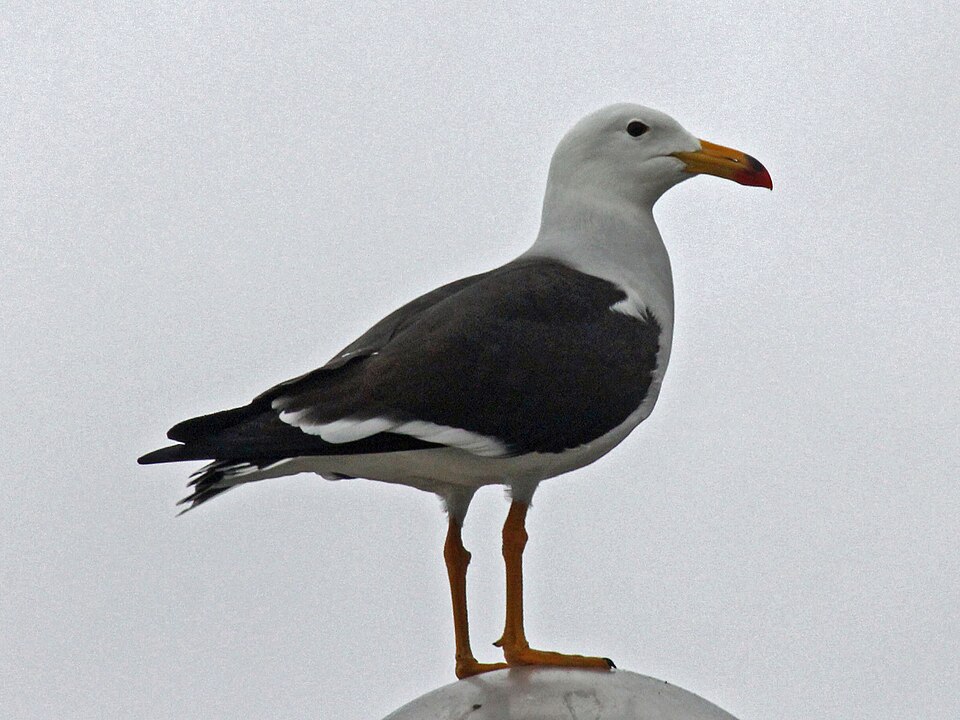
The adult has a blackish mantle (back) and, seen from afar, the body looks white, although in good light it turns out to be a very pale grey [3]. It keeps a black band on the tail throughout its life, the feature behind its old English name, and its bill is long, straight and yellow, with a large red tip [3].
In the breeding season the head is a bright white that contrasts with the pale grey of the neck and belly; in winter even adults develop a sharply bordered brown hood, against which small white crescents around the eye stand out [3]. Its resemblance to the kelp gull (Larus dominicanus) makes it hard to identify, so in Chile its nesting may have gone unnoticed in some areas [5].
Similar species
- Larus atlanticus: A gull of the Atlantic coast of South America that until recently was treated as the same species; Larus belcheri is slimmer and has a smaller bill [3].
Distribution and habitat
It is a coastal bird often found in rocky settings, although it will feed several kilometres from the shore [3]. A 2019 Peruvian paper, drawing on a 1983 reference work, places its range from Lobos de Tierra Island in northern Peru to Coquimbo in Chile, and occasionally reaches Panama [2].
Its breeding in Chile is poorly studied, and its centre of abundance lies on the shores and inshore guano islands of the Peruvian coast [5]. The few birds seen breeding on Grande (27° 14′ S) and Choros (29° 15′ S) islands, in north-central Chile, were then the southernmost breeding record for the species [5].
Biology
In the San Fernando National Reserve, in Ica, monthly monitoring carried out between June 2018 and May 2019 found it breeding on 2 islets lying off Punta Vera beach [6]. In November, at the end of spring, pairs were seen forming and birds were gathering material for their nests, built of feathers and plant debris; in autumn the pairs were tending their chicks, which at times waited alone for the parents to come back and feed them [6].
On the Chilean islands mentioned, breeding was documented by a single pair incubating on Choros Island in January 2002 and by 2 fledglings on Grande Island in February 2003 [5].
Ecology
It is omnivorous and a scavenger: it eats fish, crabs, molluscs and dead animals, and it also preys on the eggs and chicks of the guano birds [2]. Among the gulls of its region it is the one most inclined to search the rocks at low tide for prey protected by a hard shell or carapace [3].
In a seabird census carried out in July 2010 between 7° 00′ and 10° 59′ S, off La Libertad, Áncash and northern Lima, 47.92 % of the Belcher's gulls recorded approached the vessel [7]. The same study notes that earlier work had, depending on the season, observed it among the larids that come near longlines, the group that dominated among the birds associated with fishing [7].
It hosts several helminths. In 11 gulls found dead between 2011 and 2014 on the Lima beaches of Ancón, Ventanilla, Chorrillos and Pucusana, nematodes of the genera Skrjabinoclava and Contracaecum, a trematode of the genus Maritrema and the acanthocephalan Profilicollis altmani were identified [2]. The nematodes and the trematode were new records for this gull, whereas the acanthocephalan had already been described from it under a name now regarded as a synonym [2].
Profilicollis altmani develops as a larva in the crustacean Emerita analoga and becomes adult in the gull's intestine: in 1981 and 1982, 42 adult parasites were obtained from 4 gulls from Pasamayo beach, in Lima, and in sections of those heavily infested intestines the villi appeared compressed and distorted [8]. In 1982, 2 adult gulls caught alive in Miraflores were given 50 larvae each, and the parasite became established in both [8].
Conservation
Its global category is Least Concern [4].
In Peru, the Guano Islands, Islets and Capes National Reserve System provides it with places to shelter, rest and breed, as it does for other seabirds; its management plan warns that outside the reserve these species are exposed to a range of threats, mainly of human origin [9].
Health, toxicological and chemical relevance
Not medical advice. For a sting, a poisoning or an allergy, seek medical care.
One of its parasites, Profilicollis altmani, matters for public health: in 1991 infections in people were documented with a species now regarded as its synonym, and transmission could be explained by the use of its intermediate hosts, crustaceans of the genus Emerita, in dishes such as ceviche [2].
A 2022 study of this parasite points out that eating those infected crustaceans is a potential risk for people, and notes that, given experimentally, it produced viable infections in rats, mice, hamsters and pups [8].
During the H5N1 avian influenza outbreak that began in November 2022, a juvenile Belcher's gull found dead in Tacna in March 2023 was sampled, and its influenza A test came back negative [10].
Where to see it in Peru
In the San Fernando National Reserve, in Ica, it was recorded in all 4 seasons between June 2018 and May 2019, and it was breeding on 2 islets off Punta Vera beach that can be watched from the coast; Punta Vera is a rocky cliff area with limited access [6].
At Pozo Lizas beach, in the province of Ilo, near the Punta Coles marine protected area, it was seen in various months between 2009 and 2015, and it was one of the species observed on the most occasions [11].
References (11)
- WoRMS Editorial Board (2026). Larus belcheri Vigors, 1829. World Register of Marine Species. https://www.marinespecies.org/aphia.php?p=taxdetails&id=225990 (accessed 2026-10-20)
- Gomez-Puerta, L.A., Naupay, A. (2019). Algunos helmintos parásitos de la gaviota peruana (Larus belcheri). Revista Peruana de Biología, 149-156. doi:10.15381/rpb.v26i1.15919 (accessed 2026-10-20)
- Burger, J., Gochfeld, M., Kirwan, G.M. et al. (2024). Belcher's Gull (Larus belcheri). Birds of the World, version 1.1. doi:10.2173/bow.belgul.01.1 (accessed 2026-10-20)
- BirdLife International (2018). Larus belcheri: BirdLife International. The IUCN Red List of Threatened Species 2018: e.T22694282A132538076. doi:10.2305/IUCN.UK.2018-2.RLTS.T22694282A132538076.en (accessed 2026-10-20)
- Simeone, A., Luna-Jorquera, G., Bernal, M. et al. (2003). Breeding distribution and abundance of seabirds on islands off north-central Chile. Revista Chilena de Historia Natural, 323-333. doi:10.4067/S0716-078X2003000200016 (accessed 2026-10-20)
- Meza, M.A., Llapapasca, M., Romero, C. (2021). Avifauna de algunas playas de la Reserva Nacional de San Fernando (RNSF) Ica – Perú. Junio 2018 - Mayo 2019. Boletín Instituto del Mar del Perú, 29-43. doi:10.53554/boletin.v36i1.317 (accessed 2026-10-20)
- Figueroa, J., Suazo, E. (2012). Distribución de las aves marinas frente a la costa norte-centro del Perú en el invierno de 2010 y su interacción potencial con la pesquería. The Biologist (Lima), 41-71. doi:10.24039/rtb2012101461 (accessed 2026-10-20)
- Amin, O.M., Rodríguez, S.M., Rubtsova, N. et al. (2022). A comparative assessment of the morphology of Profilicollis altmani (Acanthocephala, Polymorphidae) from crustaceans and shore birds in Peru, with special notes on hook elemental analysis (EDXA), SEM imaging, histopathology, and molecular profile. Parasite, 9. doi:10.1051/parasite/2022005 (accessed 2026-10-20)
- SERNANP (2016). Plan Maestro de la Reserva Nacional Sistema de Islas, Islotes y Puntas Guaneras 2016-2020. Servicio Nacional de Áreas Naturales Protegidas por el Estado, Lima. https://sinia.minam.gob.pe/sites/default/files/archivos/public/docs/PM_RNSIIPG_2016-2020.pdf (accessed 2026-10-20)
- Leguia, M., Garcia-Glaessner, A., Muñoz-Saavedra, B. et al. (2023). Highly pathogenic avian influenza A (H5N1) in marine mammals and seabirds in Peru. Nature Communications, 5489. doi:10.1038/s41467-023-41182-0 (accessed 2026-10-20)
- Pizarro-Neyra, J. (2015). Avifauna de playa Pozo Lizas, provincia de Ilo, sur del Perú. The Biologist (Lima), 429-436. doi:10.24039/rtb20151321558 (accessed 2026-10-20)