
Marine life guide of Peru · Lamnidae
Porbeagle
Lamna nasus (Bonnaterre, 1788)
Species account
Summary
Lamna nasus is a shark of the family Lamnidae, in the order Lamniformes [1]. It is a stout, spindle-shaped shark of cold and temperate waters that lives both near the coast and far offshore in the North Atlantic and in a belt that circles the Southern Hemisphere [2]. In Peru it appears on the updated list of the country's chondrichthyans [3] and among the sharks with recorded landings [4]. Its global category on the IUCN Red List is Vulnerable [5].
Etymology
Bonnaterre described it in 1788 under the name Squalus nasus; the holotype is not known and the type locality is probably Cornwall, in England [2]. Its synonyms include Lamna philippi, which Pérez Canto described in 1886 with its type locality in Chile [2]. The FAO catalogue notes the irony that the genus name and its synonym Lamia recall the Lamia of antiquity, a monster that devoured people and was identified with the white shark, when these sharks are rather less aggressive [2]. In Spanish, FAO calls it «marrajo sardinero» [2].
Identification and similar species
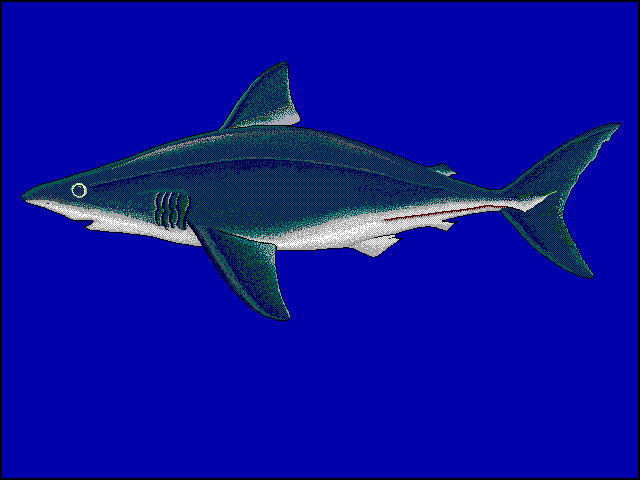
It has a heavy, spindle-shaped body, a conical and fairly long snout, long gill slits and fairly large blade-like teeth with small side cusps [2]. The first dorsal fin is large and its free rear tip is white, contrasting sharply with the rest of the fin; both the anal fin and the second dorsal are tiny, the tail stalk carries strong keels, there are further short secondary keels at the base of the tail, and the caudal fin is crescent-shaped [2].
It is grey, bluish grey or almost black above and white below, and the white of the belly stops at the end of the pectoral fin bases instead of climbing over them as a patch [2]. In some Southern Hemisphere adults the underside of the head is dark and the belly is blotched, unlike typical Northern Hemisphere individuals [2]. It can exceed 300 cm total length and may reach 370 cm, though most are smaller [2]; in Southwest Pacific samples, the largest male measured 228 cm and the largest female 208 cm fork length [6].
In Chile its fins were described from individuals landed at Coquimbo by the industrial swordfish fleet, so that the species could be recognised in sacks of fins [7]. The underside of the pectoral fin bears a dark pattern running from the tip to the inner rear edge, the first dorsal is grey with the end of its free edge white, and the caudal fin has 2 keels on each side and frayed edges [7].
Similar species
- Isurus oxyrinchus: Isurus oxyrinchus has a white pectoral underside with only slightly darkened edges, the end of the first dorsal free edge dark blue instead of white, and just 1 keel on each side of the tail, with a white patch beneath it [7].
- Lamna ditropis: Lamna ditropis, of the North Pacific, has a shorter snout, a dark free tip on the first dorsal fin and a white patch that climbs from the belly over the pectoral fin bases; some dark-faced Southern Hemisphere Lamna nasus may have been mistaken for it [2].
Distribution and habitat
It is an amphitemperate species, centred on the North Atlantic and on a belt of temperate water that rings the Southern Hemisphere through the Atlantic, Indian, Pacific and Southern Oceans [2]. In the Southeast Pacific, the FAO catalogue reports it from southern Chile to Cape Horn [2], and it has been observed between about 28 and 58° S right across the South Pacific, between New Zealand and Chile [6]. In Peru, the 2015 updated list of chondrichthyans includes it on the basis of earlier works [3].
It lives from the surface and water less than 1 m deep down to at least 700 m, and is most plentiful on the fishing banks of the continental shelf, though it is also found far from land [2]. It usually lives in cold water, generally below 18 °C and as cold as 1 °C, and it is not known from equatorial seas [2]. In the Southwest Pacific it was caught at surface temperatures of 9.9 to 22.6 °C, but catches were scarce above 19.5 °C [6].
Biology
It is ovoviviparous and its young practise uterine cannibalism: the foetuses grow enormously by eating fertilised eggs inside the uterus and their bellies swell out of all proportion [2]. Small embryos carry fang-like teeth with which they break the egg capsules, and lose them on reaching 34 to 38 cm fork length; in the Southwest Pacific, the yolk stored in an embryo's stomach came to weigh as much as 81 % of its body [6].
Litters hold 1 to 5 pups and most hold 4 [2]. Using data from observers aboard New Zealand and Australian longliners, gestation was estimated at roughly 8 to 9 months, with the embryo adding some 7 cm a month and the pup measuring 58 to 67 cm fork length at birth; there, births probably cluster in June and July, in the depth of the southern winter, whereas in the North Atlantic they happen in spring and summer [6].
In the Southwest Pacific the young grow fast and at a steady pace, by 16 to 20 cm a year, reaching 110 to 125 cm fork length by age 3, and females mature at around 165 to 180 cm [6]. In the northwest Atlantic males mature at about 175 cm fork length, around age 7, and females at about 212 cm, around age 14, and the species may live for 30 to 45 years [2].
Ecology
It is an active predator that eats mainly small and medium-sized schooling pelagic fishes such as mackerels, pilchards and herrings, but also bottom fishes such as cods, hakes and icefishes, small sharks such as Squalus acanthias and Galeorhinus galeus, and squids; it also takes hooked fish from longlines [2].
It can keep its body up to 11 °C warmer than the surrounding water, an ability that among sharks only Lamna ditropis surpasses, and that high temperature probably lets it hunt fast prey in cold water [6]. Apart from humans, its predators are almost unknown: the white shark and the orca are obvious candidates, but the FAO catalogue knew of no records of them taking it [2].
In the Southwest Pacific, males and females turned up in equal numbers up to 150 cm fork length, but among the larger sharks there were about 3 males for every female, which indicates that the large sharks, unlike the juveniles, separate by sex [6].
Conservation
Its global category on the IUCN Red List is Vulnerable [5].
Targeted fisheries in the North Atlantic depleted it heavily: Norway's catches reached 3884 t in 1933 and were only 25 t in 1994, and the FAO catalogue regarded the northwest Atlantic population as overexploited [2]. In the Southern Hemisphere it is not fished deliberately, but it is often taken as bycatch in tuna fisheries [6], and in 1997 only New Zealand reported those catches to FAO, so most of what is taken in the south goes unrecorded [2].
It is listed on CITES Appendix II [4] and, since 2008, on Appendix II of the Convention on Migratory Species, as well as on Annex I of that convention's memorandum of understanding on migratory sharks [8]. According to the analysis of the Peruvian shark fishery, the 2001 ministerial resolution that sets minimum catch sizes does not cover this species, and the Peruvian State did not list any shark species as threatened [4].
Human relevance
It has been fished heavily for human food in the temperate North Atlantic and the Mediterranean; it is eaten fresh or dried and salted, used for oil and meal, and its fins are sold for soup [2]. It is taken mainly on pelagic longlines, but also in trawls, on handlines and in gillnets [2].
In Chile it is one of the 3 most traded pelagic sharks, together with Prionace glauca and Isurus oxyrinchus, and there it is known as «tintorera»; the fins of these sharks are exported to the Asian market [7].
It seldom if ever bites people; in the North Sea adults have been filmed rushing at divers working on oil platforms, sometimes brushing against them without harm, and up to the publication of the FAO catalogue it was not known to feature in dive tourism [2].
Where to see it in Peru
In Peru it is known mainly from fisheries. The 2015 updated list of chondrichthyans includes it [3], and the analysis of 61 years of shark fishing counts it among the species with landings recorded in the country [4]. Between 2005 and 2010, observers aboard small-scale longliners sailing from Ilo, in the south of the country, identified it among the other species, which together made up 1 % of the sharks identified to species [9].
References (9)
- WoRMS Editorial Board (2026). Lamna nasus (Bonnaterre, 1788). World Register of Marine Species. https://www.marinespecies.org/aphia.php?p=taxdetails&id=105841 (accessed 2026-10-25)
- Compagno, L.J.V. (2002). FAO species catalogue for fishery purposes No. 1. Sharks of the world. An annotated and illustrated catalogue of shark species known to date. Volume 2. Bullhead, mackerel and carpet sharks (Heterodontiformes, Lamniformes and Orectolobiformes). FAO Species Catalogue for Fishery Purposes No. 1, Vol. 2. FAO, Rome, 117-126. https://www.fao.org/4/x9293e/x9293e00.htm (accessed 2026-10-25)
- Cornejo, R., Vélez-Zuazo, X., González-Pestana, A. et al. (2015). An updated checklist of Chondrichthyes from the southeast Pacific off Peru. Check List, 1809. doi:10.15560/11.6.1809 (accessed 2026-10-25)
- Gonzalez-Pestana, A., Kouri J., C., Velez-Zuazo, X. (2016). Shark fisheries in the Southeast Pacific: A 61-year analysis from Peru. F1000Research, 164. doi:10.12688/f1000research.4412.2 (accessed 2026-10-25)
- Rigby, C.L., Barreto, R., Carlson, J. et al. (2018). Lamna nasus: Rigby, C.L., Barreto, R., Carlson, J., Fernando, D., Fordham, S., Francis, M.P., Herman, K., Jabado, R.W., Liu, K.M., Marshall, A., Pacoureau, N., Romanov, E., Sherley, R.B. & Winker, H. The IUCN Red List of Threatened Species 2019: e.T11200A500969. doi:10.2305/IUCN.UK.2019-3.RLTS.T11200A500969.en (accessed 2026-10-25)
- Francis, M.P., Stevens, J.D. (2000). Reproduction, embryonic development, and growth of the porbeagle shark, Lamna nasus, in the southwest Pacific Ocean. Fishery Bulletin 98(1), NOAA National Marine Fisheries Service, 41-63. https://spo.nmfs.noaa.gov/sites/default/files/pdf-content/2000/981/04.pdf (accessed 2026-10-25)
- Hernández, S., Haye, P.A., Acuña, E. (2009). Identificación morfológica de las aletas de los principales tiburones pelágicos comercializados en Chile: azulejo (Prionace glauca Linnaeus), marrajo (Isurus oxyrhinchus Rafinesque), y tintorera (Lamna nasus Bonnaterre). Gayana (Concepción), 33-39. doi:10.4067/s0717-65382009000100005 (accessed 2026-10-25)
- Convention on the Conservation of Migratory Species of Wild Animals (2026). Porbeagle Lamna nasus. CMS species page. https://www.cms.int/en/species/lamna-nasus (accessed 2026-10-25)
- Doherty, P.D., Alfaro-Shigueto, J., Hodgson, D.J. et al. (2014). Big catch, little sharks: Insight into Peruvian small-scale longline fisheries. Ecology and Evolution, 2375-2383. doi:10.1002/ece3.1104 (accessed 2026-10-25)