
Marine life guide of Peru · Delphinidae
Dusky dolphin
Lagenorhynchus obscurus (Gray, 1828)
- Names in Peru
- Delfín oscuro · Chancho marino
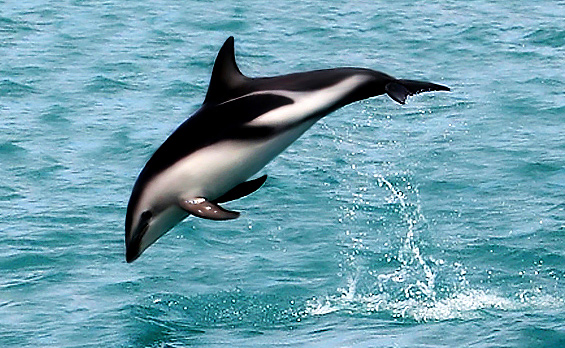
Species account
Summary
Lagenorhynchus obscurus is a dolphin of the family Delphinidae [1]. Peru's rule on approach distances calls it «delfín oscuro» or «chancho marino» and places it among the smaller cetaceans [2]. On the central coast of Peru its food is mostly anchoveta [3], and its reproduction in coastal fisheries was studied from 852 animals killed between 1985 and 1990 [4]. Its global category on the IUCN Red List is Least Concern [5].
Distribution and habitat
In Peru it lives in the coastal upwelling system, a cold and very productive water mass, and not only there: it is also described as common on the coasts of New Zealand, of South America and of South Africa [3]. Another source presents it as a Southern Hemisphere dolphin, recorded in New Zealand, southern Australia, southwestern Africa and southern South America, and also at islands such as the Falklands and Tristan da Cunha [6].
The known northern limit in Peru was near Salaverry, at about 6° S. A group of 10 to 20 adults was photographed off Los Órganos (4°9′ S) from a boat taking tourists to watch whales, on 17 October 2017; the authors take it as extending the potential range about 350 km toward the equator [6].
The master plans of protected natural areas mention it among the cetaceans of their waters. That of the Mar Tropical de Grau National Reserve counts it among the 13 species recorded in that sector, out of the 32 cetaceans reported in Peruvian waters [7]; that of the Paracas National Reserve includes it among the animals that can be seen in its waters [8]; and that of the San Fernando National Reserve lists it among 13 cetacean species between the mouth of the Ica river and San Fernando [9].
Biology
The study of its reproduction in Peru used 522 females and 330 males killed in coastal fisheries between 1985 and 1990 [4]. Births clustered in late winter, in August, September and October, although some newborns were collected as late as February [4].
Fetuses grew about 0.261 cm per day and calves were born with a mean length of 91 cm and a mass of 9.6 kg. Gestation lasted 12.9 months, lactation 12.0 months and the rest between one cycle and the next 3.7 months [4].
The testes of adult males reached their peak size in September and October, in step with the peak of conceptions; the heaviest testis, with epididymis, weighed 5120 g, and the ratio of testis mass to body mass reached 0.085, one of the highest of any mammal. That testis size, together with the small difference between the sexes and the apparent lack of aggression among males, led the authors to propose a promiscuous mating system with sperm competition [4].
Ecology
The diet was described from the stomach contents of 136 dolphins with identifiable remains, obtained in 1985 and 1986, in summer and winter, at the ports of Pucusana, Ancón and Cerro Azul on the central coast [3]. Anchoveta, Engraulis ringens, was present in 97.8 % of stomachs and made up 92.5 % of prey by number, 83.8 % by weight and 87.3 % by gross energy [3].
No other prey passed 5.1 % of the weight. Other frequent prey were the horse mackerel Trachurus symmetricus (present in 26.5 % of stomachs), the squid Loligo gahi (19.1 %), the hake Merluccius gayi (8.1 %), the sardine Sardinops sagax (4.4 %) and the jumbo squid Dosidicus gigas (11.0 %) [3]. Anchoveta was the main prey in both seasons of both years and in every reproductive class, lactating females included [3].
Prey whose size could be estimated averaged less than 30 cm and 300 g. The anchovetas eaten by the dolphins were 1.4 to 2.0 cm smaller than those taken by the purse-seine fishery, perhaps because the fishery leans toward the larger fish, or because wear on some otoliths led to underestimated lengths; the estimated size grew from 11.5 cm in the summer of 1985 to 14.3 cm in the winter of 1986 [3].
Conservation
Its global category on the IUCN Red List is Least Concern [5].
In Peru the study samples come from animals killed in fishing. The 136 diet stomachs came from dolphins caught mostly by artisanal fishers with gillnets set from dusk to dawn in the upwelling zone, among them six from a single landing by a purse-seine vessel, in the summer of 1985 [3]. The 852 animals of the reproduction study were also killed in coastal fisheries between 1985 and 1990 [4].
The master plan of the Dorsal de Nasca National Reserve records that the dusky dolphin, together with the common dolphin, the Burmeister's porpoise and the bottlenose dolphin, is among the cetaceans most often caught incidentally. It cites a press note giving 15 thousand dolphins and porpoises a year in 2019 for the artisanal fleet, and says there is no official figure for the industrial one [10].
Human relevance
Ministerial Resolution 451-2019-PRODUCE sets the minimum approach distances to marine cetaceans and lists in its annex the «delfín oscuro» or «chancho marino» among the smaller cetaceans [2]. For them the minimum distance is 50 m, and 150 m when they are feeding or socialising [2].
It is forbidden to head for or approach groups with calves or a mother with a calf; if they are met unintentionally, one must move away slowly to about 300 m [2]. The same rule gives signs for recognising smaller cetaceans feeding, such as U-shaped or circular groupings to surround prey, and socialising, such as constant play, with individuals chasing one another and throwing objects such as algae or sponges [2].
Where to see it in Peru
In October 2017 a group of 10 to 20 adults, moving with no fixed heading, was recorded for the first time at Los Órganos, at 4°9′ S, seen from a whale-watching trip [6]. The record extended the known northern limit by about 350 km from Salaverry, at about 6° S, and the authors give no further sites or sighting frequency for that area; they consider it an occasional event, possibly of vagrant individuals, since whale-watching trips from 2009 to 2017 in that area had not recorded dusky dolphins before [6].
Farther south, the 2025 and 2026 master plans of the Paracas and San Fernando reserves mention it among the cetaceans of their waters [8],[9], and the 2026 plan of Mar Tropical de Grau includes it among those of its sector [7]. None of those documents says how often it is seen or how to get there [8],[9],[7].
References (10)
- WoRMS Editorial Board (2026). Lagenorhynchus obscurus (Gray, 1828). World Register of Marine Species. https://www.marinespecies.org/aphia.php?p=taxdetails&id=231434 (accessed 2026-10-25)
- Ministerio de la Producción (2019). Resolución Ministerial N.° 451-2019-PRODUCE: establecen las distancias mínimas de acercamiento a los cetáceos marinos. Ministerio de la Producción, Plataforma del Estado Peruano (21-10-2019). https://cdn.www.gob.pe/uploads/document/file/402534/Resoluci%C3%B3n_Ministerial_N__451-2019-PRODUCE20191023-20121-3dcmvf.pdf (accessed 2026-10-25)
- McKinnon, J. (1994). Feeding habits of the dusky dolphin, Lagenorhynchus obscurus, in the coastal waters of central Peru. Fishery Bulletin 92(3), NOAA National Marine Fisheries Service, 569-578. https://spo.nmfs.noaa.gov/sites/default/files/pdf-content/1994/923/mckinnon.pdf (accessed 2026-10-25)
- Van Waerebeek, K., Read, A.J. (1994). Reproduction of Dusky Dolphins, Lagenorhynchus obscurus, from Coastal Peru. Journal of Mammalogy, 1054-1062. doi:10.2307/1382489 (accessed 2026-10-25)
- Alafaro-Shiguieto, J., Crespo, E., Elwen, S. et al. (2018). Lagenorhynchus obscurus: Alafaro-Shiguieto, J., Crespo, E., Elwen, S., Lundquist, D. & Mangel, J. The IUCN Red List of Threatened Species 2019: e.T11146A175604493. doi:10.2305/IUCN.UK.2019-3.RLTS.T11146A175604493.en (accessed 2026-10-25)
- Suárez, A.P., Jaramillo, V., Pacheco, A.S. et al. (2019). Northernmost record of dusky dolphin Lagenorhynchus obscurus in coastal waters off northern Peru (4°S). Revista de Biología Marina y Oceanografía, 359-362. doi:10.22370/rbmo.2018.53.3.1365 (accessed 2026-10-25)
- Servicio Nacional de Áreas Naturales Protegidas por el Estado (2026). Plan Maestro de la Reserva Nacional Mar Tropical de Grau 2026–2031. Anexo de la Resolución de Presidencia Ejecutiva N.° 000052-2026-SERNANP/PE. https://cdn.www.gob.pe/uploads/document/file/9468842/7752998-5-pm_2026-2031_rnmtg-f-f-f-f.pdf (accessed 2026-10-25)
- Servicio Nacional de Áreas Naturales Protegidas por el Estado (2025). Plan Maestro de la Reserva Nacional de Paracas 2025-2030. SERNANP, RPE N.° 000173-2025-SERNANP/PE. https://cdn.www.gob.pe/uploads/document/file/9233322/7577103-21-plan-maestro-rnp-2025-2030-f-f-1-f-f.pdf (accessed 2026-10-25)
- Servicio Nacional de Áreas Naturales Protegidas por el Estado (2025). Plan Maestro de la Reserva Nacional San Fernando 2025-2030. Anexo de la Resolución de Presidencia Ejecutiva N.° 000167-2025-SERNANP/PE. https://cdn.www.gob.pe/uploads/document/file/9222630/7569630-18-pm_reserva-nacional-san-fernando-2025-2030_-23-12-2025-f-f-f-f-1.pdf (accessed 2026-10-25)
- Servicio Nacional de Áreas Naturales Protegidas por el Estado (SERNANP) (2024). Plan Maestro de la Reserva Nacional Dorsal de Nasca 2024-2029. SERNANP; aprobado por RP N.° 000040-2024-SERNANP. https://cdn.www.gob.pe/uploads/document/file/5997712/5313081-anexo.pdf (accessed 2026-10-25)
More pictures
Photo: H.Büssing · CC BY-SA 3.0 · GBIF (vía GBIF) Photo: K. Waerebeck · CC0 · GBIF (NMNH Extant Biology)Museum specimen (colours may differ from the living animal)