
Marine life guide of Peru · Halichondriidae
Crumb-of-bread sponge
Hymeniacidon perlevis (Montagu, 1814)
Species account
Summary
Hymeniacidon perlevis is an orange encrusting sponge living in temperate waters of every major ocean basin, from the intertidal zone to the shallow subtidal [1]. It was first described from Devon, in south-west England, in 1814 [1].
Genetic and morphological data indicate that populations once named as other species belong to this same one, and its worldwide range appears to be largely the result of human transport [2].
Identification and similar species
The skeleton is made of styles, spicules that taper to a point at one end and are rounded at the other, mostly somewhat curved or bent, according to spicules measured from Californian specimens [2]. Published styles for Hymeniacidon from Wales, California, South Africa, New Zealand, the Caribbean and Chile measure 115 to 475 µm in length [2].
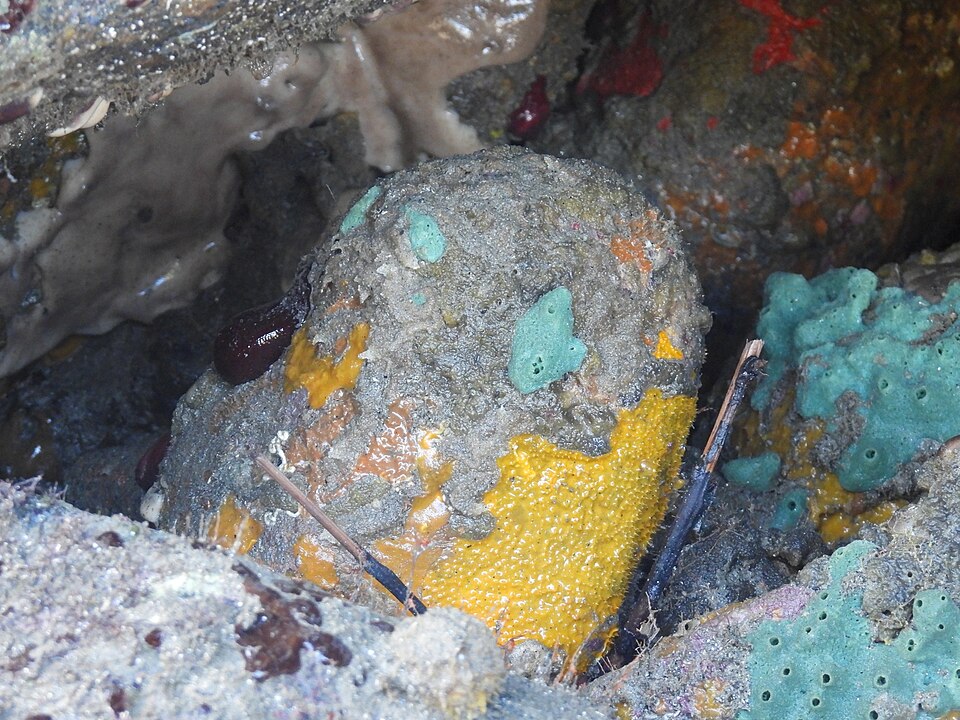
In the field, Californian specimens (then named Hymeniacidon sinapium, now a synonym [1]) were yellow to yellowish-orange with a fleshy consistency; almost all were embedded in sediment and showed projections ranging from stout cone- or bag-shaped oscula to long tendril-like digitations [2].
Spicules alone do not separate it from its relatives: Hymeniacidon flavia, from Japan and Korea, cannot be distinguished from Hymeniacidon sinapium by spicule shape and can only be told apart with genetic data, the colour of the living sponge or larval morphology [2].
Similar species
- Hymeniacidon flavia: It cannot be told apart by spicules; only by genetic data, live colour or the larva [2].
Distribution and habitat
Genetic and morphological data support its presence in Europe, on the Atlantic coasts of North and South America, on the Pacific coast of North America and in Asia [2]. In southern Africa, sequences were obtained from 61 samples in a survey of 53 rocky-shore sites (the sponge turned up at 23 of them), and were 99 to 100% identical to those from other regions of the world [1].
For the Pacific coast of South America, Turner notes that morphological data suggest it is present but that no genetic data exist yet for those populations; the spicules of the Chilean name Hymeniacidon fernandezi measure 200 to 340 µm, within the range of the species [2]. A niche model predicts suitable habitat from southern Chile to northern Peru, which is not the same as a confirmed Peruvian record [1].
It occurs from 3 m above the low-tide line down to the shallow subtidal [1]. It grows buried in sediment or on hard substrate, and seems most abundant in the intertidal of muddy bays with heavy sedimentation [2].
Biology
It is viviparous and can shift from gonochorism to successive hermaphroditism, in which oocytes precede spermatogenesis; oocytes are fertilised inside the sponge and give rise to ciliated parenchymella larvae [3].
In the Mar Piccolo of Taranto (Ionian Sea), 20 tagged specimens, ten in each of two groups defined by exposure to air, were monitored between February 2006 and January 2007: most females of the permanently submerged group restricted oocyte production until May, and by September none of the monitored specimens was alive [4].
In laboratory data summarised by Turner, all larvae stopped swimming and explored the bottom 19 hours after release, and all had settled by 43 hours, a short period typical of sponges [2].
In the drainage conduits of an Italian fish farm, with water held at 18 °C, the sponge was active all year and sexual elements appeared only sporadically; its volume grew most between August or September and January or March [3].
Ecology
In California it occupies estuaries and rocky intertidal shores as well as subtidal kelp forests; its abundance in some habitats makes an effect through occupation of space likely, although its impact has not yet been measured [2].
In the Mar Piccolo, specimens exposed to air at low tide were shielded from dehydration and solar irradiation by a dense algal assemblage, whereas permanently submerged ones near the soft bottom might be affected by anoxic crises, a hypothesis of the author [4]. Asexual reproduction by fragmentation is described as widespread and important for population survival, especially under adverse conditions [3].
Human relevance
Its spread is attributed mainly to adults attached to ship hulls and to shellfish moved between aquaculture facilities, since the larval stage is so brief; ballast water is mentioned as another possible route, but hull fouling and adult fragmentation are considered more plausible [1].
There is recent interest in using it as a bioremediator of the microbial load of water, including potentially pathogenic bacteria [3].
References (4)
- Samaai, T., Turner, T.L., Kara, J. (2022). Confirmation of the southern African distribution of the marine sponge Hymeniacidon perlevis (Montagu, 1814) in the context of its global dispersal. PeerJ. doi:10.7717/peerj.14388 (accessed 2026-10-25)
- Turner, T.L. (2020). The marine sponge Hymeniacidon perlevis is a globally-distributed exotic species. Aquatic Invasions, 542-561. doi:10.3391/ai.2020.15.4.01 (accessed 2026-10-25)
- Mercurio, M., Longo, C., Pierri, C. (2023). Life-cycle traits in the demosponge Hymeniacidon perlevis in a land-based fish farm. PeerJ. doi:10.7717/peerj.14685 (accessed 2026-10-25)
- Gaino, E. (2010). Reproduction of the Intertidal Sponge Hymeniacidon perlevis (Montagu)Along a Bathymetric Gradient. The Open Marine Biology Journal, 47-56. doi:10.2174/1874450801004010047 (accessed 2026-10-25)