
Marine life guide of Peru · Hippopodiidae
Hippopodius hippopus
Hippopodius hippopus (Forsskål, 1776)
Species account
Summary
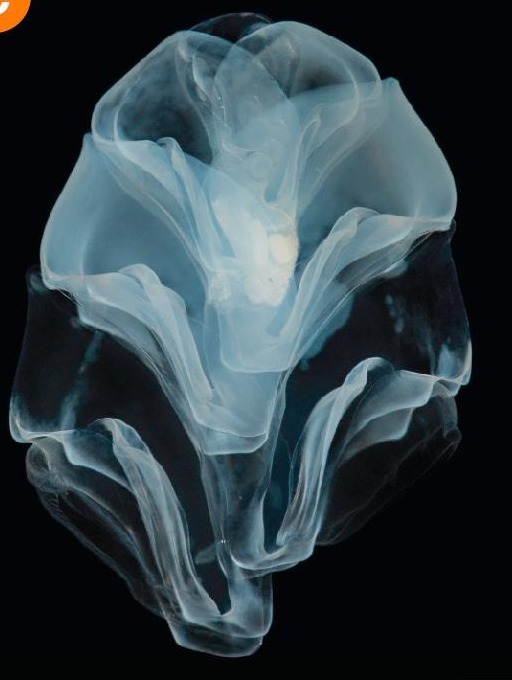
Hippopodius hippopus is a calycophoran siphonophore of the family Hippopodiidae. It is a floating, gelatinous colony that moves by means of faceted swimming bells joined to one another [1]. The world register treats it as an accepted species with a circum-subtropical range and a mainly epipelagic habitat [2]. In the genus Hippopodius, stimulating the bells triggers flashes of light generated in an epithelium that conducts impulses [3].
Identification and similar species
The colony bears several faceted swimming bells, each arising on a pedicel from the one before. As they mature, a number of them stay joined and form a hollow cylinder, from whose rear end the stem emerges. Of all the bells, only the lowest 2 are functional; the mesogloea of those two and of the smaller bells provides buoyancy [1].
The family has no bracts, and the stem can be drawn completely into the cylindrical chamber when the colony is not feeding. The Hippopodiidae comprise 2 genera, and the tentillum of Hippopodius has a short U-shaped cnidoband, unlike the longer, folded cnidoband of Vogtia [1].
The current name derives from Gleba hippopus, described by Forsskål in 1776; the genus Hippopodius is credited to Quoy and Gaimard (1827). The world register lists 17 synonymised names, including the original Gleba hippopus, and among them are Hippopodius luteus and Hippopodius ungulatus [2].
Distribution and habitat
The world register describes the species as circum-subtropical and mainly epipelagic in habitat [2]. A general review of siphonophores places Hippopodius hippopus among the warm-water species that live mostly in the shallow layers of the epipelagic zone at tropical latitudes [1].
The same review gives the epipelagic zone as 0 to about 300 m depth (without referring to this species in particular) and notes that variation within the species was seen among individuals collected in the Atlantic and in the Pacific [1].
Biology
In the bells of Hippopodius, 4 responses spread through excitable epithelia: luminescence, blanching, muscular involution of the margin, and secretion. Swimming is controlled independently by the nervous system, and epithelial impulses inhibit it [3].
Each luminous flash matches one epithelial impulse, and at least 3 impulses are needed before the first one is recorded. Flashes sum and facilitate one another, and no steady glow was seen. The light is generated inside cells of the exumbrellar epithelium [3].
Blanching, by contrast, is linked to granules forming in the neighbouring mesogloea; it reaches its saturation level within 10 seconds, and transparency returns over a period of 10 minutes to 1 hour. Gap junctions are presumed to act as the pathways for electrical coupling between cells [3].
Bioluminescence is very common among siphonophores: according to one review, 91% of them show it in some form [1].
Ecology
According to Purcell's 1981 work, as cited by Pugh, Hippopodius hippopus fed exclusively on ostracods. Pugh analysed data from Discovery stations in the northeast Atlantic and found a clear relation between the abundance of ostracods and that of hippopodiids, whereas copepods correlated better with other calycophoran siphonophores [4].
In a study of 24 epipelagic siphonophore species, the calycophorans, which generally have many small gastrozooids, fed mainly on small copepods and other small prey, and the largest prey tended to be bigger in species with longer gastrozooids [5].
In general, according to Mapstone's review, small active siphonophore species inhabit the epipelagic zone (0 to about 300 m) and lie in wait for copepods and other zooplankton, spreading their tentacles rapidly to entrap prey; this is not documented specifically for Hippopodius hippopus [1].
References (5)
- Mapstone, G.M. (2014). Global Diversity and Review of Siphonophorae (Cnidaria: Hydrozoa). PLoS ONE, e87737. doi:10.1371/journal.pone.0087737 (accessed 2026-10-25)
- WoRMS Editorial Board (2026). Hippopodius hippopus (Forsskål, 1776). World Register of Marine Species. https://www.marinespecies.org/aphia.php?p=taxdetails&id=135449 (accessed 2026-10-25)
- Bassot, J.-M., Bilbaut, A., Mackie, G.O. et al. (1978). BIOLUMINESCENCE AND OTHER RESPONSES SPREAD BY EPITHELIAL CONDUCTION IN THE SIPHONOPHORE HIPPOPODIUS. The Biological Bulletin, 473-498. doi:10.2307/1540785 (accessed 2026-10-25)
- Pugh, P.R. (1991). Co-occurrence of hippopodiid siphonophores and their potential prey. Hydrobiologia, 327-334. doi:10.1007/BF00026482 (accessed 2026-10-25)
- Purcell, J.E. (1981). Dietary composition and diel feeding patterns of epipelagic siphonophores. Marine Biology, 83-90. doi:10.1007/BF00397071 (accessed 2026-10-25)