
Marine life guide of Peru · Hexanchidae
Bluntnose sixgill shark
Hexanchus griseus (Bonnaterre, 1788)
- Names in Peru
- Tiburón de seis agallas
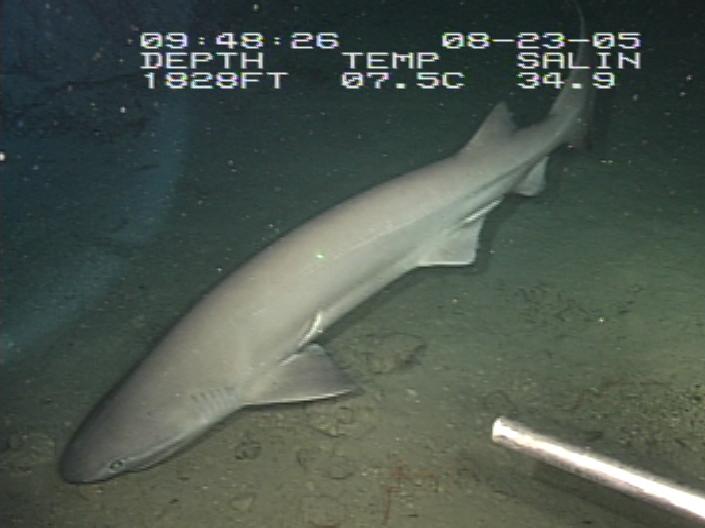
Species account
Summary
Hexanchus griseus is a large deepwater shark recognised by its six pairs of gill slits and a single dorsal fin set far back on the body [1],[2]. It lives worldwide over continental and insular shelves and slopes, from about 40 m to more than 2500 m deep [2]. In Peru it appears in the country's checklist of cartilaginous fishes [3]. The IUCN Red List classifies it as Near Threatened [4].
Identification and similar species
The animal has six pairs of gill slits, one dorsal fin placed toward the rear of the body, and a subterminal mouth whose upper and lower jaws carry different tooth patterns [1]. The snout is rounded and blunt [2].
Newborns are thought to measure 61 to 74 cm in total length [2]; a female neonate landed in Baja California Sur was 63 cm long and still had an umbilical scar [2]. Adults can reach about 6 m, with females larger than males [1]. In Hawaii, researchers tagged two mature males of 326 and 352 cm and three large subadult females of 309, 346 and 412 cm total length [5].
Distribution and habitat
It occurs in tropical and temperate waters around the world [1], over continental and insular shelves and slopes [2]. Its depth range runs from surface waters to about 3000 m [1]. Divers have seen it at around 40 m and submersibles at more than 2500 m [2].
Although regarded as a bottom-dwelling, deepwater species, it has been recorded in shallow US estuaries such as Puget Sound in Washington and San Francisco Bay in California [1]. In Hawaii, five tagged sharks spent most of the day between 500 and 650 m deep, at 5–7 °C, and most of the night between 200 and 350 m, in water of 10–16 °C [5].
Biology
It is ovoviviparous: females give birth to between 22 and 108 pups, and gestation length and reproductive frequency are unknown [1]. It matures late, at around 20 years, grows slowly, and its longevity is unknown [1]. A neonate caught in February 2023 in a gill net at about 45 m deep suggests that shallow coastal waters off Baja California Sur may serve as a pupping ground, and that the birthing season may vary between regions [2].
It is thought to be a generalist feeder: it preys mainly on bony fishes, cartilaginous fishes, cephalopods and crustaceans and also scavenges, and marine mammals gain importance in the diet as it grows [6]. At a bait station in Puget Sound, subadults took food by three different methods, ramming, biting and suction, and ramming was the most frequent on both bait types [6].
Ecology
It makes daily vertical migrations, descending at dawn and ascending at dusk. In Hawaii, dawn descents lasted a median of 59 min and dusk ascents 81 min [5]. By day it tolerates cold, low-oxygen water, with a saturation of 10–25 % [5]. Its large body mass may slow cooling during the descent, and the sharks did not reduce their activity at depth [5].
In Puget Sound, a diving and video study from 2003 to 2005 gathered 273 observations; 37.8 % of tagged sharks returned to the study site, and estimated abundance ranged from 27 to 98 individuals with strong seasonality [1].
Conservation
Human relevance
Where to see it in Peru
The sources consulted do not say where or at what depth it can be seen in Peru. The species is included in the updated checklist of cartilaginous fishes of the southeast Pacific off Peru, published in 2015 [3]. Outside Peru, divers have observed it at around 40 m, and shark-diving tourism with this species is practised in the United States and Canada [2].
References (6)
- Griffing, D., Larson, S., Hollander, J. et al. (2014). Observations on Abundance of Bluntnose Sixgill Sharks, Hexanchus griseus, in an Urban Waterway in Puget Sound, 2003-2005. PLoS ONE, e87081. doi:10.1371/journal.pone.0087081 (accessed 2026-10-25)
- Whitehead, D.A., Gayford, J.H. (2024). First record of a neonate bluntnose sixgill shark (Hexanchus griseus) from Baja California Sur, Mexico. Ecology and Evolution, e11664. doi:10.1002/ece3.11664 (accessed 2026-10-25)
- Cornejo, R., Vélez-Zuazo, X., González-Pestana, A. et al. (2015). An updated checklist of Chondrichthyes from the southeast Pacific off Peru. Check List, 1809. doi:10.15560/11.6.1809 (accessed 2026-10-25)
- Finucci, B., Barnett, A., Bineesh, K.K. et al. (2020). Hexanchus griseus: Finucci, B., Barnett, A., Bineesh, K.K., Cheok, J., Cotton, C.F., Dharmadi, Graham, K.J., Kulka, D.W., Neat, F.C., Pacoureau, N., Rigby, C.L., Tanaka, S. & Walker, T.I. The IUCN Red List of Threatened Species. doi:10.2305/IUCN.UK.2020-3.RLTS.T10030A495630.en (accessed 2026-10-25)
- Coffey, D.M., Royer, M.A., Meyer, C.G. et al. (2020). Diel patterns in swimming behavior of a vertically migrating deepwater shark, the bluntnose sixgill (Hexanchus griseus). PLOS ONE, e0228253. doi:10.1371/journal.pone.0228253 (accessed 2026-10-25)
- McNeil, B., Lowry, D., Larson, S. et al. (2016). Feeding Behavior of Subadult Sixgill Sharks (Hexanchus griseus) at a Bait Station. PLOS ONE, e0156730. doi:10.1371/journal.pone.0156730 (accessed 2026-10-25)