
Marine life guide of Peru · Charadriidae
American oystercatcher
Haematopus palliatus Temminck, 1820
- Names in Peru
- Ostrero americano
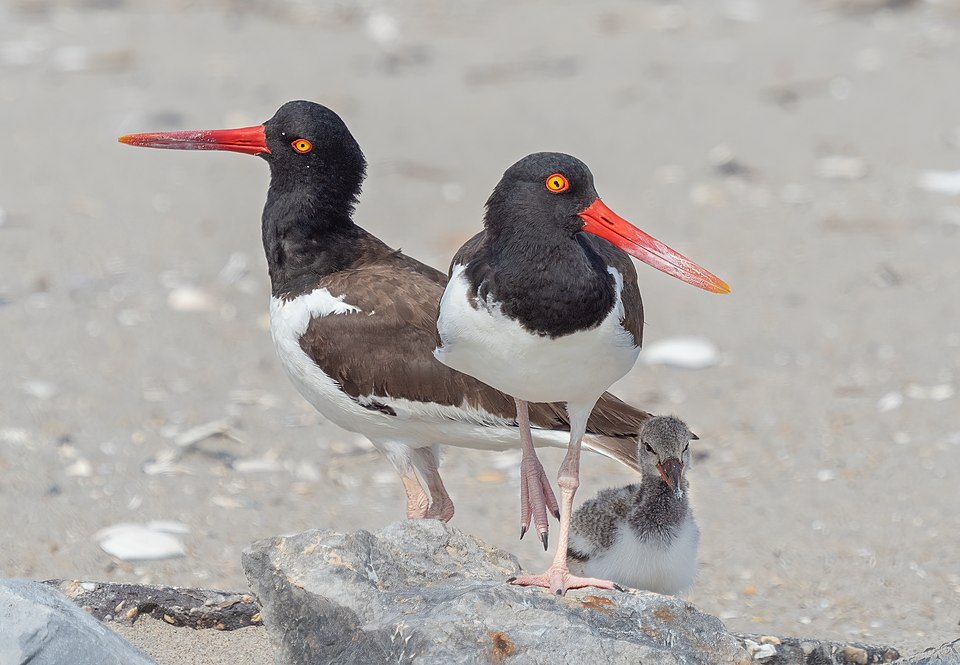
Species account
Summary
Haematopus palliatus is a shorebird described by Temminck in 1820 [1]. It belongs to the oystercatcher family, Haematopodidae, which has a single genus, Haematopus [2]. In Peru it is called «ostrero americano» [3]. The Pacific coast of South America is home to the subspecies Haematopus palliatus pitanay, which ranges from Ecuador to southern Chile [4]. At Pantanos de Villa, Lima, it nests on sand less than 50 m from the highest high-tide line, and oystercatchers in general tolerate people poorly [5]. The IUCN Red List classifies it as Least Concern in its 2025 assessment [6].
Identification and similar species
It belongs to the group of pied oystercatchers, with a white belly and black back, whereas the black oystercatchers are dark all over; the literature also notes that pied oystercatchers tend to have a longer, more pointed bill [7].
The South Pacific subspecies is the smallest of the 5 recognised, except in bill length, and it lacks the inner white marks at the tips of the primary feathers [4]. In the field, juveniles and adults are told apart by the colour of the bill and the eyes [4].
Similar species
- Haematopus ater: The blackish oystercatcher is black all over, while Haematopus palliatus has a white belly [7].
Distribution and habitat
It is a coastal bird widely distributed across the Americas, with 5 subspecies; in the South Pacific, from Ecuador to southern Chile, it is represented by Haematopus palliatus pitanay [4]. Another description places this race between Ecuador and Chiloé [7].
In Peru it appears on the bird list of the Los Manglares de Tumbes National Sanctuary, at the country's northern tip [3]. On the central coast it nests on the sand strip of the Marvilla Circuit in the Pantanos de Villa wetlands, Lima [5], and at the La Arenilla coastal wetland in La Punta, Callao [2].
At Pantanos de Villa, all 11 nests found in 2020 lay less than 50 m from the highest high-tide line, 38.5 m on average, on ground with no vegetation [5]. In central Chile, pairs hold territories mainly in estuaries and on sandy beaches, and outside the breeding season the estuaries also take in adults and juveniles probably arriving from other stretches of coast [4].
Biology
According to the literature summarised in a Peruvian study, its breeding season runs from August to February and it lays 1 to 4 eggs, which take 24 to 29 days to hatch [2]. In central Chile the breeding season runs from September to March [4].
In the Marvilla Circuit, between September and October 2020, 24 eggs were found in 11 nests, with a mean clutch of 2.18 eggs and between 1 and 3 per nest [5]. Every nest was a hollow in the sand, 15.6 cm across and 4.4 cm deep on average, and 45.5 % were decorated with bits of shell, plastic and other objects; the eggs, sand-coloured with small dark spots, blend into their surroundings [5].
Incubation lasted 22 to 28 days, and both parents tended the nest at every stage [5]. The chicks hatch well developed: they spend roughly one day in the nest and, as soon as their feathers dry, they follow their parents [5].
Hatching success at that site was 20.83 % and nest success 27.3 %; of the eggs that failed to hatch, 5 were infertile, 1 showed signs of predation, possibly by a rodent, and for 6 the cause was unknown [5]. In southeastern Buenos Aires Province, Argentina, between 1997 and 2001, hatching success was also low, at 25.85 %, with 0.24 fledglings per pair per season, and losses were due to storms, predators and human disturbance [8].
It is a long-lived bird: in central Chile, apparent annual survival was 0.87 in adults and 0.53 in birds ringed as chicks [4]. Between 2016 and 2021, 33 pairs followed there raised 13 fledglings [4].
Ecology
In Antofagasta Bay, northern Chile, it feeds mainly on beds of the Antofagasta piure, Pyura praeputialis, a tunicate that covers the middle band of the intertidal rocks [7]. Between August and October 1997 there were on average 10.63 American oystercatchers on the study platform against 1.0 blackish oystercatcher, and 97.75 % of observations of the former were attacks on piure, against 45 % for the latter [7].
The American oystercatcher pierces the piure's tunic with its bill and picks smaller individuals, 49.34 mm on average, than those taken by the blackish oystercatcher, 60.22 mm [7]. Each bird ate on average 59 piures during a daytime low tide of about 6 hours, with a maximum of 118, while the blackish oystercatcher more often went for hard-shelled prey such as limpets, snails and sea urchins [7].
In the estuaries of central Chile, oystercatcher numbers peak in autumn, between April and May, and fall to their lowest in late spring, between November and December [4].
Conservation
The IUCN regards it as Least Concern in its 2025 global assessment [6]. In Chile the Pacific subspecies was classified as Near Threatened in 2019, out of concern that its long life might mask a decline caused by too few young joining the population [4].
In central Chile, censuses of 4 estuaries and birdwatcher data showed a positive trend, but a model built on the survival and breeding rates measured there predicted a decline, with a growth rate of 0.93 per year; the authors suggest that some estuaries work as sinks that depend on birds arriving from elsewhere [4].
At Pantanos de Villa, the human activity seen most often in the nesting area was horse riding; tracks of bicycles, motorbikes and above all quad bikes were also found, and less often campfires, small-scale fishing, dogs and unauthorised people; park rangers also suspect that outsiders come in and take the eggs [5]. In Lima and Callao, human disturbance, from pets and vehicles among other causes, is one reason why there are few nests on the coast [2].
Where to see it in Peru
On the Lima coast it nests in the Marvilla Circuit of Pantanos de Villa, where 11 nests were followed in September and October 2020; it is a protected natural area that charges visitors an entry fee [5]. In February 2024 a pair bred in the La Arenilla sector of the La Arenilla coastal wetland in La Punta, Callao, an area run by the La Punta district municipality [2]. In the north, it appears on the bird list of the Los Manglares de Tumbes National Sanctuary published in 2023 [3].
References (8)
- WoRMS Editorial Board (2026). Haematopus palliatus Temminck, 1820. World Register of Marine Species. https://www.marinespecies.org/aphia.php?p=taxdetails&id=159128 (accessed 2026-10-20)
- Podestá, J., Barona, D. (2025). Primer registro reproductivo de Haematopus palliatus (Temminck, 1820) en la zona sur del distrito de la Punta, Callao. South Sustainability, e123. doi:10.21142/SS-0601-2025-e123 (accessed 2026-10-20)
- Servicio Nacional de Áreas Naturales Protegidas por el Estado (2023). Plan Maestro del Santuario Nacional Los Manglares de Tumbes 2023-2027. SERNANP, RP N.° 064-2023-SERNANP. https://cdn.www.gob.pe/uploads/document/file/4137567/RESOLUCION%20PRESIDENCIAL%20N%20064-2023-SERNANP.pdf.pdf (accessed 2026-10-20)
- Thomson, R.F., Vukasovic, M.A., Santander, I.M. et al. (2025). Population trends and vital rates for the American Oystercatcher (Haematopus palliatus pitanay) in Central Chile. Journal of Field Ornithology. doi:10.5751/JFO-00597-960103 (accessed 2026-10-20)
- Arenas, A., Camarena, N., Ponce, J. et al. (2020). Reproductive success of Haematopus palliatus, the Common oystercatcher, and anthropic activities in the Marvilla Circuit, Pantanos de Villa, Lima- Peru. South Sustainability, e020. doi:10.21142/SS-0102-2020-020 (accessed 2026-10-20)
- BirdLife International (2025). Haematopus palliatus: BirdLife International. The IUCN Red List of Threatened Species 2025: e.T22693644A281849747. doi:10.2305/IUCN.UK.2025-2.RLTS.T22693644A281849747.en (accessed 2026-10-20)
- Pacheco, C.J., Castilla, J.C. (2000). Ecología trófica de los ostreros Haematopus palliatus pitanay (Murphy 1925) y Haematopus ater (Vieillot et Oudart 1825) en mantos del tunicado Pyura praeputialis (Heller 1878) en la Bahía de Antofagasta, Chile. Revista Chilena de Historia Natural, 533-541. doi:10.4067/S0716-078X2000000300017 (accessed 2026-10-20)
- Bachmann, S., Darrieu, C.A. (2010). Biología reproductiva del Ostrero Pardo (Haematopus palliatus) en el sudeste de la provincia de Buenos Aires, Argentina. El Hornero, 75-84. doi:10.56178/eh.v25i2.702 (accessed 2026-10-20)