
Marine life guide of Peru · Delphinidae
Gray grampus
Grampus griseus (G. Cuvier, 1812)
- Names in Peru
- Delfín de Risso · Delfín gris
Species account
Summary
Grampus griseus is a dolphin of the family Delphinidae [1]. It is robust, with a bulbous head, and lives in temperate, subtropical and tropical waters around the world [2]. It feeds mostly on squid and tends to keep to the shelf edge and the continental slope [2],[3]. For the Peruvian sea, IMARPE modelled its potential habitat from 21 cruises carried out between 2000 and 2014 [3]. Its global category on the IUCN Red List is Least Concern [4].
Identification and similar species
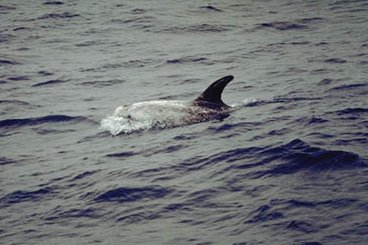
It is a medium-sized, robust dolphin with a narrow tail stock, a bulbous head marked by a vertical crease and an indistinct beak; the dorsal fin is tall and sickle-shaped, set about midway along the back [2]. It measures 8.5 to 13 feet and weighs 660 to 1100 pounds, and males and females are similar in size [2]. A female stranded on the central coast of Chile measured 322 cm [5]. It has 2 to 7 pairs of peg-like teeth in the lower jaw and usually none in the upper [2].
Calves are dark, with a cape and saddle on the back and few or no scars; with age the colour lightens from black, dark grey or brown to pale grey or almost white [2]. Adults are usually heavily scarred, from tooth rakes and from round marks left by prey, cookiecutter sharks and lampreys; mature adults swimming just beneath the surface usually look white [2].
Distribution and habitat
It occurs worldwide, from 64° N to 46° S, and prefers the mid-temperate waters of the continental shelf and slope between latitudes 30° and 45°, often over about 3300 feet of water with steep bottom relief, though it also uses shallow coastal areas [2]. In Chile, an analysis of 44 records showed a continuous distribution between 20°13′ S and 40° S, with a preference for waters deeper than 1000 m and a peak of records in the austral summer [6]. There are no records from Chile's oceanic islands, and the southernmost ones, near 52° S, probably belong to Atlantic dolphins [6].
For the Peruvian sea, an IMARPE study using data from 21 hydroacoustic survey cruises (2000-2014, from 3°23′ S to 18°21′ S) built potential-habitat models with surface temperature, surface salinity and depth as variables [3]. Risso's dolphin showed potential habitat near the edge of the continental shelf between 7 and 11° S, where the shelf is wide, and patches of potential habitat in oceanic waters between 4 and 7° S and between 14 and 18° S [3].
Biology
It can dive to at least 1000 feet and hold its breath for up to 30 minutes, although its dives usually last only a few minutes; before diving it typically takes 10 to 12 breaths spaced 15 to 20 seconds apart [2]. In the Azores, 7 tagged individuals recorded 266 dives reaching between 20 and 623 m depth [7].
Of those dives, 82 were spin dives, which begin with an intense stroke at the surface and a sideways rotation to the right, followed by a rapid descent [7]. Of these, 91 % included foraging buzzes, and their mean maximum depth was 426 m, against 178 m for dives without a spin [7].
It reaches sexual maturity at about 8.5 to 9 feet in length; breeding and calving can happen all year round, with a gestation of about 13 to 14 months [2]. Newborns measure 3.5 to 5.5 feet and weigh about 45 pounds, and the species lives for at least 35 years [2].
Ecology
It feeds mainly on squid, as well as fish and other cephalopods, and does so mostly at night, when prey is nearer the surface [2]. The stomach of a female stranded at Guanaqueros, Chile, at 30° S held 8 pairs of cephalopod beaks, all from the jumbo squid Dosidicus gigas; local fishers report seeing these dolphins feeding in the squid fishing zone without interacting with the fishing operations [5].
In the Azores the dolphins hunted at whatever depth the deep scattering layer occupied through the day, a dense stratum of prey that sinks by day and rises toward the surface at night, and toward dusk the dolphins turned to shallower dives without a spin [7]. The authors note that its target depth is around 50-600 m [7].
Off Peru, the authors of the IMARPE model note that the likely habitat zones coincide with northern and southern waters where jumbo squid (Dosidicus gigas) occurs, a squid these cetaceans eat [3]. Groups are usually 10 to 30 animals, though aggregations of hundreds or thousands have been seen, and they sometimes associate with other dolphins, such as the bottlenose dolphin [2].
Conservation
Its global category on the IUCN Red List is Least Concern [4].
Threats include entanglement and capture in gillnets, longlines and trawls, direct hunting for meat and oil in Indonesia, Japan, the Lesser Antilles, Sri Lanka and the Solomon Islands, ocean noise, and contaminants that build up in its body [2]. It is listed on CITES Appendix II [2].
Incidental catches have been recorded in Peru, according to a review cited by Olavarría and colleagues [6]. In Chile, in March 1989, 5 dolphins became entangled and drowned in the nets of a boat fishing for jack mackerel [6].
Human relevance
Its relationship with fisheries is mixed. On 19 December 1991, during a trip to check reported losses on bottom longlines off Valparaíso, 15 Risso's dolphins accompanied the vessel for about 10 minutes, and the fish caught on the longline were undamaged [6]. In the Coquimbo artisanal squid fishery, fishers say the dolphins feed in the same zone without interacting with the fishing operations [5].
Elsewhere in the world it has been hunted for meat and oil [2]. In 1992 on Santa María island, Chile, 14 dolphins stranded alive and were returned to the water by local fishers, and 3 later washed up dead [6].
Where to see it in Peru
The sources consulted do not describe places or seasons for watching it from the Peruvian coast. What they do indicate is that it is a deep-water dolphin: in Chile sightings are generally over waters deeper than 1000 m, and records cluster in the austral summer in the northern waters [6].
For Peru, the IMARPE model points to the edge of the continental shelf between 7 and 11° S and to patches in oceanic waters as potential habitat, and it rests on data from pelagic-resource survey cruises, not from watching trips [3].
References (7)
- WoRMS Editorial Board (2026). Grampus griseus (G. Cuvier, 1812). World Register of Marine Species. https://www.marinespecies.org/aphia.php?p=taxdetails&id=137098 (accessed 2026-10-25)
- NOAA Fisheries (2026). Risso's Dolphin. NOAA Fisheries species directory. https://www.fisheries.noaa.gov/species/rissos-dolphin (accessed 2026-10-25)
- Llapapasca, M., Quiñones, J. (2021). Modelos de hábitat potencial de Odontocetos Teutófagos (Grampus griseus y Globicephala spp.) en el ecosistema norte de la Corriente de Humboldt. Boletín del Instituto del Mar del Perú, 224-238. doi:10.53554/boletin.v36i1.328 (accessed 2026-10-25)
- Kiszka, J., Braulik, G. (2018). Grampus griseus: Kiszka, J. & Braulik, G. The IUCN Red List of Threatened Species 2018: e.T9461A50356660. doi:10.2305/iucn.uk.2018-2.rlts.t9461a50356660.en (accessed 2026-10-25)
- Yates, O., Palavecino-Sepúlveda, P. (2014). On the stomach contents of a Risso's dolphin (Grampus griseus) from Chile, Southeast Pacific. Latin American Journal of Aquatic Mammals, 171-173. doi:10.5597/lajam00185 (accessed 2026-10-25)
- Olavarría, C., Aguayo-Lobo, A., Bernal, R. (2001). Distribution of Risso's dolphin (Grampus griseus, Cuvier 1812) in Chilean waters. Revista de Biología Marina y Oceanografía, 111-116. doi:10.4067/s0718-19572001000100011 (accessed 2026-10-25)
- Visser, F., Keller, O.A., Oudejans, M.G. et al. (2021). Risso's dolphins perform spin dives to target deep-dwelling prey. Royal Society Open Science, 202320. doi:10.1098/rsos.202320 (accessed 2026-10-25)
More pictures
Photo: Nicolás Villaseca Merino · CC BY-SA 4.0 · GBIF (iNaturalist research-grade observations) Photo: 呂一起(Lyu yi-chi) · CC BY 4.0 · GBIF (iNaturalist research-grade observations)